dailynewsnblog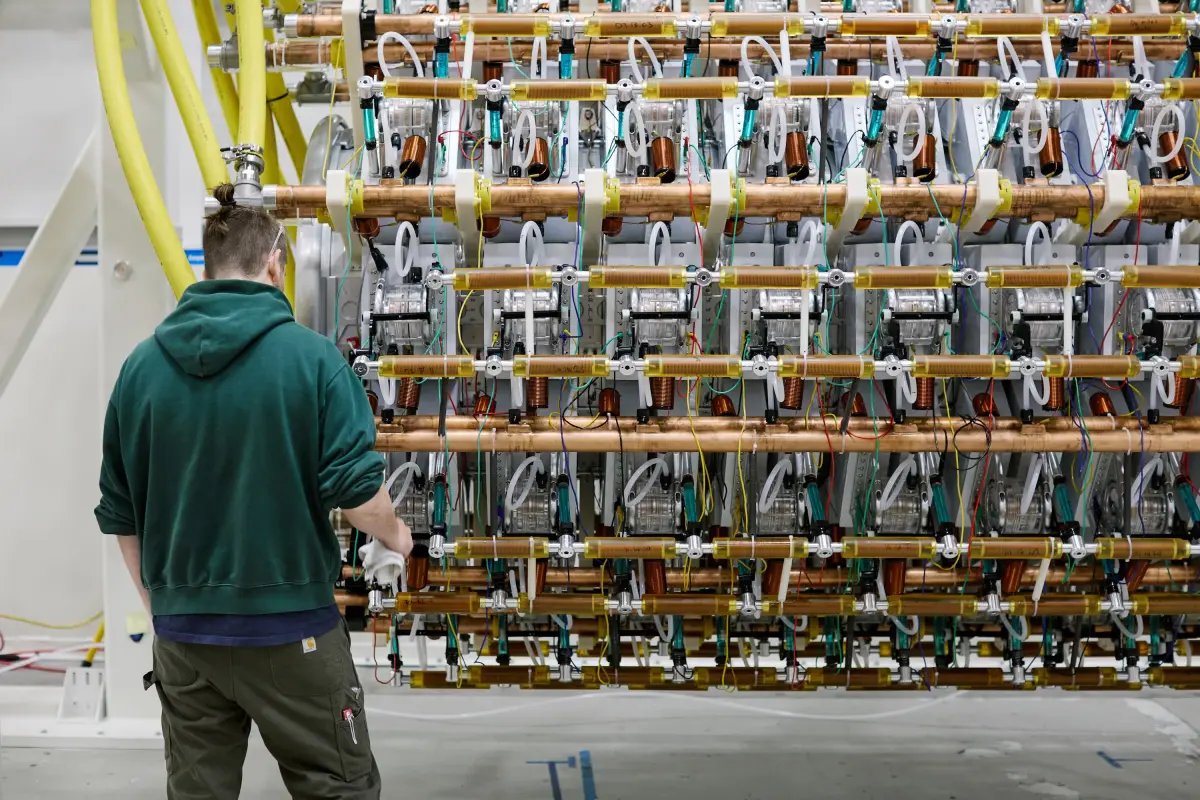
Fusion power is getting back to its roots. As fusion startups keep chasing their ultimate goal — putting electrons on the grid — many are also now embracing, or returning to, the defense applications that laid the foundation for the industry.
The sector emerged decades ago when physicists looked for more constructive uses of the science behind the thermonuclear bombs that proliferated during the Cold War. The national security angle never really went away. A groundbreaking fusion power experiment in 2022 happened at the National Ignition Facility, which has supported national security applications for more than 25 years.
That shift has accelerated as venture dollars committed to climate tech — the funds that typically have supported fusion startups — have stalled. Fusion startups have captured a large portion of recent climate tech funding, but fusion is an expensive business, and VCs are always happy when their portfolio companies find other sources of money.
That’s where the defense industry comes in. The defense industry has explored laser weapons for years, but interest has spiked as drones have reshaped modern warfare. Traditional air defense systems were designed to target human-piloted aircraft, which tend to be larger and fewer in number. That has led to some comical mismatches between aggressor and defender. For example, about a decade ago, a U.S. ally used a $3 million Patriot missile to shoot down a $200 consumer drone. Effective, but not very efficient.
Laser weapons promise to alter the math. Instead of firing a single, expensive, one-use missile per shot, hey fire quickly and relatively cheaply, using electricity drawn from a generator or a ship’s reactor or engine.
Fusion startups working on laser-based reactor designs are ideal partners in developing such weapons. Last week, laser-based fusion startup Xcimer announced a partnership with and investment from RTX, the conglomerate that includes defense contractor Raytheon. Under the deal, Xcimer gets funding from RTX Ventures, while RTX can start exploring how to use Xcimer’s powerful lasers for its own purposes.
Denver-based Xcimer currently operates what it says is the largest privately owned laser system in the world, which it plans to use to develop a power plant. Inside its power plant, lasers will bombard fuel targets, compressing them until the atoms inside fuse and release energy. The startup’s current laser system, Phoenix, operates at an order of magnitude lower power than will be required for a power plant, but it is powerful enough to have caught the attention of the defense industry.
Xcimer isn’t the only player in the defense space. Pacific Fusion announced a memorandum of understanding last month with the National Nuclear Security Administration (NNSA) to work together on high-energy-density fusion experiments.
The startup recently broke ground on a demonstration facility in New Mexico not far from the Sandia and Los Alamos National Laboratories. While its primary purpose is to demonstrate that the company’s design can generate more power than the facility consumes, it has other uses. The fusion reactions at Pacific Fusion’s facility will be far more powerful than those the government currently uses to perform nuclear weapons experiments.
“It turns out that the facility that we’re building also has utility in this world-leading defense application,” Keith LeChein, co-founder and chief technical officer at Pacific Fusion, told TechCrunch recently.
It might sound like a convenient coincidence, but it isn’t one. Defense applications were “always on our mind,” said Carrie von Muench, co-founder and chief operating officer at Pacific Fusion. LeChien, who developed the company’s core technology, previously worked at Sandia National Laboratories, the Lawrence Livermore National Laboratory, and the National Nuclear Security Administration.
Fusion power has come a long way since the first weapons scientists dreamt it up decades ago, but its national security applications haven’t been forgotten. Their recent reacquaintance is perhaps overdue, and promises to give willing fusion startups a helpful boost.
When you purchase through links in our articles, we may earn a small commission. This doesn’t affect our editorial independence.