dailynewsnblog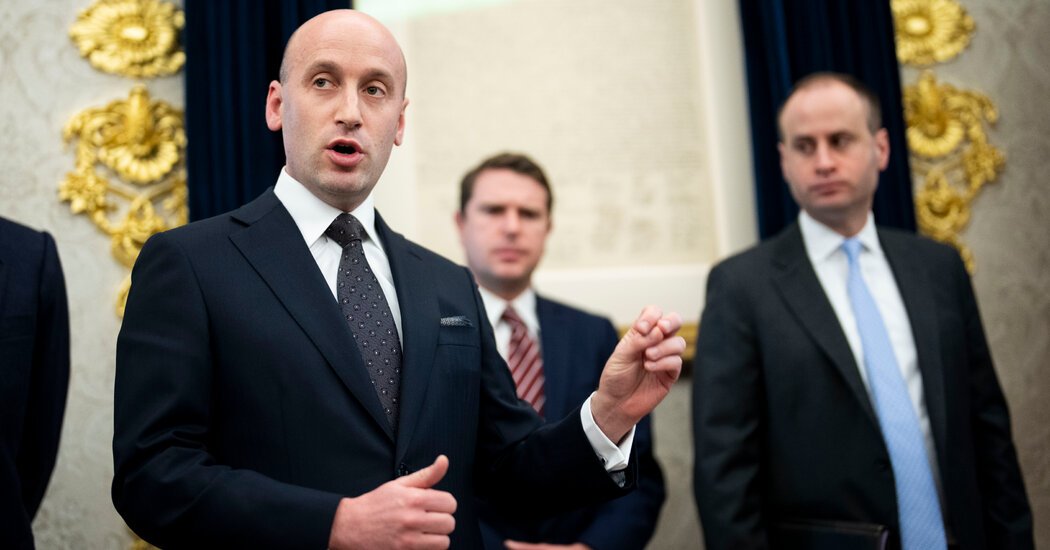
Last spring, Will Scharf, an arch-conservative lawyer serving as the White House staff secretary, wrote a secret memo to the chief of staff that reflected growing unease in the West Wing about one of the extreme measures being weighed by Stephen Miller, the powerful adviser driving President Trump’s deportation campaign.
Dated April 29, 2025, and stamped “confidential,” the memo was careful and lawyerly but amounted to a warning against end-running the rule of law. The subject line read: “THE WRIT OF HABEAS CORPUS.”
Habeas corpus — the centuries-old right to force the government to justify, before a judge, why it has locked a person up — is enshrined in Article I of the Constitution. Mr. Scharf’s memo, in its unassuming way, was a blinking red warning light. The second Trump White House was deliberating an explosive new claim of presidential power: the suspension of habeas rights for unauthorized immigrants.
The suspension of habeas corpus has occurred just a handful of times in U.S. history, and always under the most dire circumstances of war or invasion. Yet to a greater degree than previously known, administration officials, encouraged by Mr. Trump, actively weighed taking that step in the early months of his second term — this time to accelerate the mass deportation of immigrants in the country illegally.
Flush with a decisive 2024 election victory, Mr. Trump and some members of his team wanted to test how far the emboldened president’s authority could be pushed, setting off previously unreported internal struggles over where the limits should be.
The man who outlined his concerns in the memo, Mr. Scharf, was no resistance figure. A trim, balding, Harvard-trained lawyer who had run for office in Missouri, he had bemoaned John McCain as too moderate for the 2008 Republican nomination, and believed Mr. Trump had been vindictively prosecuted after his 2020 election loss.
He had helped develop the Trump team’s legal arguments behind the successful effort to get the Mar-a-Lago classified documents indictment thrown out, as well as the arguments behind the presidential immunity case that prevailed at the Supreme Court. He had embraced the most contentious elements of Mr. Trump’s agenda, but was quickly coming up against the limit of what the Constitution, in his reading, could be made to bear.
The Constitution, Mr. Scharf wrote in his memo to Susie Wiles, the White House chief of staff, permits suspension of habeas corpus only in cases of rebellion or invasion. Courts have almost uniformly held that only Congress can do it.
He added: “Even where Congress has explicitly suspended habeas corpus rights, the Supreme Court has held that some alternative process must be provided to defendants, with procedural safeguards akin to a habeas corpus action.”
“It prevents, in effect, governmental actors from detaining, imprisoning or executing individuals arbitrarily,” Mr. Scharf wrote.
In early April last year, the Supreme Court had allowed the administration to continue its use of the Alien Enemies Act as the basis for deporting Venezuelans who were in the United States illegally. But the justices also ruled that the migrants were entitled to challenge their deportations in court before being expelled. The detainees, the court held, could file lawsuits citing habeas corpus to challenge the basis for their removal, substantially slowing the administration’s deportation drive.
Inside the White House, Mr. Miller, the influential deputy chief of staff, saw an opening for an idea he had raised previously: What if Mr. Trump simply claimed the power to suspend habeas corpus?
Then the locked-up immigrants would be blocked from receiving hearings or even from seeking court orders to prevent their removal from the country. This was an opportunity for Mr. Trump not only to speed up deportations, but also to assert vastly expanded power over a legal system that was getting in his way.
Suspending habeas corpus was one of two radical ideas Mr. Miller had been pushing that alarmed Mr. Scharf. The other was invoking the Insurrection Act to deploy the military to enforce the law on American streets as protests grew against deportation sweeps.
Mr. Scharf wrote confidential memos to Ms. Wiles on both topics, setting out in a low-key way why taking either step would shatter historical norms and likely precipitate hazardous legal and constitutional battles. A senior administration official, speaking on background because the official was not authorized to discuss the matter publicly, said for this article that “senior staff” had requested the memos, and that they were seen by relatively few people.
But the documents reflected alarm among a small group of senior aides. They felt that Mr. Miller’s eagerness to test the limits of executive power — and to accuse other branches of encroaching on it, echoing a president who bristled at any constraint — risked steering the administration, and the country, in a dangerous direction.
In the case of the Insurrection Act, Vice President JD Vance pushed to invoke it just days after federal agents shot and killed Alex Pretti, a Minnesota critical care nurse who was protesting the administration’s immigration policies.
The details of internal debates over how aggressive Mr. Trump should be in seeking to deport millions of immigrants and crack down on those protesting his policies are drawn from reporting for a forthcoming book, “Regime Change: Inside the Imperial Presidency of Donald Trump.”
In reporting the book, the authors spoke with Mr. Trump and conducted more than 1,000 interviews with a wide range of people close to him, including campaign officials, White House staff members, officials serving in government departments and agencies, former aides, donors, lawmakers, friends and business associates.
In a statement provided for this article, Abigail Jackson, a White House spokeswoman, said, “Members of the administration often have conversations about many different lawful options to implement the president’s agenda — with the president always being the ultimate decider.”
A Dangerous New Line
At the center of the internal White House debates over suspending habeas corpus and invoking the Insurrection Act were Mr. Miller, intent on pushing the limits of the constitutional system, and Mr. Scharf, a process-driven lawyer little known outside the West Wing.
As the staff secretary, Mr. Scharf was the final stop for paperwork flowing through the White House before it reached the president’s desk. Among other duties, his office processed the executive actions and presidential memorandums behind what became known as the “retribution” agenda.
But Mr. Scharf belonged to a small group inside the administration that, while supportive of the president’s agenda, was quietly trying to pull him back from the more aggressive moves pushed by Mr. Miller and others — actions that promised Mr. Trump quick results but kept producing costly entanglements in court.
Their worry was self-inflicted damage: Weak legal arguments would invite sweeping rulings against the administration, and those rulings would constrain everything that came after. Mr. Scharf was not alone in his concerns about suspending habeas rights. David Warrington, the White House counsel, had told colleagues he was skeptical of some of Mr. Miller’s views of executive authority. Some figures in the White House privately called suspending habeas corpus “insane.”
Mr. Miller, according to West Wing officials, had at first tried to charm Mr. Scharf, but soon came to see him as an obstacle. Weeks after the inauguration, he was issuing sharp directives to Mr. Scharf’s office about how it should operate.
When it came to suspending habeas corpus, one of the most powerful constitutional protections of individual rights, Mr. Miller was in effect encouraging something Mr. Trump had long dreamed of: bypassing judges in deportation cases.
The president was interested. He asked advisers about Abraham Lincoln’s suspension of habeas rights during the Civil War. Mr. Miller directed the Justice Department to study the issue.
The Trump administration was not known for encouraging or tolerating internal dissent. But Mr. Scharf put his concerns down in writing as aides realized the discussion was becoming serious.
“The history of habeas corpus dates back to the very dawn of English common law,” he recorded in his memo to Ms. Wiles. “Denial of habeas corpus rights was a key grievance underlying the American Revolution, and the right to apply to the federal courts for habeas review dates to the beginning of the republic.”
Throughout U.S. history, Mr. Scharf wrote, all three branches of government had been loath to interfere with habeas corpus, “doing so only in the direst of circumstances, and typically with respect to very limited categories of individuals.”
Habeas corpus had been formally suspended only four times, most recently after Pearl Harbor. In every case, the country was at war or facing armed rebellion. Only Lincoln, at the start of the Civil War, had ever claimed the power without congressional authorization, and only during a long congressional recess.
Mr. Scharf cited President George W. Bush, whose expansive claims of executive power helped lay the groundwork for Mr. Trump’s second term. Mr. Bush had claimed that he could indefinitely imprison terrorism suspects at Guantánamo Bay, and that no court had jurisdiction to hear their habeas petitions. But in a landmark 2008 case, the Supreme Court ruled that the detainees still had a constitutional right to file such lawsuits.
“The upshot of these cases is that for all persons held in de facto U.S. territory, habeas rights apply, or in the limited circumstance of military detainees, an adequate alternative to habeas must be provided,” Mr. Scharf concluded.
Mr. Scharf did not say what Mr. Trump should do. But the implication was plain. Suspension of habeas rights without congressional authorization would almost certainly be found unlawful, and the court fight would become a huge, self-inflicted distraction.
The day after Mr. Scharf sent the memo to Ms. Wiles, Mr. Trump publicly alluded for the first time to his consideration of taking that drastic step.
“There’s one way that’s been used by three very highly respected presidents,” he said during a cabinet meeting, referring to his options for going around the courts in the case of Kilmar Armando Abrego Garcia, the Salvadoran national who had been living in Maryland and had been wrongly deported to a notorious terrorism prison in El Salvador known as CECOT. “But we hope we don’t have to go that route,” Mr. Trump added.
When CNN later reported that Mr. Trump’s cabinet comments referred to suspending habeas corpus, and that the president was directly involved in the discussions, Mr. Miller addressed reporters outside the West Wing.
“The Constitution is clear, and that of course is the supreme law of the land, that the privilege of the writ of habeas corpus can be suspended in a time of invasion,” Mr. Miller said. “So it’s an option we are actively looking at.”
Mr. Miller was intentional about his choice of words. The president had been trying to recast the immigration surge across the southern border during the Biden years as an invasion by enemy forces — a highly dubious claim intended to unlock extraordinary powers, intended only for wartime, to repel the migrants. Mr. Miller kept using the word “invasion” even after border crossings had fallen to multidecade lows.
“Look, a lot of it depends on whether the courts do the right thing or not,” Mr. Miller added to the reporters, a not-so-subtle warning to federal judges to give the president the leeway he was seeking.
After weeks of uproar, and disagreement between government officials on whether it could be done, the proposal eventually faded from view. Asked about it later, Mr. Trump appeared to acknowledge discussing suspending habeas corpus, but downplayed that the discussions were serious, and suggested it was not worth doing so just then.
“If you’re going to do that, that’s a big one,” Mr. Trump said. Referring to Mr. Abrego Garcia, he said, “You wouldn’t do it for that particular person.”
Mr. Trump got some of what he wanted anyway, through a bureaucratic sleight of hand.
For nearly 30 years, immigration laws had been interpreted with a clear distinction between people stopped at the border and people arrested inside the country. Many of those apprehended at the border could be held in mandatory detention without a hearing. But those arrested inside the United States — including people who had been living in the country, some for years or decades — often faced an easier path to appear before an immigration judge and request release on bond.
In July 2025, Immigration and Customs Enforcement officials made a crucial shift. From that point on, the administration would treat immigrants arrested inside the United States, including those who had been in the country for years, as if they had just been stopped at the border, meaning they could be held without a bond hearing. The vast majority of detained migrants would not qualify to see a judge, because asylum claims at the border had been so restricted.
Many federal judges ruled against the new interpretation, but the administration frequently ignored them. Even without overtly taking away a fundamental right that would affect millions of people, Mr. Miller’s team had found a way to gum up the legal works for many migrants for months on end.
Confronting the ‘Enemy Within’
With the suspension of habeas corpus seemingly off the table for the time being, the administration was still weighing another explosive use of executive authority: invoking the Insurrection Act. This was an action that Mr. Trump had often mused about in his first term, but had never taken.
The renewed pressure came from a corner of the White House that grew ascendant last fall. The September 2025 assassination of the conservative activist Charlie Kirk had galvanized Mr. Vance and Mr. Miller — longtime allies on the question of left-wing political violence — to broaden federal investigations of domestic terrorism to encompass a wider range of progressive groups.
By winter, the second Trump White House saw itself at war against “an enemy within” the United States, and the courts were not the only battleground.
Efforts by activists to impede roundups of immigrants were accelerating in some cities, in some cases drawing crowds onto the streets. The protests prompted renewed discussions inside the administration about the Insurrection Act.
Most West Wing aides agreed that there had been moments during the George Floyd protests of 2020 when use of the Insurrection Act might have been defensible. But what was happening on the ground in 2025 in response to the administration’s immigration policies bore no resemblance to the upheaval and destruction of that summer.
For Mr. Trump, the question of how to handle protesters became entangled in what he had long sought to portray — often with wild exaggeration — as an epidemic of violent crime in Democratic-led cities. His solution was to put troops on the streets, at least in the form of the National Guard. It was an instinct that had begun to harden over the summer after a young staffer in Elon Musk’s Department of Government Efficiency operation was beaten up on a street in Washington.
The Insurrection Act empowers the president to deploy military forces to quell widespread unrest and assist state law enforcement. Once again, Mr. Miller was the chief instigator, pressing the president to invoke it. He was pushing on an open door: Mr. Trump had for decades been drawn to the idea of domestic military deployments.
When the president began publicly threatening to do just that — to use the Insurrection Act to circumvent a Supreme Court ruling barring his deployment of the National Guard to Illinois over the governor’s objections — Mr. Scharf wrote another confidential memo.
“The Insurrection Act serves as a break-the-glass exception to the traditional, general prohibition on the use of the military in the domestic setting,” Mr. Scharf wrote in the memo, dated Oct. 29, tracing the history of its use.
The most recent use was during the 1992 Los Angeles riots, when the acquittal of four police officers in the beating of a Black man, Rodney King, triggered six days of destruction that left 63 people dead, nearly 2,400 injured, and whole blocks of the city in flames.
The 1992 deployment had come, as Mr. Scharf noted, at the request of California’s governor. What Mr. Miller was pushing — and the president was eager to do — had no precedent under these relatively-peaceful circumstances.
“Most legal analysts agree that the Insurrection Act does provide the president with exceptionally broad powers and authority, essentially unreviewable by the other branches of government,” Mr. Scharf wrote.
But he cautioned that it would almost certainly be challenged in court the moment it was invoked, slowing the process and “potentially obviating any advantage to be gained in terms of the flexibility that it would provide to the president.”
Privately, Mr. Scharf stressed to colleagues that suspending habeas corpus for immigrants and invoking the Insurrection Act without genuine need were two steps the White House could not afford to take.
But as the administration pushed ICE deeper into cities, and as protests against the president’s immigration policies intensified in response, the pull of the idea remained strong for some in the West Wing.
An Insurrection Act Debate
The discussion came to a head in late January. Federal agents had shot and killed two U.S. citizens who had been voicing their opposition to the administration’s deportation policies in Minnesota — Renee Good, a poet and mother of three, on Jan. 7, and Mr. Pretti, an intensive care nurse, on Jan. 24. The ensuing protests had grown into the most intense unrest of Mr. Trump’s second term. Mr. Miller and other senior officials accused Ms. Good of “domestic terrorism,” and Mr. Miller called Mr. Pretti an “assassin.”
Yet a few days after the Pretti killing, and even as the administration was moving to de-escalate the situation, Mr. Vance walked into Ms. Wiles’s West Wing office shortly after 9 a.m. for the regular senior staff meeting, and took a seat at the end of her long conference table.
Attendance was lighter than usual. Mr. Miller sat to his right, his back to the windows overlooking West Executive Avenue. Mr. Scharf sat at the opposite end of the table. Mr. Warrington, the White House counsel, was beside the vice president. Ms. Wiles took her customary wingback chair near the fireplace. Her deputy, James Blair, took the other.
Mr. Vance got to the point. They needed to invoke the Insurrection Act, swiftly, to crush the unrest in Minnesota. It would be painful in the short term, he said, but the message it would send — that paid agitators could not get away with disrupting ICE operations — would make sure no one tried it again. (There was no evidence that either Mr. Pretti or Ms. Good had been paid activists.)
Mr. Scharf spoke next. Without referring to the confidential memo he had sent Ms. Wiles in October, he laid out his objection: The law, as he understood it, simply did not fit the circumstances on the ground.
Mr. Miller, unusually subdued, pushed back only mildly. The boundaries of the Insurrection Act, he suggested, had never really been tested.
“That’s not true, Stephen,” Mr. Scharf said. “It’s very prescriptive.”
Someone noted the use of the law in 1992. Someone else made the obvious rejoinder: This was not the L.A. riots.
Then Mr. Blair weighed in with the political case. The scenes of federal agents in Minnesota already looked chaotic, he said, and the public was recoiling. He put three questions to the room: What does the Insurrection Act give us that we don’t already have? What changes on the ground would be worth the heat? What else could they win that would justify the public relations cost?
The room was quiet. Nobody had a good answer.
For weeks, Ms. Wiles, the chief of staff, had been fielding calls from elected officials and business leaders about Minnesota. After Mr. Pretti was killed, she had pointedly told colleagues that the reason for sending federal agents to Minneapolis had been “to arrest people who were getting federal benefits wrongly. This is what we went to Minnesota for. And we are so far off that mission.”
But as was often her way in charged discussions, she said little now, giving the others the floor.
From his seat on the couch, Steven Cheung, the White House communications director, laid out the public relations problem. Mr. Vance, having heard the arguments, appeared to soften. Perhaps now was not the time.
The meeting broke up without a decision — a vague consensus to keep thinking about it. But it had been clarifying in its own way. Even after the administration’s posture had helped escalate tensions in Minnesota, even with the blowback mounting, the vice president and Mr. Miller were still searching for a reason to put federal troops on American streets.
Under immense public pressure, the administration would subsequently take a different course of action. The most vocal immigration hard-liner, Gregory Bovino, the Customs and Border Protection commander-at-large, was removed from his post, and the administration held back on ICE pushes in cities in the weeks after Mr. Pretti’s death.
Yet just as the idea of suspending habeas corpus was set aside but never fully abandoned by some inside the White House, the Insurrection Act, at least in the eyes of its proponents, would remain a loaded weapon in a West Wing eager to test the limits of presidential power.