dailynewsnblog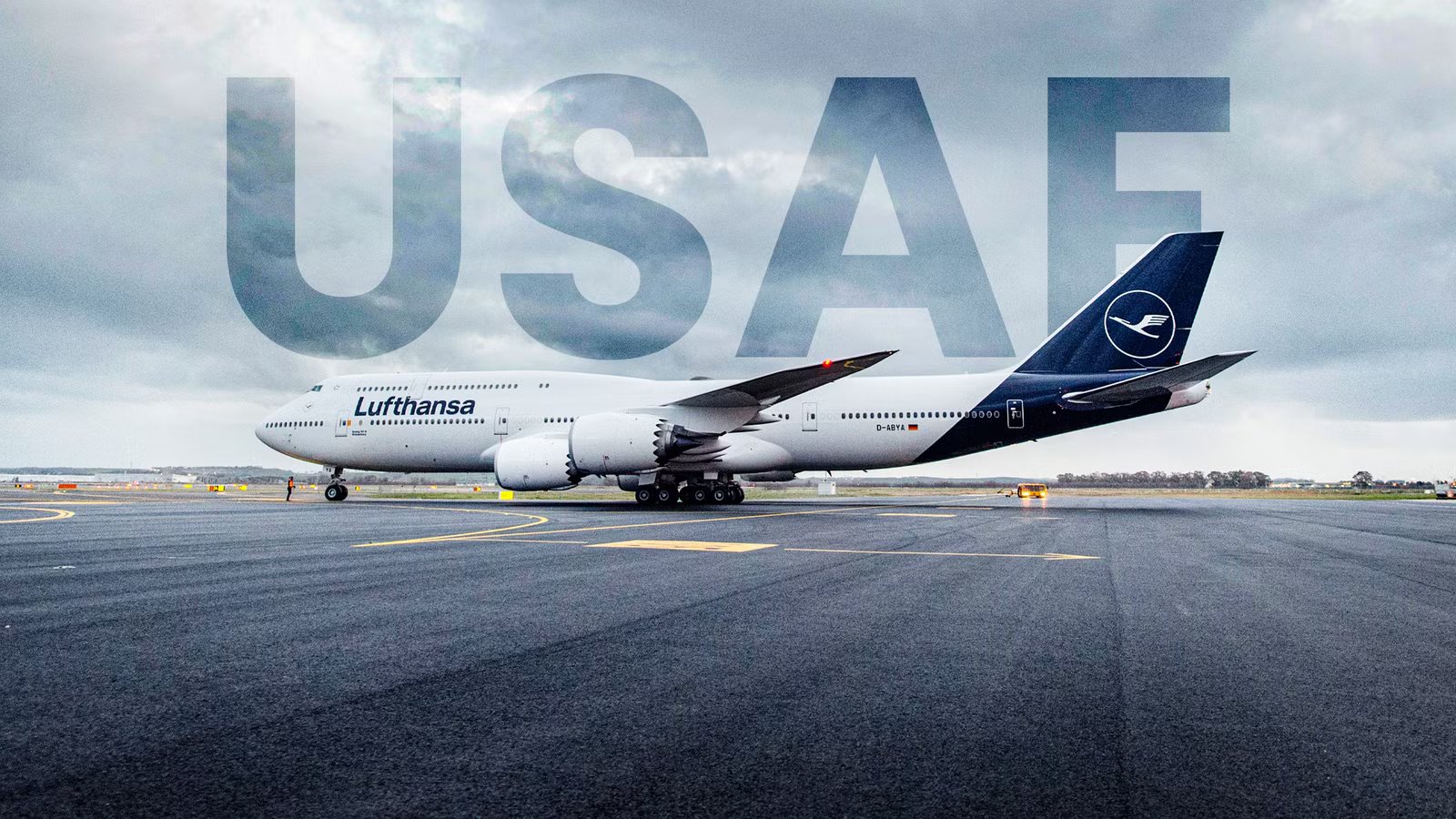
In a move that has sent shockwaves through the aviation industry, the US Air Force has finalized a $400 million deal to acquire two Boeing 747-8 airliners from the German flag carrier,  Lufthansa. This guide explores the strategic necessity behind this procurement, examining how a commercial icon from Frankfurt is becoming a critical lifeline for the most demanding aviation project in the world.
The 747 has long served as a vital asset for the US military; it has functioned as the primary symbol of American global reach for over three decades. However, with the current fleet of VC-25A aircraft nearing the end of their operational lives and their successors mired in significant production hurdles, the importance of this secondary acquisition cannot be overstated.
A Costly Delay

The entire Lufthansa deal flows from a single uncomfortable fact that the replacement Air Force One jets are years late and billions over budget.  Boeing originally won a $3.9 billion contract in 2018 to deliver two VC-25B presidential jets, which are heavily modified versions of the 747-8i passenger airframe. While the new presidential aircraft were initially expected to enter service in December 2024, that deadline has since collapsed completely under the weight of technical complexity and labor shortages.
Current projections from the US Air Force suggest that the first VC-25B will not be delivered until mid-2028, with the White House confirming earlier in 2025 that 2029 is a more realistic start date. This delay has pushed the total program cost, including necessary infrastructure and testing, to a staggering $6 billion. Boeing has incurred massive losses on the project due to the fixed-price nature of the contract, as workers must navigate plenty of complicated engineering feats required to transform a commercial jet into a nuclear-hardened flying fortress.
Originally, every technician working on the aircraft must maintain a top-secret security clearance, creating a narrow bottleneck in a labor market already struggling with general shortages. These high turnover rates among qualified mechanics reduced the pool of available talent, leaving the US Air Force to lower the security requirements to compensate.
The Biggest Gift You Can Get

The decision to acquire these specific airframes was born from a narrowing list of options in the global widebody market. With the final Boeing 747 rolling off the assembly line in 2022, the US Air Force found itself in a race against time to secure a stable supply chain for a platform that is no longer in production. By targeting Lufthansa’s fleet, the Pentagon is securing two of the youngest and best-maintained 747-8i aircraft in existence, specifically those previously registered as D-ABYD and D-ABYG. This acquisition ensures that the presidential airlift mission has a dedicated pool of parts and training platforms that are technically synchronized with the upcoming VC-25B.
Securing these jets from the secondary market was a mechanical necessity because the 747-8i is a fundamentally different machine compared to the legacy 747-200. While the older jets rely on analog gauges and cable-driven flight controls, the newer variant utilizes advanced fly-by-wire technology and the GEnx-2B67 engines. In 2026, the list of operators using the passenger version of this aircraft has dwindled to just three carriers: Lufthansa, Korean Air, and  Air China. Sourcing from Lufthansa was the most logical choice for the USA, given the airline’s rigorous maintenance standards and the massive 19-strong fleet of 747-8s that they continue to operate on marquee routes.
This is not the first time such an event has happened and has actually occurred numerous times between carriers and nations, most notably in the 2018 gift of a luxury 747-8 from the Qatari Emiri Flight to Turkey. Much like the current situation in the USA, the Turkish government utilized a pre-owned jumbo to modernize its executive transport capabilities without waiting years for a new production slot. The current Lufthansa deal, combined with the 2025 gift of a 747-8 from Qatar to the Trump administration, creates a unique bridge fleet that allows the US government to maintain operations while the primary VC-25B program navigates its own technical labyrinth.

Why Is Boeing’s Delayed 747-8 Air Force One Program $2 Billion Over Budget?
It will be more costly than expected due to a time-consuming modification process, supply disruptions, and other challenges.
Major Upgrade In Technology

The two Lufthansa airframes, despite their identical origins, are destined for very different futures within the US Air Force inventory. One aircraft, formerly registered as D-ABYD, was delivered to the military in early 2026 and is slated to remain in flyable condition to serve as a dedicated training platform for pilots and flight engineers. The second airframe, D-ABYG, is expected to arrive later this year and will serve as a high-value part source from the outset.
This acquisition marks a pivotal shift in how the Presidential Airlift Group prepares its crews for the cockpit. Training for the elite pilots of the 89th Airlift Wing has been contracted out to commercial partners like Atlas Air, which operates a small fleet of 747 freighters and provides simulator time. By bringing these Lufthansa jets in-house, the US Air Force is establishing an independent internal training capability, reducing its reliance on civilian contractors and allowing for more rigorous, mission-specific flight regimes that can only be practiced on a physical airframe.
The necessity of having a physical aircraft for training stems from the massive technological gap between the current 747-200 fleet and the newer 747-8. A pilot may be highly experienced in the analog environment of the older VC-25A, but the 747-8 is far more modern, with engines that generate 66,500 pounds (296 kN) of thrust each. This leap in performance and automation means that simulators alone cannot replicate the seat-of-the-pants feel required for the precision landings and tactical maneuvers often necessary for a presidential arrival.
Complex Reinforcement

The physical airframes from Lufthansa provide a much-needed backup, but the path to converting a standard airliner into a military asset remains a technical labyrinth. This conversion process is the primary reason why the US Air Force is so desperate for these training jets. Pilots must be ready for a flight deck that is being entirely re-engineered to survive a nuclear event. The complexity is not found in the luxury cabins, but in the unseen infrastructure that powers the presidential command suite.
The sheer scale of the modification is staggering, with technicians installing over 200 miles (321.9 kilometers) of specialized, shielded wiring throughout the fuselage. These upgrades are necessary to protect the aircraft’s electronics from electromagnetic pulses (EMP) and to support the classified communications equipment required for a flying fortress.
This technical rigidity explains why recent gifts from international partners cannot simply be pressed into service as primary aircraft. These luxury-configured jets may well be pristine, but they lack the structural reinforcements and specialized electrical shielding found in a true military-specification VC-25B. Consequently, these gifted aircraft serve more as a diplomatic asset, much like the Lufthansa jets, providing immediate VIP transport capability while the primary mission airframes undergo their decade-long transformation.

The New Boeing 747-8 Air Force One: What’s The Latest?
Will we see a new Air Force One before the end of the decade?
The Final Stand

The Boeing 747 has long held a place of reverence within Lufthansa’s fleet, serving as the airline’s long-haul flagship and the literal soul of its global operations. For decades, the distinctive hump of the jumbo jet was a common sight at  Frankfurt Airport, symbolizing German engineering excellence and the reach of European commerce. To Lufthansa, the 747 was a brand ambassador that allowed the carrier to dominate the competitive North Atlantic and Asian markets with a level of prestige that smaller twin-engine jets simply could not replicate.
The transition of these aircraft from commercial service to military duty represents a bittersweet final chapter for the Queen of the Skies. As Lufthansa, as well as airlines globally, shift toward more fuel-efficient models like the Airbus A350 or the Boeing 777X, the 747’s unique four-engine reliability and massive internal volume are becoming increasingly rare. The US Air Force is essentially the last remaining customer with a mission profile that requires the specific capabilities of the 747-8, ensuring that while the type may vanish from passenger terminals, it will remain the ultimate symbol of authority in the skies for the next several decades.
This acquisition ensures the 747’s legacy continues in the most prestigious role imaginable. Lufthansa passengers once toasted with champagne in the upper deck, and now, future occupants of these specific airframes will be pilots training for the defense of the USA. The irony is not lost on aviation historians: a German commercial icon, originally designed to democratize global travel, has now become the backbone of American presidential security, proving that the Queen’s versatility knows no borders.
The True Defender Of The President

Shutterstock | Simple Flying
The acquisition of the Lufthansa jets raises a fundamental question about the future of high-security aviation. Is this the last time we will see a four-engine jumbo jet in such a critical role? As the US Air Force looks toward the 2030s and 2040s, the global aviation landscape is moving toward twin-engine efficiency, making the maintenance of orphan fleets like the 747 an increasingly expensive and complex endeavor. Getting these airframes now, the Pentagon is stockpiling a 30-year supply of peace of mind, ensuring that the presidential mission is not grounded by a lack of specialized flight control sensors or structural brackets.
When a production line dies, the secondary market becomes the new front line of national security. The difficulty in maintaining the current 747-200 fleet, which has required engineers to fabricate parts from scratch using original blueprints from the 1980s, has served as a cautionary tale. These Lufthansa spares represent a proactive attempt to avoid that same fate for the 747-8, providing a mechanical safety net that protects against any further industrial decline at Boeing or its subcontractors.
Experts believe that if the 2028/29 delivery deadline for the primary VC-25B jets slips further, these Lufthansa airframes could take on an even more prominent role. They are already positioned to provide thousands of hours of training that would otherwise put unnecessary wear on the primary presidential aircraft. Whether they are flying over the USA for pilot certification or being dismantled in a hangar for their high-value components, these jumbos are now an inseparable part of the American narrative, ensuring that the Queen of the Skies remains the undisputed protector of the Commander-in-Chief.