dailynewsnblog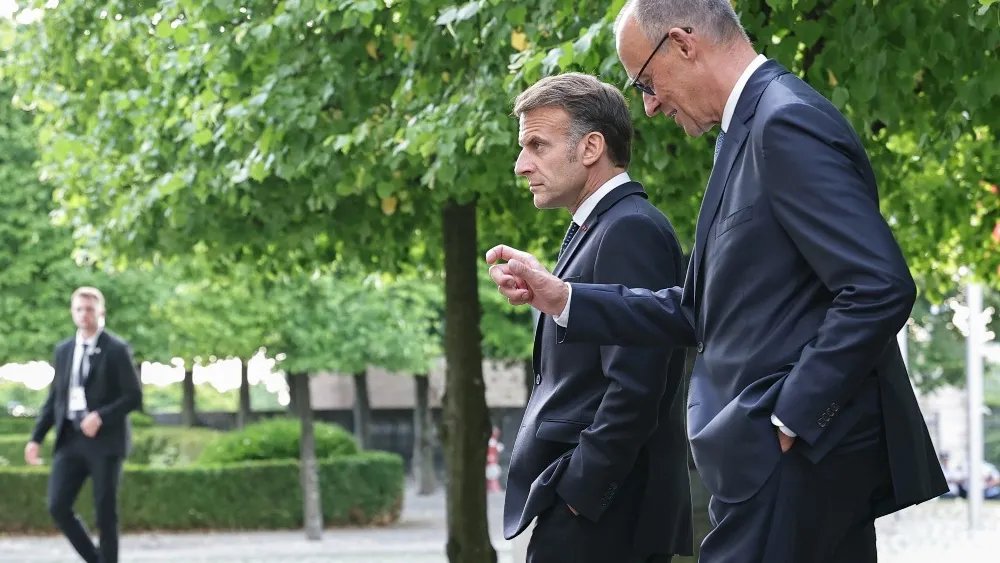
Days before European trade leadership is slated to meet with Chinese counterparts to hash out the issue of a fast-growing trade imbalance, French President Emmanuel Macron and German Chancellor Friedrich Merz are making a play to deploy a powerful legislative weapon against the deluge of imports.
Merz and Macron wrote to European Commission President Ursula von der Leyen to say that the 27-member trade bloc’s domestic manufacturing sectors and its overall economy have been threatened by systemic market-distortion practices and that the issue requires swift attention.
“Without delaying the full use of the existing set of instruments, we need a comprehensive framework to complement our toolbox with new legal instruments—in a lean and non-bureaucratic way,” they wrote. A rapid-response mechanism modeled on America’s Section 301 duties would speed up and streamline the Commission’s process for addressing unfair trade practices or market imbalances, they believe.
Along with other European leaders, Macron has spoken openly and often about the impact of a growing deluge of China-originating imports has had on domestic producers, noting that the United States’ efforts to rectify its own trade deficit with the sourcing superpower has led to a redirection of products to the European market.
Washington’s Section 301 tariffs, some of which were applied to China during President Donald Trump’s first term and were built upon by President Joe Biden, have slowed the flow of Chinese products in certain critical sectors into the U.S. market. Trump applied more duties to trading partners, including China, after an investigation into practices tied to forced labor concluded this summer.
Macron and Merz’ proposal hinted that the EU needed its own razor-sharp trade cudgels to wield against swelling import volumes, which have seen the bloc’s trade deficit with China grow by a whopping 1 billion euros ($1.125 billion) per day.
The EU’s existing Anti-Coercion Instrument, referred to colloquially as the “trade bazooka,” imbues the Commission with substantial authorities to constrain imports in the face of practices or policies that can be characterized as economic coercion, firing it off takes too much time, Merz and Macron argued. A months-long investigation would need to take place before its use could be approved, and the majority of EU governments would need to vote in favor of the plan.
The proposal out of Paris and Berlin would erect safeguards against those vetoes so the Commission could act faster.
The letter also proposed that the Commission take steps to ensure that Europe further diversify its supply chains to reduce reliance on China. According to a report from Reuters, the Commission characterized the French and German leaders’ plan as valuable and potentially viable, as it pointed to issues like dumping and government subsidies that Von der Leyen has herself highlighted as detrimental to Europe’s economy.
European Trade Commissioner Maroš Šefčovič will travel to Beijing on Thursday to carry out the final round of trade rebalancing talks with Chinese trade officials—negotiations which began four months ago. The results of those discussions will be discussed at a summit of European leaders in Brussels on Oct. 15-16.