dailynewsnblog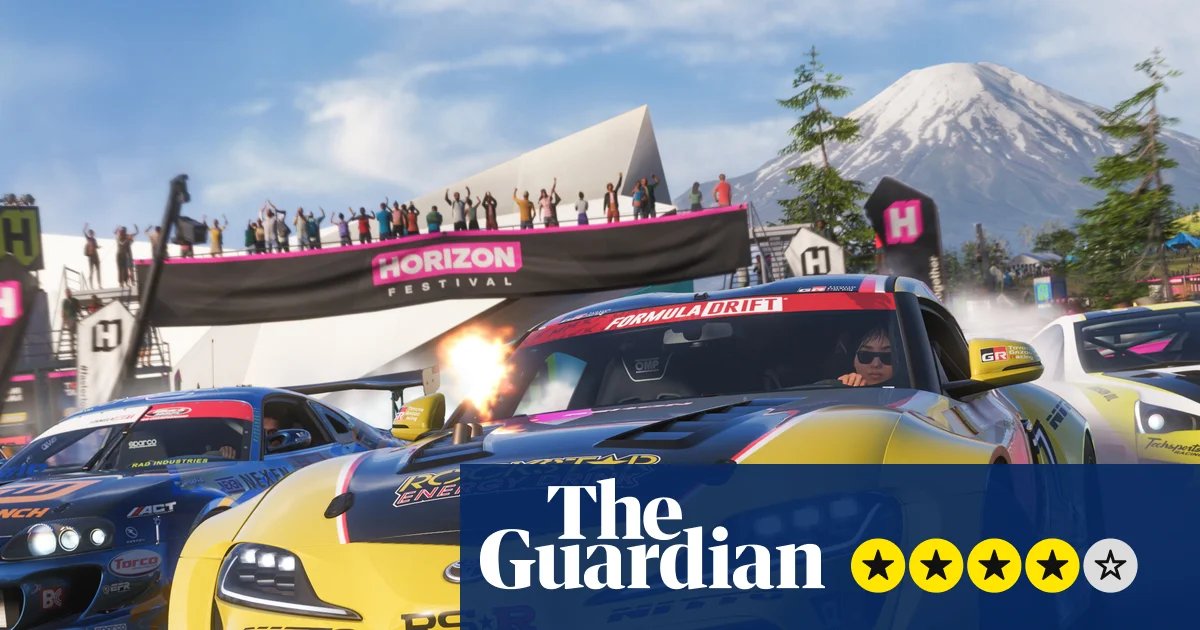
The Forza Horizon games have always been about drama. Not just the tension and excitement of racing, but also the sensory impact of the natural environment – the sun rising over a dense city, rain clouds hovering above a valley floor. There are moments in this game – perhaps after emerging from a dense forest, or coming up from an underpass – where Mount Fuji briefly appears in the distance, hazy yet majestic, the Platonic ideal of a volcano – and it almost takes your breath away. Fans of this series have been waiting years for Japan and now here it is, the whole country, reduced, remixed and repackaged as a driving paradise.
In many ways, Forza Horizon 6 is a continuation of what this series has always been about. You enter a festival-style driving competition then drive around a vast map splattered with various races and challenges, earning reputation by competing well and buying new vehicles for your extensive garage. There are slight changes this time – you start as a rookie not an established legend, so you have to qualify to enter the festival, and Playground has re-introduced the need to unlock successive levels of competition bringing back the sense of progression from the earliest titles in the series. You start out clattering about in slower C-class vehicles on easier circuits and have to work hard to start lining up against super cars such as the Ferrari J50 or Lamborghini Huracán.
Progress is through winning races of course, but also through carrying out challenges such as speed traps and jumps, or simply pulling cool drifts and other stylish driving manoeuvres as you explore. And you’re not just unlocking festival events, there’s a whole strand of the game named Discover Japan, where you take part in driving tours of beautiful areas, your guide pointing out places of interest while you zoom past at 150mph. There’s even a Crazy Taxi-style delivery side hustle, where you fulfil takeaway orders in a cute little truck to unlock better jobs and more cash.
Money is spent on cars, naturally, and after 20 hours I have the sort of collection that billionaires would lay off 85% of their staff to own. An Aston Martin Vulcan, a Jaguar XJ220 S in sky blue, a classic 1986 Audi Quattro. It goes without saying that these things are beautifully modelled, and as ever, you can re-paint them and cover them in decals, or simply search the user-generated market for cool custom designs. My GMC Jimmy SUV is painted in sugary pink and festooned with manga art. Aside from cars, you can also buy a variety of houses dotted around the map, and then customise and upgrade your garage so other players are able to pop in and admire your vehicles, like a testosterone-fuelled version of Animal Crossing.
None of this would mean anything if the handling wasn’t fun, but oh goodness, it really is. Race events take in streets, muddy fields, gruelling slopes and winding mountain tracks, and the cars all react exactly how they should. The Jeep Trailcat grips mud like a magnetic clamp, the Honda NSX-R GT corners faster than a runaway roller coaster. On tarmac, there’s always enough give in the tyres to allow spectacular drifts (this is Japan after all, the home of drift racing), but you can usually pull it back without spinning into the bushes. Braking discipline is the number one skill to learn in the urban races or the mountain-based touge runs where corners are tight and unforgiving. While racing through fields, however, there’s room to slip and slide with thrilling abandon.
And you’re never really playing alone. Sure, you can treat the game as a vast solo campaign, but if you’re online, there are always other participants on your roads. You can choose to race against other people on the campaign races instead of AI drivers, or select Horizon Play! and take part in crazed championship competitions against a dozen strangers. In our test, the servers held up well, with almost no glitches and very little waiting time between races. If you want to meet up with friends and bomb it along the Hakone Nanamagari route, tripping speed cameras for kicks, you can.
If I have a complaint about this game it’s that its version of Tokyo city doesn’t feel quite Tokyo enough. All the familiar sites are intricately replicated and instantly recognisable (the radio tower, Akihabara, the Shibuya crossing), but bereft of the thronging masses of pedestrians, the sounds, the fashions, the clamour of this super-high-tempo city, it all feels weirdly sterile, even post-apocalyptic. Almost the best way to experience the city is from a distance, cruising the coastline of the game’s Ito region, seeing the skyscrapers glisten in the sun. It was perhaps unrealistic to expect in a racing game something as bustling and enthralling as the Tokyo of the Yakuza series.
But mostly, it’s business as usual at the Forza Horizon festival: an expansive map filled with scenic and seasonal variety (plus hidden cars!), an intuitive yet still challenging handling model and hundreds of challenges to take part in. Forza Horizon 6 adds to the size and visual splendour of the environment, brings in better progression and provides an impressive array of accessibility options for players with different abilities, including full auto drive, limitless fast travel and high contrast mode. It does not revolutionise what this series has always done, there is nothing radical here to attract a whole new base of players. But that’s fine. There is no other way most of us will ever get to sit in a Porsche 911 GT3 and cruise into the Daikoku parking area with Yellow Magic Orchestra playing on the radio. For that experience, and so many others, the designers of this beautiful game should be thanked and applauded.