dailynewsnblog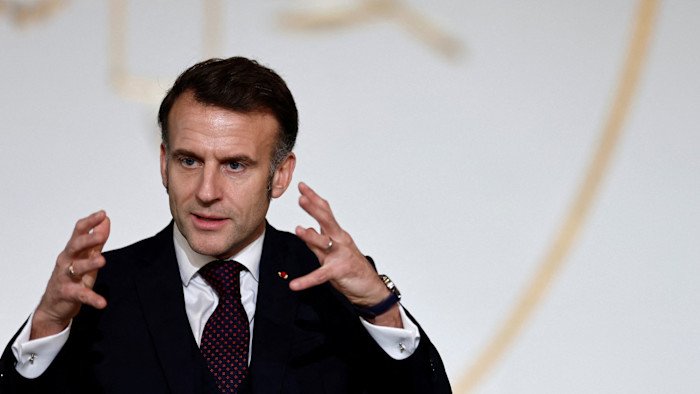
This article is an on-site version of our Europe Express newsletter. Premium subscribers can sign up here to get the newsletter delivered every weekday and fortnightly on Saturday morning. Standard subscribers can upgrade to Premium here, or explore all FT newsletters
Good morning. Europe is dealing with an “openly anti-European” US administration that “shows contempt” for the EU and “wishes its dismemberment”, French President Emmanuel Macron has warned. He said in an interview with the FT and a handful of other European newspapers that tensions over Greenland were not over, adding that “the US will, in the coming months — that’s certain — attack us over digital regulation.”
Today, I bring you Macron’s thoughts on how to boost the EU’s economic competitiveness by “Buying European”, and Laura reports on an annual index that suggests European citizens think their governments are increasingly corrupt.
Protection paradox
The EU must embark on an economic “revolution” of “protection which is not protectionism,” French President Emmanuel Macron has declared in a pitch to his fellow leaders as they grapple with how to reboot the bloc’s economy.
Context: The EU’s economy has fallen behind its global rivals, particularly the US and China. EU leaders will gather on Thursday for a “retreat” to discuss potential remedies.
“The revolution we need is, in fact, on the economic front,” Macron told a group of newspapers including the FT. “For me, the economic strategy to make our Europe a power lies in what I call protection, which is not protectionism, but rather European preference.”
Paris has long pushed for European “strategic autonomy”, which other capitals have rebuffed as contradictory to the EU’s single market and its free-trading principles.
But that approach has gained credibility in recent years in response to Russia’s invasion of Ukraine, tariffs imposed by US President Donald Trump and his demands that the continent take care of its own defence. Trump’s threat to invade Greenland exacerbated a sense among EU leaders that they could no longer trust the US as a strategic partner, with impacts on economic co-operation.
French officials in Brussels have pushed for “Buy European” clauses in a wide range of legislation, particularly concerning public procurement.
“The question before us is whether, ultimately, if you decide to remain a market open to all winds, without making your own decisions, you will be swept away,” said Macron.
“We need to have protected European content in critical sectors such as chemicals, steel, automotive, and defence. This is key if we want to defend our producers,” he said.
“Today we are facing, in particular, two major players who no longer respect the rules of the World Trade Organization,” he added, pointing to China and the US. “And so, if we don’t agree . . . to protect in order to restore fair trade terms, we will be swept away.”
Not everyone agrees with this assessment.
A position paper circulated by Germany, Belgium and Italy was notable for not mentioning “Buy European” as a strategy to fortify the EU economy. Instead, the way forward is to complete the single market, slash red tape, find means to reduce energy prices and conclude more “ambitious” trade deals, they argue. Simple.
Chart du jour: Meatgrinder

Russia’s army in Ukraine has suffered a sharp rise in casualties, as Moscow continues to entice new recruits with lavish bonuses.
Bad impression
European citizens view their governments as increasingly corrupt, as a new index shows that progress in fighting corruption and bolstering independent institutions has stalled, writes Laura Dubois.
Context: Transparency International’s corruption perceptions index (CPI) measures how corrupt citizens believe their governments are. It is released once a year and covers 182 countries and territories.
This year, the average global score has fallen for the first time in more than a decade to 42 out of 100, according to TI’s latest report published today. “The vast majority of countries are failing to keep corruption under control,” notes the NGO.
Europe ranks as the world’s least corrupt region, but TI warns that progress in fighting corruption has declined, with the average score sliding from 66 to 64.
Thirteen countries have seen a significant decline in their scores, for instance Hungary, where premier Viktor Orbán’s government has repeatedly been accused of corruption and undermining the judiciary, or Slovakia, where anti-corruption rules and whistleblower protections are being dismantled.
Hungary and Bulgaria have a score of 40 — the lowest in the EU — followed by Romania with 45.
But TI also singled out Spain, which has a score of 55, or France, at 66, as countries where standards are sliding.
The top-scoring country was Denmark with 89 points, followed by Finland with 88 and Norway with 81.
“In the current geopolitical climate, Europe should be raising, not lowering, its anti-corruption ambitions,” said Flora Cresswell, TI’s regional adviser for western Europe. “Corruption is not inevitable: Europe and its leaders must act now to show ambitious, enforceable reform and global leadership.”
What to watch today
UN General Assembly president Annalena Baerbock addresses the European parliament in Strasbourg.
European parliament votes on list of safe countries of origin for immigrants.
Now read these
Recommended newsletters for you
Free Lunch — Your guide to the global economic policy debate. Sign up here
The AI Shift — John Burn-Murdoch and Sarah O’Connor dive into how AI is transforming the world of work. Sign up here
Are you enjoying Europe Express? Sign up here to have it delivered straight to your inbox every workday at 7am CET and on Saturdays at noon CET. Do tell us what you think, we love to hear from you: europe.express@ft.com. Keep up with the latest European stories @FT Europe