dailynewsnblog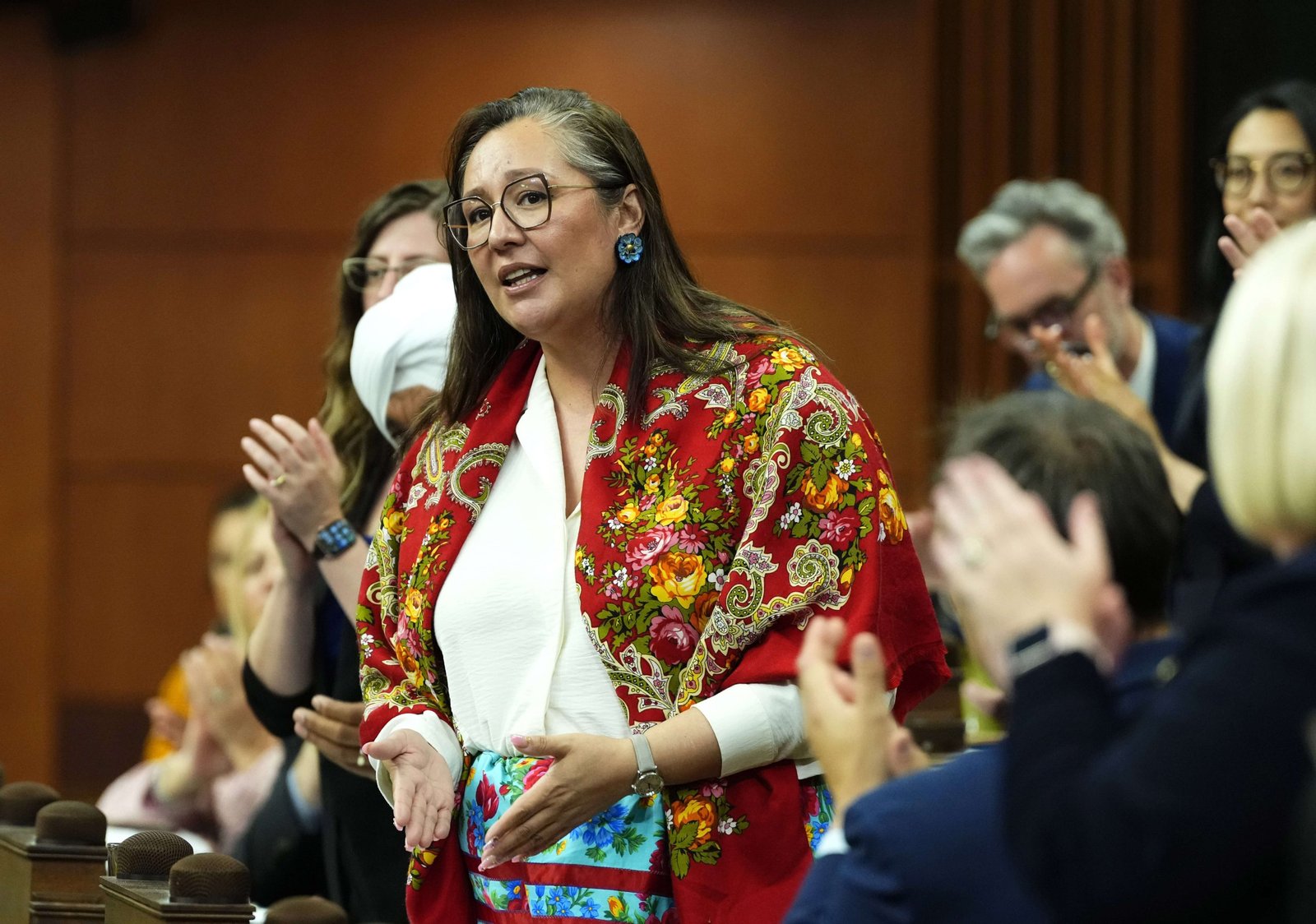
At a press conference on Thursday, Caldwell First Nation Chief Nikki van Oirschot said the government needs to “separate political convenience from justice” and pass the bill as soon as possible.
First Nations advocates are making a last-minute push to urge the Liberal government to pass legislation eliminating discriminatory measures in the Indian Act and the contentious second-generation cutoff.
Assembly of First Nations National Chief Cindy Woodhouse Nepinak, members of the Caldwell First Nation and other Indigenous leaders marched on Parliament Hill on Thursday to demand that the government push Bill S-2 across the legislative finish line before Parliament rises for the traditional summer recess later this month.
BACKGROUND: Bill S-2 unlikely to pass before summer recess
At a press conference prior to the procession, Caldwell First Nation Chief Nikki van Oirschot said the government needs to “separate political convenience from justice” and pass the bill as soon as possible.
“Reconciliation is not measured by speeches, it’s measured by action. It’s measured by whether parliament is willing to remove the barriers that it created.”
Bill S-2 was introduced last year in response to a B.C. Supreme Court decision known as the Nicholas ruling that stuck down measures in the Indian Act that prevented descendants of enfranchised First Nations peoples from receiving status.
But it has faced an uphill battle in Parliament after senators passed an amendment that would end the controversial second-generation cutoff, which denies Indian status to people who had a non-First Nation parent and grandparent.
The Senate amendment would allow status to be passed on to a child if at least one of their parents were recognized as having status.
Indigenous Services Minister Mandy Gull-Masty said the government supports ending the cutoff but requires more time to consult, noting the one-parent rule isn’t unanimously supported by First Nations. Critics have called this a stall tactic that allows the Liberals to put off meaningful changes.
The Liberals are holding consultations on the cutoff and Gull-Masty has promised to table separate legislation on the issue, though hasn’t offered a timeline.
Sen. PJ Prosper, who introduced the Senate amendment, told reporters at a separate press conference on Thursday that over 500 First Nations have voiced support for the one-parent rule. His office even offered up a map of every First Nation that has come out in support of the change.
“That is why I find it baffling that the government continues to delay on the basis of needing more consultation. No other order of government requires unanimity before moving forward,” he said, adding that the 1985 changes to the Indian Act that brought in the second-generation cutoff were made after no consultation with First Nations.
Joining Prosper at the media availability, NDP MP Leah Gazan said the government’s approach starkly contrasted with the rush to push through the Liberals’ major projects bill last spring. Bill C-5 passed in 20 days despite concerns from Indigenous communities.
“The government is saying that it cannot move too fast. This is a blatant double standard, which by now has become totally unsurprising from the Carney Liberal government.”
In a statement to iPolitics earlier this week, Gull-Masty’s office said the minister remained “committed to forwarding legislative reform options that address the second-generation cut-off and section 10 voting thresholds in a manner that reflects the perspectives and priorities of First Nations.”
“It is a critical and deeply personal issue for many individuals, families and communities, and addressing it meaningfully is an important part of advancing reconciliation,” read the statement.
The minister’s office said that the ongoing consultation process has “already proposed diverse solutions” to the second-generation cutoff, including “options beyond the single-parent rule amendment introduced by the Senate.”
The office added that the government has an “obligation to carefully and appropriately consider and consult on all proposed solutions, in accordance with First Nations’ right to self-determination.”
Woodhouse Nepinak said the government couldn’t justify delaying S-2 by pointing to the need for more fulsome discussions on Indigenous citizenship, though acknowledged the need for more substantive reforms in the future.
“Bill S-2 is a step forward, but it is not the final step. Real change means ending discrimination, respecting First Nations jurisdiction, and ensuring that First Nations are empowered to fully exercise our right to self-determination.”
While Bill S-2 was passed by the Senate in the fall, it was only introduced in the House in late February and referred to committee in April.
This came despite the government facing a court deadline to pass the measures in S-2 responding to the Nicholas ruling.
The B.C. Supreme Court ruling originally gave Ottawa until the end of April to make those reforms, a nearly one-year window. During the hearings, lawyers for the government conceded the existing rules on enfranchisement violated the Charter.
As that deadline drew closer, lawyers for the federal government went back before the court asking for a six-month extension. A temporary one-month extension was granted to await a ruling, though a B.C. Supreme Court judge ultimately decided last month against giving the government more time, as iPolitics first reported.
The deadline wasn’t automatically reinstated as the government has a 30-day window to appeal.
Ryan Beaton, a partner at Juristes Power Law who represents the plaintiffs in the Nicholas case, said he believes Ottawa will wait until the final days to launch its appeal, which could drag out the process even longer.
Despite the looming deadline, a government source told iPolitics in an exclusive story last month that the Liberals are unlikely to pass S-2 before the summer recess because too many stakeholders want to testify about the bill at committee.
Liberal MP and committee chair Terry Sheehan told iPolitics recently that it’s difficult to predict the pace of the review of S-2 as members voted to hold concurrent studies on Indigenous policing and Arctic affordability, the latter of which was proposed by the Conservatives.
Conservative and Bloc Quebecois MPs on the committee are calling for S-2 to pass quickly with the Senate amendment in place, but could be outvoted by the Liberals, who now have a majority after changes to the composition of committees were made earlier in the spring.
At the committee meeting on Thursday, Conservative MP Billy Morin moved a motion to wrap up clause-by-clause review on the bill by Tuesday. If that were to happen, S-2 would then return to the House, though it would be up to the government to determine next steps.
Gull-Masty was appearing before the committee to discuss her department’s latest spending plans.
The Liberals hold a majority on the committee and in the House. That means Morin’s motion won’t pass without the government’s support or Liberal MPs breaking with party leadership.
The House is scheduled to rise on June 19. That would likely allow for two more meetings for the Indigenous and northern affairs committee, which meets on Tuesdays and Thursdays.
READ MORE: Indigenous advocates call for meeting with Carney as they press for S-2 to pass before summer
Members of the Indian Act Sex Discrimination Working Group are also demanding a meeting with Prime Minister Mark Carney to explain why Bill S-2 must be passed before the House rises for the summer.
And Sharon McIvor, a founding member of the working group, had submitted a parliamentary e-petition calling for S-2 to pass as it stands, and it received nearly 14,300 signatures.
Zoë Craig-Sparrow, vice-president for Justice for Girls, a member of the working group, said she’s also requested a meeting with Gull-Masty about the bill but her offer was refused. She told iPolitics last week that she was only offered up lower-ranking officials from Gull-Masty’s office.