dailynewsnblog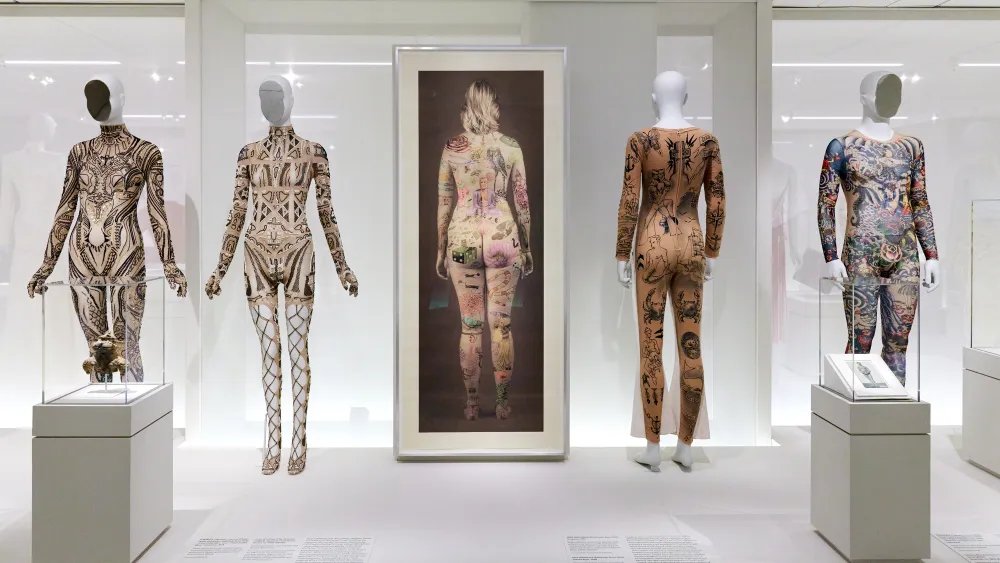
The Metropolitan Museum of Art’s unveiling of “Costume Art” drops the velvet ropes that once corralled the exclusive worlds of fashion and art, giving visitors an all-access pass to all types of dressed bodies and some not-so-dressed ones, too.
It’s not just that the Costume Institute’s spring exhibition is now conveniently housed just steps away from The Great Hall in the Condé M. Nast Galleries, but its 200 or so pairings map out the centuries-sweeping connections between works of art and garments. Instead of looking at fashion through the lens of art, the dresses, jeans, body stockings, bustiers and other garments are more prominently positioned. By flipping the switch, the aim is to look at fashion and the human form with a wider, and hopefully, wiser lens that considers our commonality, too.
The 12,000-square-foot prime real estate indicates just how indispensable fashion is to art as well as to The Met in terms of attracting visitors and donors through The Met Gala. Last year’s event raised a record-breaking $31 million for the Costume Institute and Monday night’s gala is expected to top that, thanks partially to lead sponsors Amazon founder Jeff Bezos‘ and Lauren Sánchez. What started as a private dinner for 50 people in 1948, which was immediately crowned “The Party of the Year,” the Met Gala remains the primary fundraiser for the Costume Institute.
The show’s title winks at The Costume Institute’s origins, which date further back to 1937. Before merging with The Met, the Costume Institute operated as an independent institution. “Costume Art” is also meant to magnify fashion’s status as art, not despite its intimacy with the body but because of it, according to chief curator in charge Andrew Bolton.
During a preview of the expansive, but comprehensive show Saturday, Bolton emphasized how the human figure and the dressed body are the recurrent aesthetic throughout The Met’s collections.
“Costume Art” literally has something for every body on view. The first section, “Diversity in Bodily Being,” consists of “Naked and Nude Body,” “Classical Body,” “Abstract Body,” “Reclaimed Body,” “Pregnant Body,” “Corpulent Body” and “Disabled Boy.” The second part, “Bodily Being in Its Universality,” is made up of “Epidermal and Inscribed Body,” “Anatomical Body,” “Vital Body,” “Aging Body” and “Mortal Body.” If all of that body-happy lingo sounds a little redundant, there’s an exclamation point at the end of it.
Standing beside a handful of Somarta’s “Atlas III” bodysuits in a range of skin tones and artist Anders Bergstrom’s “Brown Bag Test, December 21, 2014,” (which fashion types might mistake as Pantone-type swatches), Bolton said, “The body is under attack from different places — first and foremost from artificial intelligence, and from politics. So the idea of celebrating the body in all of its forms, differences and beauty is something that might resonate with the times under which we are living. Different bodies are being questioned.”
Although fashion “made such inroads” about body diversity a few years ago, Bolton challenged whether that level has been sustained. By placing different body types that have not been “socially valorized” on pedestals, which the first section of the show does, and on platforms, as the second one offers, is a way to start a conversation about all bodies, he said.
Nine individuals, including the fashion designer Michaela Stark, had their bodies scanned to create more life-like mannequins, as opposed to the ultrathin physique that the fashion industry, dare we say, embodied for years. Stark’s subversive “Corpulent Body” designs intentionally create exposed bulges, creases and breasts. A Willie Norris-designed T-shirt imprinted with “Queer Capital” and denim shorts are displayed on an Aariana Rose Philip-inspired mannequin that is seated in a wheelchair form.
The connectedness of fashion and art, as well as all of humankind, pulses throughout the show. “It’s about commonality and differences at the same time, and a celebration of body plurality,” Bolton said.
Fittingly, “Costume Art” starts with a two-sided portal with Albrecht Durer’s “Adam and Eve, 1504,” Vivienne Westwood’s fall 1989 nude-colored leggings, and Andreadamo’s fall 2023 bodysuit on one side. Lucen’s “Adam With Apple” spring 2023 ensemble and Walter Van Beirendonck’s spring 2009 flesh-colored cartoon-like ensemble imprinted with “Get Natural Get Naked” are showcased on the other side. Bolton explained, “In a way, it’s a role reversal of the four, where in this case, Adam has the apple.”
Such tongue-in-cheek signals flicker throughout the show such as in the “Aging Body” area, where a fall 2024 Vetements oversize hoodie imprinted with “I’m Retired (This is as dressed up as I get)” and floor-length skirt is paired with Batsheva’s fall 2024 ruffled skirt and two-tone sweater stitched with “Hag.” Over in the “Pregnant Body,” a Hiroko Okada photo of two seemingly pregnant men wearing only briefs is displayed with Xander Zhou’s spring 2019 cropped “New Wors Baby” T-shirt on a seemingly pregnant mannequins with jeans.
In this Ozempic-loving, looksmaxxing and steps-counting age that we exist in, “Costume Art” serves up sculpted and ultra-sheer garments — and artworks — that reveal the human body. The Met is not only flexing its vast holdings, but it is also hinting at our voyeuristic society in an in-on-the-joke kind of way. A Dior ensemble by former artistic director of women’s collections Maria Grazia Chiuri is displayed on a pedestal so that visitors are effectively looking up the skirt to see its intricate design. Seiran Tsuno’s transparent “Out Of Body Dress” is also set up high so that the prompt is to look up the billowing garment into what normally is concealed on a mannequin. That ghostly garment is paired with Edward Munch’s “The Scream.” Score another laugh for the curatorial team.
Gallery-goers are sure to find shapes, forms or designs that they can relate to, whether that be Dsquared2’s tattoo-like jumpsuit from spring 2016 or Schiaparelli’s ribbed spring 2016 haute couture dress. Goth lovers and realists may gravitate to the “Bodily Being in Universality” area, where platforms are used for an eye-to-eye relatability. There such subtexts of skeletons, skulls, blood, aging, injury, anatomy and mortality can be found. Iris van Herpen’s bone-like fall 2011 haute couture ensemble, Thom Browne‘s fall 2024 haute couture muscled-looking gown, Jean Paul Gaultier‘s haute couture fall 2006 black dress with a spiny back design, and Imme Van der Haak’s “Beyond the Body” shrouds imprinted with an image of an elderly woman wearing only underwear and lipstick all qualify. Ditto for Robert Wun’s “Through the Flesh” fall 2024 haute couture blood-red gown — and matching spiky acrylic nails, another sign of The Met’s of-the-moment mindedness.
Selfie lovers and what-is-art skeptics alike may suddenly identify with many forms they look at, which have reflective faces. That accent was handled by the artist Samar Hejazi so that everyone sees themselves in the ensembles. That look-at-me touch doesn’t just heighten the intrigue, it humanizes fashion’s greatest folly, which is getting people to dress up and get out of their comfort zone. Even the show’s translucent scrim, which separates the layout, is meant to create points of intersection, such as considering the similarities between varying types of bodies.
Deciding on the 200 or so ensembles — and artworks — that are showcased involved combing through The Met’s 17 curatorial departments, which encompass more than five millennia of artistic output that cross cultures, geographies and epistemic traditions, as Bolton points out in “Costume Art’s” whopping 418-page catalogue. About half of the ensembles were created within the past decade, which relays an of-the-times show versus an overly scholarly one.
Although “Classic Body” presents a row of striking ivory-toned designs from Madame Grès, Fortuny, Madeline Vionnet, Eta Hertz and Gilbert Adrian, the show serves up many designs from on-the-rise designers like Melitta Baumeister, Yiqing Yin, Duran Lantink, Harry Pontefract, Renata Buzzo, Yuima Nakazato and Peter Jensen. There are also leading resources like Saint Laurent (one of the exhibition’s sponsors), Comme des Garçons‘ Rei Kawakubo, Yohji Yamamoto, Undercover’s Jun Takahashi, Alexander McQueen, Olivier Theyskens, Issey Miyake and Westwood.
Historical pieces are scarce save for items like a British “robe de la francaise,” from the 1740s. Even the grander pieces on view, like a lavender Worth and Bobergh gown circa 1862-1865 and the House of Dior “Eugenie” rose-colored ballgown from Christian Dior’s fall 1948 collection, may resonate with fans streaming the Margot Robbie version of “Wuthering Heights” or binge-watching “Bridgerton.”
“The other day a colleague came through and said, ‘This is like a G-rated movie. There’s something here for everyone,” Bolton said. “I love that idea. That was exactly what I hope to achieve — people can connect with it in different ways.”
When “Costume Art” opens to the public on May 10, it will be on view for eight months — another sure signal of The Met’s faith in fashion. And the galleries as a whole are meant to have a permanence akin to The Met’s Egyptian galleries or its Greek and Roman ones, according to Bolton, who highlighted the materiality, plaster walls, beams and lighting that also project onto the ceiling for a cloud-like feel.
As for the takeaway, Bolton would love for showgoers to explore other areas of the museum, making their own connections about the bodies that are represented and with the fashions that they are wearing.
“It almost acts as a blueprint or a map for people to take away mentally. All of these bodies have existed throughout generations. Nothing is new. These bodies have been around, since the beginning.”
While guests heading to the Met Gala have been given a “Fashion Is Art” dress code, Bolton is counting on some of the typologies from the exhibition to come to life.
“I suspect we’ll see some ‘Naked and Nude,’ and goddess dressing from the classics section. I think a lot of men will gravitate toward the ‘Anatomical Body’ and the ‘Mortal Body.’ For the ‘Inscribed Body,’ some men may be wearing their tattoos inscribed on their suits,” he said. “I was more worried that they would wear a Campbell’s soup can, or dress as ‘Madame X,’ or come in with a picture frame around their necks. But I hear they’re really engaging with the structure of the exhibition. That’s exciting. I love the idea that the red carpet will become an extension of the exhibition — static mannequins will come alive on the red carpet.”