dailynewsnblog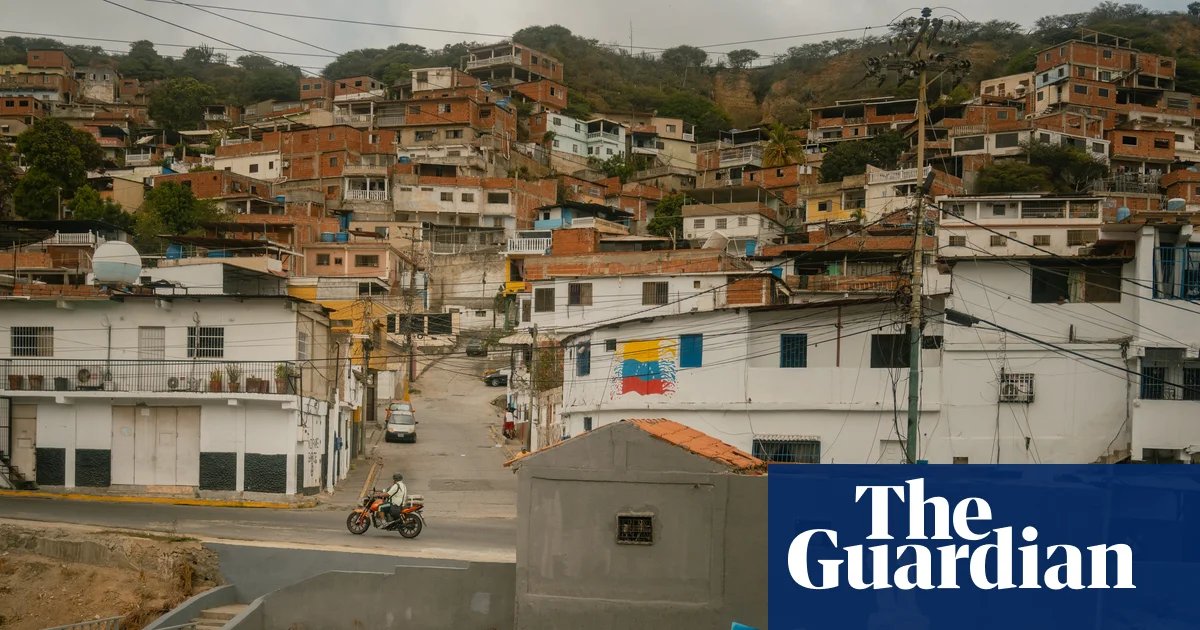
When Ángel Linares heard a strange buzz followed by an explosion, his first thought was that neighbours were setting off fireworks to celebrate the new year.
Then his windows shattered, the building’s walls shook and its facade was ripped off, sending him flying on to the ground of an apartment suddenly reduced to rubble. His 85-year-old mother, Jesucita, feared Venezuela’s northern coast had been devastated by an earthquake, like the one she remembers from 1967.
Next door, Elizabeth Herrera jumped out of bed in her pyjamas and realised something more sinister was afoot when the post-explosion silence was filled with the sound of gunfire: “Tah-tah-tah-tah-tah-po-po-tah-tah-tah.”
“Is it a coup? … I don’t believe ‘Papá Trump’ would have dared to invade,” Herrera remembers her husband speculating as their housing estate’s panicked residents struggled to make sense of the mayhem just before 2am on 3 January.
All four residents of the Urbanización Rómulo Gallegos project in Catia La Mar, a seaside town 20 miles north of Caracas, were wrong. Donald Trump had indeed ordered an invasion of Venezuela, albeit a lightning-fast one to abduct the country’s then president, Nicolás Maduro.
Their community found itself at the eye of the storm as air-to-surface missiles rained down on defence and radar systems and radars along the country’s Caribbean coast and helicopter-borne Delta Force fighters swept south towards the capital. “They were 10 minutes that felt like an interminable hour,” said Herrera, who lost two elderly neighbours during the attack that was apparently targeting military installations on a nearby hill.
She recalled her autistic son’s anguish as they rushed out into the darkness and sheltered in a nearby school. “Mummy, are we the baddies? Are Venezuelans the baddies? Are they going to kill us?” he asked.
“I told him, ‘No, it’s probably just an issue between the White House and Miraflores,’” she replied, referring to Venezuela’s presidential palace.
“So why are they shooting at us?” her son insisted. “In his autistic mind … it made no sense that if this was a thing between governments, why were the missiles falling here?”
More than four months after Operation Absolute Resolve, Herrera and her neighbours are far from the only ones still trying to make sense of Trump’s intervention and its impact on the future of a country already reeling from years of poverty, hunger and repression.
Across Venezuela, ordinary citizens, opposition activists, diplomats, businesspeople and members of Maduro’s movement are trying to fathom the bewildering new era ushered in by the autocrat’s capture and Trump’s unexpected decision to recognise his vice-president, Delcy Rodríguez, who has held power since.
“Everything is so confusing …. This feels sometimes like an illusion,” said Jesús Armas, a former political prisoner and ally of the exiled opposition leader and Nobel laureate, María Corina Machado, who had hoped to take power but has been sidelined from Venezuela’s post-Maduro transformation.
Changes have undoubtedly occurred since Maduro’s 13-year rule was brought to an end during a two-and-a-half hour blitz that left scores of Cuban and Venezuelan troops and at least three civilians dead.
After years of increasingly despotic rule, which deepened after Maduro was accused of stealing the 2024 presidential election, an incipient political thaw has descended.
Murals of Maduro have been painted over, his portraits quietly removed from some government offices, and foreign journalists are being allowed into the country for the first time since the 2024 vote.
Hundreds of political prisoners have been freed and dissidents have emerged from hiding or returned from exile to continue their push for a transition back to democracy.
On a recent evening, hundreds of people gathered outside Venezuela’s most notorious political prison – a shopping mall-turned-torture centre called El Helicoide – for a previously unthinkable protest to demand fresh elections and the release of the estimated 500 detainees remaining.
“People have lost their fear,” said Jeisi Blanco, a human rights campaigner, as colleagues chalked the names of those still incarcerated on the pavement under the gaze of police who filmed participants but did not intervene.
“They aren’t just statistics, they are people with stories and with families who have spent more than three years behind bars,” she said.
Armas, who was released from El Helicoide in February as a gesture from Maduro’s heirs, said: “I feel great … I feel hope right now. I know that we are going to change this country.
“We’re going to bring back freedom … and I know Venezuela will be a democracy in the next few months,” he said, insisting Machado would return in the coming weeks to tour Venezuela, rally supporters and complete its political transformation.
US officials also celebrate what many here call the “new political moment” enabled by Trump’s audacious, although, to many, illegal raid. “The president likes action. He also likes deals, and he likes progress, and we’re seeing all of that in a very short period of time,” said Jarrod Agen, the director of Trump’s national energy dominance council, after arriving in Caracas on the first US commercial flight to the oil-rich country in more than seven years.
“We’re moving at Trump speed … I’m super excited,” he said, flanked by smiling Venezuelan officials who have spent years at loggerheads with their US counterparts.
But alongside the excitement and optimism there is bafflement and trepidation about the fact that Maduro’s rendition led not to fully fledged regime change or democratisation, but to a peculiar rapprochement between the fallen dictator’s authoritarian allies and their longtime foes in Washington.
Trump has repeatedly praised Rodríguez as a “terrific” partner, while Venezuela’s new leader has given no indication that fresh elections are coming. “I don’t know, some time,” she deflected when asked recently when a vote might be held.
Caracas-based diplomats voice astonishment at the political handbrake turn performed by Maduro’s supposedly anti-imperialist successors, who have rolled out the red carpet for Trump officials – and allowed Venezuela to be turned into what some have called a US protectorate – with virtually no explanation.
“It’s the theatre of the absurd, it’s Beckett,” said one foreign envoy, recalling how, after Japan’s 1945 surrender to allied forces, Emperor Hirohito urged citizens to “bear the unbearable and endure the unendurable” to salvage their nation’s future.
Rodríguez’s team had offered no such justification for embracing Trump, the diplomat said: “They just went from A to B without explaining why.”
Experts say the once improbable marriage of convenience between Washington and Caracas is rooted in Trump’s desire to secure access to Venezuela’s vast oil reserves and for a foreign policy “win” amid the debacle in Iran, and Rodríguez’s determination to retain power and save the political movement Hugo Chávez founded more than 25 years ago.
“The purpose is not to be the cat’s paw of the United States, to be a partner of the United States,” said Tom Shannon, a US diplomat who has worked with Venezuela since the 90s.
“The purpose is to maintain and preserve the Bolivarian revolution, to the extent that it can be preserved, and to do what has to be done in order for that revolution to be preserved and for the political leadership that has defined it to be able to survive.”
“I’m sure she feels it to be humiliating,” he said of Rodríguez, whom he has met numerous times. “She finds herself in a position that I’m sure she sees as politically complicated and difficult, but historic in terms of the trajectory of the Bolivarian revolution.”
For opponents of the movement, who blame it for an economic and humanitarian disaster that has forced about a quarter of the country’s population to flee abroad, the détente and incomplete transition have left a bitter taste.
Sitting outside her home, next to a government memorial to the victims of Trump’s attack, Herrera recalled her initial exhilaration at what seemed like imminent change, even as parts of her housing estate lay ruined.
“I thought it was all over … I thought, thank goodness we’re going to escape this situation which is strangling us,” she said, a freshly painted government mural behind her bearing the message: “We will prevail”.
But as the days passed, the excitement turned to dismay. “On the news they talk about how much oil they’ve taken and how much gold … yet we’re stuck in the same place … [If Trump came here] I’d ask him to think about Venezuelans and not just the natural resources that Venezuela has,” she said.
“I feel hope but I also feel fear … Our fear is harbouring hope that the situation is going to change and then this not happening.”
Sitting on a sofa beside a shrapnel-pocked portrait of Venezuela’s liberation hero Simón Bolívar, Jesucita Linares said her main worry was a repeat attack.
In preparation, she has turned her shopping trolley into an emergency go-bag filled with clothes and medicine. “I’ve been asking God for this never to happen again,” said Linares. “But you never really know.”