dailynewsnblog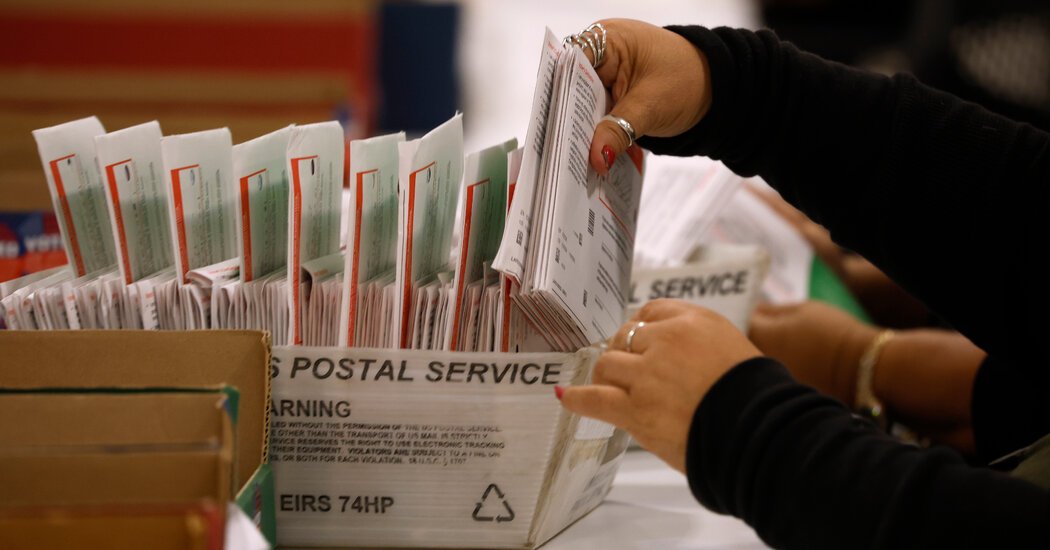
A federal court in Massachusetts struck down crucial components of an executive order from President Trump that sought to place significant restrictions on mail voting as “unlawful, null, and void.” The order had, in part, tried to use federal oversight of the U.S. Postal Service to regulate mail voting.
The ruling from Judge Indira Talwani amounted to a broad rejection of the Trump administration’s attempts to change federal election procedures through an executive order, repeatedly emphasizing that the Constitution grants authority over elections not to the executive branch but to individual states and Congress.
“The Constitution does not grant the President any specific powers over elections,” Judge Talwani wrote, adding emphasis by underlining the words “does not.”
More than 20 Democratic attorneys general representing states across the country brought the legal challenge in federal court in Massachusetts.
Mr. Trump’s executive order, signed in March, called on the Department of Homeland Security to compile state-by-state citizen lists to help determine voter eligibility. It called on the Postal Service to verify voters based on lists provided by states. Earlier this month, the Postal Service complied with the order, releasing a proposed rule consistent with many of Mr. Trump’s demands.
The decision comes as Mr. Trump has renewed his push to pass federal legislation that would impose fresh voting restrictions, canceling the signing of a celebrated bipartisan housing measure on Wednesday and instead demanding that Republicans first pass the president’s priority voting legislation known as the SAVE America Act.
A spokesperson for the Postal Service did not immediately respond to requests for comment.
Abigail Jackson, a spokeswoman for the White House, defended the executive order’s legality and said that the administration was “confident that we will ultimately prevail” in putting in effect the executive order. She reiterated the administration’s intent to pass the SAVE America Act in Congress.
“President Trump is committed to ensuring that Americans have full confidence in the administration of our elections,” Ms. Jackson said.
Multiple lawsuits have challenged the executive order, including a separate case in Washington, D.C., where a judge initially decided not to block the order after concluding that, because it had not yet been carried out, no state or party had suffered legal harm.
Judge Talwani, however, found that the executive order had already forced many states that were part of the Massachusetts lawsuit to change election policies and procedures. Connecticut had already shifted election staff away from other duties to begin planning for the executive order, and nearly half of the states were grappling with the fact that they had already purchased mail ballot envelopes that were not in compliance with the directive.
“Not only are Plaintiff States experiencing injury now with respect to planning, but it is undisputed that, should the E.O.’s directives go into effect, Plaintiff States will incur compliance costs,” Judge Talwani, who was appointed by former President Barack Obama, wrote.
The ruling focused on two sections of the executive order that sought to create state-by-state citizenship lists within the Department of Homeland Security and direct the Postal Service to use an approved list of voters to guide election mail.
Judge Talwani found that the authority to create voter lists and to determine voter eligibility rests with the states, writing that “the Constitution reserves the power to determine voter eligibility to the States alone.”
But she also questioned whether records that the government would be relying on would be able to “track name changes (such as when a woman changes her name at marriage) or residence changes when citizens move from State to State.”
“It is clear that the federal agencies charged with compiling Confirmed Citizen Lists lack the ability to create complete and accurate lists of the U.S. citizens residing in every State,” Judge Talwani wrote.
And the judge returned to the question of executive authority, finding that “the President lacks any authority to compile voter lists for each State.”
Similarly, regarding the provision directing the Postal Service to take a more direct role in overseeing mail voting, Judge Talwani found the agency lacked authority over elections.
“No law enacted by Congress delegates authority to control mail-in voting to USPS,” Judge Talwani wrote, adding that the service “lacks statutory authorization to promulgate any binding regulations on mail-in voting.”
The judge’s ruling comes a day after Postmaster General David Steiner confirmed in a hearing before the Senate that a proposed rule would block mail ballots in states that do not hand over sensitive voter data to the federal government.
Mr. Steiner has repeatedly said that the Postal Service would follow court orders.
In an interview with The New York Times earlier this year, he said that he would defer to the courts on the legality of Mr. Trump’s executive order and reaffirmed that the service would “absolutely” continue to deliver mail-in ballots.
Zach Montague contributed reporting.