dailynewsnblog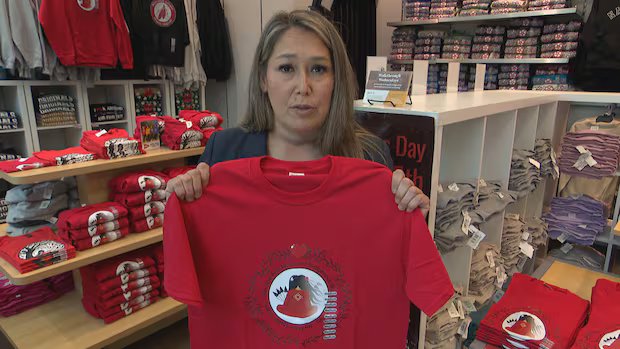
A Winnipeg-based Indigenous clothing company is accusing fast-fashion brand Shein of stealing dozens of its designs.
“We’re all really upset about it. A lot of anger’s coming from it,” said Michelle Cameron, the owner and founder of Indigenous Nations Apparel Company, or INAC.
“I was really shocked. And then it turned to anger and disgust.”
Last Friday, customers of her Polo Park shopping centre store alerted her to what appear to be copies of her products being sold on the website of Shein, a global e-commerce company that specializes in fast fashion.
In all, Cameron said 20 INAC designs are being sold on the site without permission.
“It’s even our staff members that they’re using [in] their photos. The one picture has my daughter in it. It’s absurd,” she said.
When Cameron reached out to Shein, she got an emailed response with a link to where she could file a complaint. She’s now seeking legal advice.
Many of INAC’s designs comment on the mistreatment Indigenous people have faced, including stolen land, and those designs themselves are now being stolen, Cameron said.

“There’s even a design on there that has our company name on it,” Cameron said, featuring a chief’s head and reading “established 2021,” the year INAC was established. “So, they even took that.”
The one that hurts the most is a shirt designed for Red Dress Day, the national day of awareness for missing and murdered Indigenous women, girls and two-spirit people, Cameron said.
“So much thought [went] into it, and it means something to each and every one of us because we all have Indigenous family members that are missing or murdered,” she said.

The image of that design on Shein’s website is the one featuring Cameron’s daughter.
Shein said in an emailed statement to CBC News late Tuesday afternoon that it “immediately removed the listings from our platform and launched an investigation” after learning the items were being offered by third-party sellers on Shein Marketplace.
Shein said sellers are required to certify their products do not infringe on intellectual property.
“We take all claims of infringement seriously and act swiftly when valid complaints are raised by IP rights holders,” Shein said in the email.
“We continue to invest in and strengthen our processes to ensure partners adhere to our strict policies.”
Cameron has heard from many people urging her to trademark the designs to protect them, but to do that for each one would be costly, she said.
“In the apparel world, all [someone has] to do is change a logo by 10 per cent and it is no longer your logo. So, for us to make that financial investment [to trademark everything] doesn’t always make sense,” she said.
But each design involves a lot of work by INAC, Cameron said.
“We usually plan out our designs a year in advance. All of us Indigenous staff, we all gather together and talk about what designs we want to come up with … and what does it mean to us as Indigenous people,” she said.
“All the designs that go into our store, there’s an Indigenous artist attached to it [and] a royalty that goes back [to them].”

Winnipeg’s Indigenous Nations Apparel Company, or INAC, says it’s seeking legal advice after it found copies of some of its designs being sold on the fast-fashion website Shein.
A company that takes that design without permission is “actually just taking away from all the effort we put in, and all the heart,” Cameron said.
“There was a time that we [Indigenous people] didn’t own businesses. Now we’re taking our place in the business world, and it’s really sad to see a company … trying to profit from it [with] no credit to the designers and everything we do.”
‘A battle you can’t win’
Jackie Traverse, a Winnipeg-based multidisciplinary Anishinaabe artist from Lake St. Martin First Nation, has also had her designs taken and used on other products.
“This has been going on with me for about 16 years,” she said.
In recent years, some of Traverse’s images have shown up emblazoned on Orange Shirt Day T-shirts sold on social media and e-commerce websites.
“There’s pretty much nothing you can do about it. And with the rise of AI, good luck,” she said. “It’s just going to keep happening.”
Anyone can ask AI to create an image in someone else’s style, or mixed with other styles, Traverse said, noting she has witnessed her creations used that way.
“You can’t even watermark [photographs of] your work to protect it,” she said. “It’s a battle you can’t win.”

She’s proud of her work and creates it to be seen — but if it becomes too popular, “it means it’s going to get stolen,” Traverse said.
“But you can’t not share your work. That defeats the purpose of creating art. So, I’m just going to do what I can with my work.”
Traverse said in her case, it seems to be primarily companies based in China that are pilfering the work.
“I’ve given up. I don’t even complain about it no more, because what’s the point? I don’t even have any advice for anybody. I just say good luck.”
INAC’s Cameron said years ago, it would have been difficult, if not impossible, to find a store in a mainstream mall that catered to Indigenous culture.
“[We] put everything that we had, all of our heart, into building a store for our people,” she said.
Now, products that once would only be found at a powwow or Indigenous conference are trending, and bigger retailers are trying to get a piece of the pie, Cameron said.
“If you truly want to have that product on your website, contact the artist first. Contact the company, maybe come up with a partnership or an agreement or a royalty or something, or … even just asking permission.”
For those stealing designs, “I want to tell them that it is disgusting, what you’re doing,” Cameron said. “I think you need to do better.”