dailynewsnblog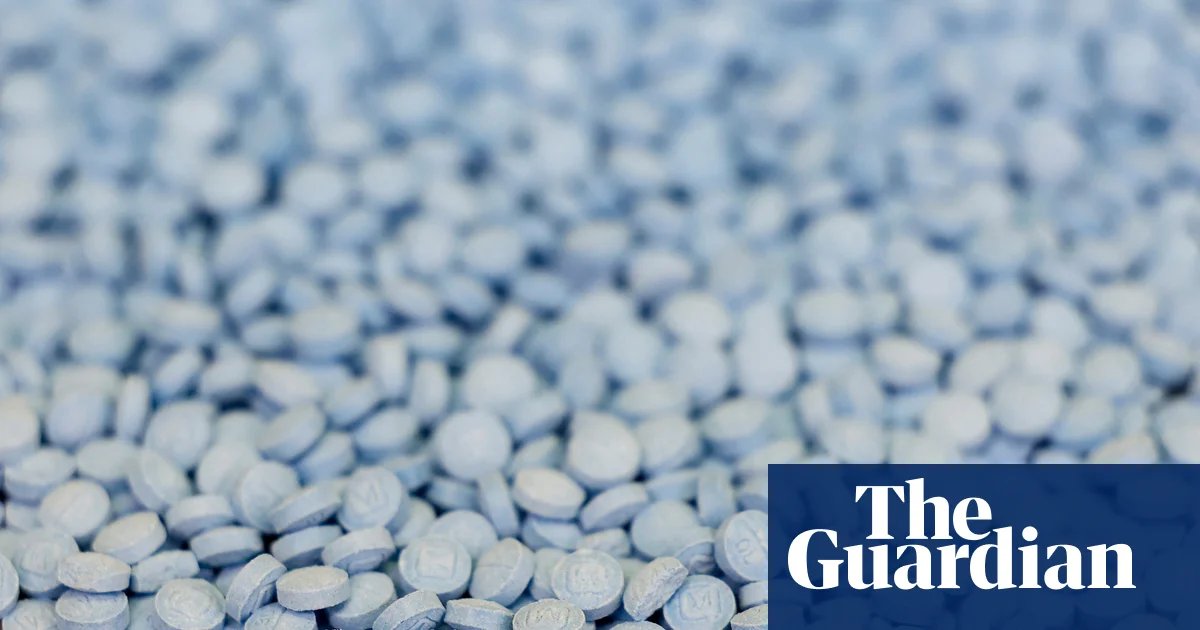
As Donald Trump travels to Beijing this week, fentanyl – and China’s role in its supply chain – remains an enduring point of acrimony in bilateral relations.
At a UN meeting in March, the US again accused China of failing to stop its chemical industry selling the precursors required to make the potent synthetic opioid, while China suggested the US was shifting the blame for its domestic drug problem.
Yet there are growing signs that the US fentanyl crisis has turned a corner – and some experts believe that interventions made in China have played a key role.
“There was a supply shock: the purity of fentanyl fell,” said Keith Humphreys, a professor at Stanford University. “The question is why was there a supply shock. And most indicators point to China.”
On returning to the White House, Trump made fentanyl a foreign policy priority and quickly designated the criminal groups trafficking it as foreign terrorist organisations while slapping tariffs on countries involved in its supply chain – including China, the main source of fentanyl precursors, many of which are basic chemicals with legitimate uses.
But by the summer of 2023 – during the Biden administration – overdose deaths at the national level had already begun to fall. By November 2025, they were down by more than a third.
Investigators are still trying to unpick the factors behind the fall, but one theory put forward by Humphreys and his co-authors in a recent study published by Science links it to interventions in China that may have caused a long-lasting disruption to the fentanyl supply chain.
The authors point to a dramatic fall in the purity of fentanyl being seized by US law enforcement from May 2023 to the end of 2024 – the latest data publicly available – which correlates with the fall in overdose deaths.
There was a similar fall in purity in Canada, which is a distinct fentanyl market, suggesting the cause might originate where they both source their precursors: China.
The idea that the flow of precursors was disrupted is supported by reports from 2024 of cartel cooks struggling to source them, while new and strange adulterants appeared in the fentanyl on US streets, suggesting those cooks might have been experimenting with alternative synthesis pathways.
But there are big caveats. For one, it is difficult to pinpoint which of China’s self-reported interventions might be responsible. And then it’s also unclear that the fall in purity is what actually caused the fall in overdose deaths.
Nonetheless, Liu Pengyu, the spokesperson at the Chinese embassy in Washington, said in a statement that China was glad to see fentanyl overdose deaths had decreased and noted that the US government’s 2025 National Drug Threat Assessment “implies that Chinese government efforts have made [a] contribution to addressing the fentanyl problem in the US”.
Henrietta Levin, who was director for China on Biden’s National Security Council, said her former colleagues saw the Science paper as showing that their pressure on China had worked. “I think China could have done more,” said Levin. “But what they did do mattered.”
Further supply side interventions are likely to be on the agenda at this week’s summit.
Ideally, said Levin, these would include China changing laws to make it easier to prosecute drug trafficking, and more action from its commerce ministry to really control the behaviour of chemical companies.
“A lot of this comes down to enforcement,” said Levin. “China announced export controls [on various fentanyl precursors], and that’s important. But Chinese chemical companies are gauging how serious the government is about actually enforcing those restrictions.”
Yet history shows that, so long as the demand is there, supply shocks are always temporary – and can have unpredictable effects, even making things worse.
Indeed, it was only after China put a blanket ban on fentanyl in 2019 that the supply chain evolved to loop Mexico’s cartels in, who began to import precursors from China and then traffic the finished product over the US-Mexico border, almost entirely replacing their previous trade in heroin.
“There’s a kind of myopia here,” said Nabarun Dasgupta, director of the University of North Carolina’s opioid data lab. “That time, the geopolitics of it backfired.”
Additional research by Yu-Chen Li