dailynewsnblog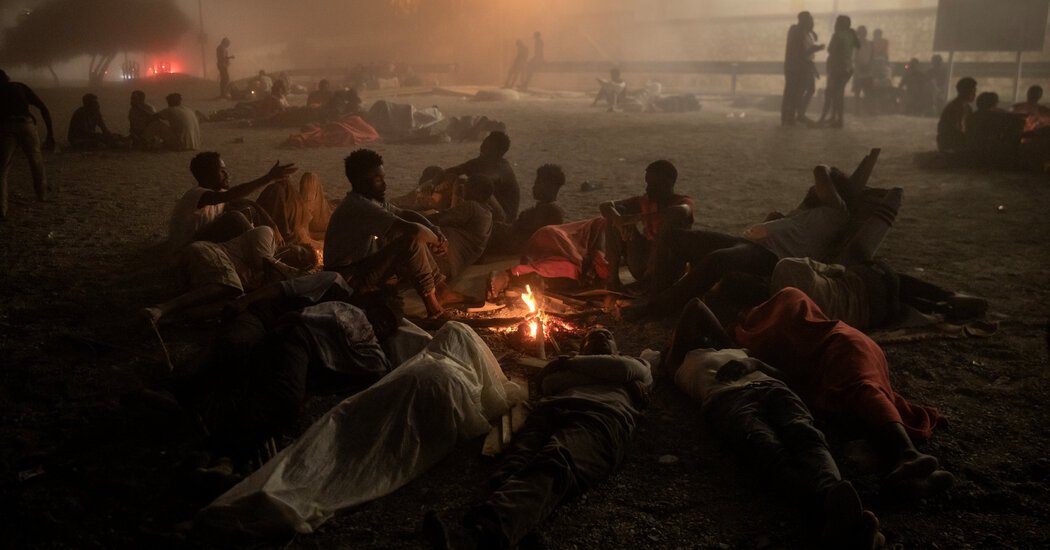
In its chaos, desperation and sheer scale, the sudden surge this week of tens of thousands of migrants into a Spanish territory in North Africa recalled similar scenes 11 years ago along the coasts of Greece and Italy.
It was that 2015 crisis — when more than a million people, mostly from the Middle East, swept into southern Europe — that deepened opposition to immigration across Europe and emboldened the far right.
Now as then, far-right leaders have tried to exploit scenes of border chaos on the doorstep of Europe. In Britain, France and Italy, anti-immigrant politicians warned that the latest crisis was stark proof of the dangers of Spain’s immigration policies, which are more liberal than those of many of its European neighbors.
The difference is that these far-right parties, largely marginal in 2015, are now either in power or have a plausible path to it. And Europe’s centrist leaders, desperate to avoid a political backlash, have adopted some of their hard-line policies and language on immigration, abandoning the more welcoming approach of 2015. In little more than a decade, the far right has largely reshaped the immigration narrative.
“If centrist leaders give the impression that they are being outflanked on these issues, they will lose the narrative completely,” said François Gemenne, an expert on migration and climate issues at HEC Paris, a business school. “That’s why they feel obliged to show themselves as very tough on issues like border control.”
Centrist leaders from Denmark to France quickly condemned the influx to Ceuta, the Spanish territory whose borders were overwhelmed on Thursday. They vowed to fortify their own frontiers to block the migrants, even though most of the new arrivals had turned around and crossed back into Morocco within hours.
Prime Minister Mette Frederiksen of Denmark, a social democrat who has enacted one of Europe’s strictest asylum policies, called on her fellow leaders to consider suspending Spain from the Schengen area, which allows free movement between 29 countries in Europe.
There was little to differentiate her reaction from that of Prime Minister Giorgia Meloni of Italy, a right-wing leader who came to power promising to curb immigration. Ms. Meloni said the images from Ceuta were “striking and demonstrate, once again, that uncontrolled illegal immigration poses a concrete threat.” Italy, she added on social media, “will not stand by and watch.”
Chancellor Friedrich Merz of Germany demanded that Morocco “take back illegal migrants immediately.” It was a long way from Angela Merkel, Germany’s last center-right chancellor. She famously said, “wir schaffen das” — “we can do this” — when confronted with a wave of refugees from war-torn Syria in 2015, many of whom are now European citizens, integrated into European society.
These responses attest to the general hardening of Europe’s immigration policies, a trend that has made Spain’s current left-wing government an outlier. Countries like Sweden, once viewed as generous in creating routes to citizenship, have passed stricter rules on granting asylum and legal residency. More aggressive measures at sea have seen maritime migration levels plummet since 2015.
Analysts said the tough tone from leaders this week reflected a recognition that, even if Europe is far from seeing a repeat of the 2015 crisis, public opinion can still be easily swayed by dramatic images — whether of rickety boats landing on English beaches or young men scaling chain-link fences to enter Spanish territory.
“It’s the visible lack of control that’s the problem,” said Sunder Katwala, the director of British Future, a London institute that focuses on integration and identity. “That will resonate with the core audience of the populist parties.”
Mr. Katwala noted that the number of migrants smuggled across the English Channel in small boats was down sharply so far this year. France and Britain announced a “one-in, one-out” agreement last year under which the British government can send back some migrants who cross the channel illegally. Yet Reform U.K., Britain’s main anti-immigrant party, has led polls for most of the year.
Across Europe, far-right parties continue to flourish, even though it has become harder for migrants to reach the continent by any route. Net migration statistics — the number of people arriving minus those leaving — dropped in 2025 in Britain, Germany and Spain from the previous year, according to Eurostat, the statistical service of the European Commission. They rose modestly in France and Italy.
“Visible things get seen and reported,” Mr. Katwala said, referring to the chaos in Ceuta. “Invisible things do not.”
Spain’s prime minister, Pedro Sánchez, is among the few centrist or left-leaning leaders to try to maintain a publicly welcoming stance on immigration, allowing more than a million illegal immigrants to apply earlier this year for formal status.
Accused of encouraging the Ceuta crisis with such policies, Mr. Sánchez countered that it was possible to welcome immigrants while keeping control of the border. He asserted that from 2021 to 2025, more people entered the European Union illegally through Italy, the Western Balkans and Greece than through Spain. And he noted that most of the people who crossed into Ceuta on Thursday had left by Saturday.
“This has been achieved in close coordination with the Moroccan authorities and with very little support from other European states, while pursuing the effective and solidarity-based migration policy that Spain has consistently implemented over recent years,” he wrote in an open letter to European leaders that was published on Saturday.
Memories of 2015 are still vivid in Europe, which was reshaped politically by the influx from Syria, Afghanistan and other countries. The following year, Britain, fueled by anti-immigrant sentiment, voted to leave the European Union, even though it was not heavily affected by that wave of migration.
In Germany, the far-right party Alternative for Germany made major inroads in a federal election in 2017 by exploiting fears of uncontrolled immigration, and could win state elections for the first time this fall in eastern Germany.
In France, Marine Le Pen, the candidate of the anti-immigrant National Rally party, rode the issue into the second round of the 2017 presidential election. Ms. Le Pen, who is running for president a fourth time, signaled she was planning to turn the Spanish crisis into a campaign theme.
“Faced with the massive and coordinated influx of migrants into Spain, encouraged by the Spanish government, France must without delay strengthen controls at its borders,” she said on social media.
Her deputy, Jordan Bardella, laid out the line of attack that right-wing opponents of Mr. Sánchez will likely use against him.
“By regularizing hundreds of thousands of undocumented immigrants, Spain’s socialist Prime Minister Pedro Sánchez has opened the doors of Europe to all dangers,” Mr. Bardella said on social media.
In Britain, Nigel Farage, the leader of Reform U.K., warned that the migrants entering Ceuta would make their way toward the French northern coast, and onward to Britain, by crossing the English Channel.
“Believe me, unless we get a Reform government, those scenes you’re seeing in Spain today, many of those young men, lots of them dangerous, will be heading toward Calais and coming to our country, too,” Mr. Farage said in a video posted on YouTube, referring to a French port.
Mr. Farage’s relentless focus on immigration even played a role in the failure of Britain’s centrist former prime minister, Keir Starmer. He resigned last month after becoming deeply unpopular, partly because he failed to convince Britons that he was doing enough to fix problems like the illegal channel crossings.
Mr. Starmer hardened his rhetoric about immigration during his two years in office, even warning once that Britain risked becoming an “island of strangers.” But although he oversaw a drop in immigration, he was never able to take credit for the reduction in arrivals.
Giulia Imbert contributed reporting.