dailynewsnblog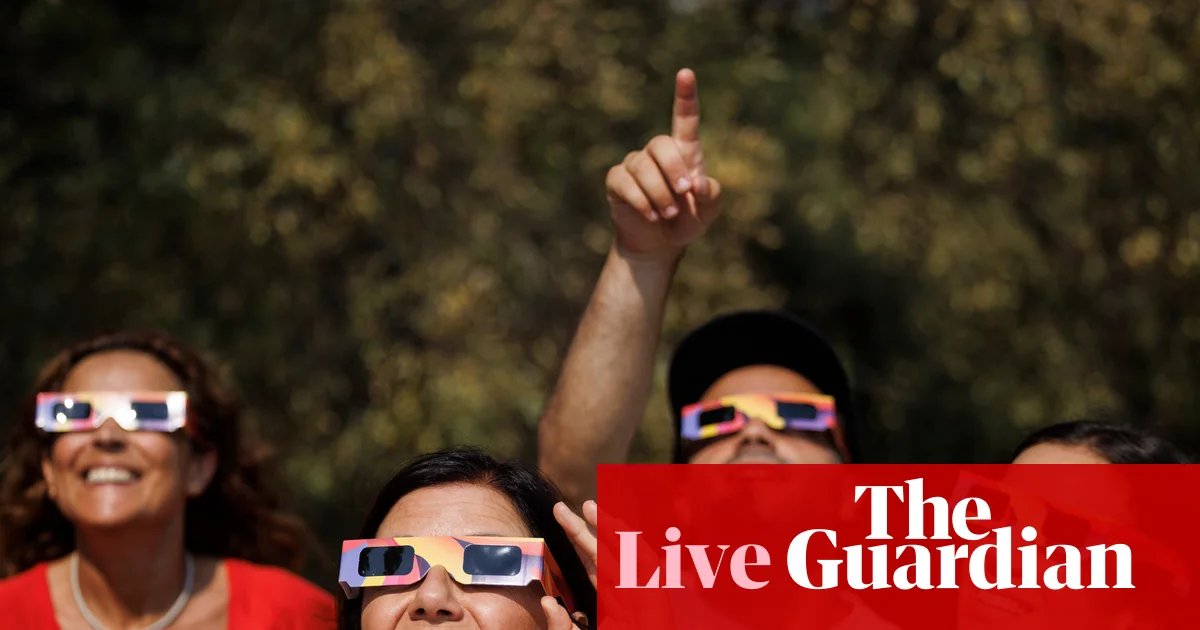
Welcome to the greatest show off earth

Jakub Krupa
Got your eclipse glasses at the ready?

Do not fret if not. Not everyone is prepared like this guy.

We’ve got you covered.
Welcome to the live coverage of today’s total eclipse, which will be seen in parts of Europe, including Iceland, the UK, and Spain.
Over the coming hours, we’ll bring you:
Tips on how to view the phenomenon safely
First-hand reports from places where crowds are gathering
A quick look at the science behind the shadow
The best pictures and videos from key viewing spots
And yes, there will be a live stream, too.
It’s Wednesday, 12 August 2026, it’s Jakub Krupa here, and this is Europe Live.
Good afternoon.
Key events
And our main video feed is now showing pictures from Stavanger in Norway…
Crews responding to a wildfire in Cape Cornwall with fears it could obstruct the view of the eclipse
Steven Morris
in Sennen Cove, Cornwall
There’s a pall of smoke over Cape Cornwall that might obscure the view of the eclipse for some.
The smoke is coming from a wildfire near Land’s End airport.
Cornwall fire and rescue service said: “Crews are responding to a wildfire in the area of Crows-An-Wra, St Buryan.”
Cornwall council added: “There is a lot of smoke in the area. Please avoid the area and keep windows and doors closed if you live nearby.”
The eclipse will also start in the UK soon, but “peak solar obscuration time” – also known as “most of the sun will be covered” – is still just over an hour away from now in the first 15 mins after 7pm, depending on where you are.
First signs of solar eclipse in Iceland
We are starting to see first signs of the solar eclipse in Iceland, thanks to the Icelandic public broadcaster RÚV.
Just under an hour until the full eclipse there in Látrabjarg.
And it will be the longest eclipse anywhere in Icelandic mainland, lasting two minutes and 13 seconds.
You can watch RÚV’s live stream on YouTube here.
Solar eclipse in Europe 2026 – live video
Our live feed for the evening is now up, with various best shots from around the world.
It’s here:

Stephen Burgen
in Spain
Tonight the old observatory in the Ebro estuary will celebrate its second total eclipse.
Built in 1904 in readiness for the eclipse a year later it is also perfectly positioned to get an almost 100 per cent view of this one.
Created as part of network of observatories established by the Society of Jesus, better known as the Jesuits, the Ebro observatory is now a research centre thanks to the data it has accumulated over the past 120 years.
“As we’ve been here so long, we have some of the longest series of data in existence which allows us to carry out long-term studies,” Juan José Curto, head of science at the observatory.
“The Jesuits exchanged information with other observatories which has allowed us to build a fantastic library.”
Present in the observatory tonight are: Nobel physicist Didier Queloz, the astronaut Pedro Duque and NASA scientists Ellen Baker and Teresa Nieves-Chinchilla
Steven Morris
in Land’s End, Cornwall
Eclipse watchers are not just heading to the Cornish cliffs to watch the phenomenon. Many people were opting for vantage points on inland hilltops, moors and standing stones.
Carolyn Kennett, a Cornish expert in archaeoastronomy, said eclipses would almost certainly have been unexpected for ancient people and could have inspired awe, wonder, and perhaps, terror.
She said:
“Knowledge of significant eclipses may have been passed down through generations, becoming part of oral histories, traditions, and mythology. An eclipse is a powerful spectacle, and for people without a modern scientific explanation, such an event would likely have carried profound meaning. It is possible that witnessing an eclipse influenced the beliefs, stories, rituals, or even choices of those who experienced one.”
The Rev Karsten Wedgewood, priest in charge of St Just-in-Penwith, up the road from Land’s End, was planning a picnic at a prehistoric funerary cairn, and, perhaps, a prayer based on psalm 8, known as the psalm for stargazers:
“When I consider your heavens/the work of your fingers,/the moon and the stars…”
Parachute display and live music parties as Cornwall prepares for eclipse show
Steven Morris
in Land’s End, Cornwall
Across Cornwall, towns, villages and pubs are staging eclipse events.
In the harbour port of Falmouth, they clearly didn’t think the astronomical phenomenon was enough and an air display has been arranged, including a Royal Navy parachute display team and a formation wing-walking team. One of the hotels is hosting an evening of sea shanties.
Other cafes, pubs and attractions are running eclipse parties, some with live music and with certified eclipse glasses provided. Radio stations are blaring out The Whole of the Moon by the Waterboys and Van Morrison’s Moondance.
Members of Kernow Astronomers are posting themselves at the National Trust’s site Carnewas at Bedruthan, near Padstow, with telescopes fitted with filters to enable visitors to observe the solar eclipse safely.
What happens to your eyes when you look at the eclipse?

Rachel Hall
So, what happens to your eyes when you look at the eclipse, and is it different to looking at the sun?
It is not medically more dangerous to look at the solar eclipse than the sun under normal conditions, but the risk is greater because it’s easier to look at the sun when it’s mostly obscured.
“Under normal conditions the eye’s protective responses do the work: painful glare, reflex aversion within a second or so, blepharospasm, tearing, and a constricted pupil. Almost nobody can hold fixation on the full disc long enough to reach the photochemical damage threshold,” said Panayiotis Maghsoudlou, a clinical lecturer in ophthalmology at the University of Bristol.
“During an eclipse the sky darkens, your pupils widen, and the glare drops enough that staring feels comfortable, so people gaze at the exposed sliver of sun for minutes with a wide-open pupil and no warning discomfort. That’s why eye injuries cluster around eclipses even though the sun itself is unchanged.”
You also may not immediately realise the damage.
“The retina does not contain pain receptors. Symptoms generally appear later, as blurred or reduced central vision, a blind spot, distortion of straight lines and altered colour perception,” he said.
He added that although many patients improve over weeks to months, recovery is not guaranteed, and some people are left with permanent damage and a lasting blind spot.
After the 1999 eclipse, there were 70 reported cases of visual loss, half of which were reported within two days of the eclipse.
Moorfields Eye Hospital received 1,600 calls to its eclipse helpline and saw 220 people in its emergency department, while Birmingham Eye Hospital received around 300 calls and saw 64 people at its special eclipse clinics.
How to safely watch the solar eclipse – video
The European Space Agency has warned that “looking directly at the Sun without proper protection can cause serious eye damage,” as it stressed that “regular sunglasses are not safe for observing a solar eclipse.”
In case it wasn’t obvious, do not look directly at the sun either.
Here are our best tips and tricks for you:
What are your plans for tonight? Let us know!
Jakub Krupa
How are you preparing for the eclipse? Any special plans?
Let me know at jakub.krupa@theguardian.com
Anticipation builds as people wait for solar eclipse – in pictures
Lava spews as Mount Etna puts spectacular display and disrupt flights
Lorenzo Tondo
in Palermo, Sicily
For several days, Mount Etna, one of the world’s most active volcanoes, has been putting on a spectacular display, spewing incandescent magma, sending long streams of lava down its slopes and showering the surrounding area with ash.
Explosive activity has been recorded on Etna’s north-eastern flank, where new fractures have opened, while the Voragine crater has continued to produce towering plumes of ash reaching heights of about 4,500 metres.
The latest eruptive phase on Europe’s highest active volcano was continuing from vents at altitudes of 2,750 metres (9,022ft) and 2,360 metres, feeding several lava flows and creating extensive lava fields, according to Italy’s National Institute of Geophysics and Volcanology (INGV).
INGV’s Volcano Observatory Notice for Aviation (VONA) remained at red, its highest alert level, indicating an ongoing risk to aircraft from ash emissions.
The volcanic ash has caused widespread disruption at Catania airport, forcing the cancellation of numerous flights. On Tuesday, the ash cloud drifted as far as Malta, about 220km (140 miles) south of Etna, forcing airlines to cancel flights to the Mediterranean island at the height of the tourist season.
At the same time, the eruptions have drawn thousands of tourists to Etna, fascinated by the spectacle of fire and glowing lava illuminating the volcano after dark.
In recent years, experts have observed that Etna has been spewing so-called “primitive magma”, a term used to describe magma whose composition has changed relatively little from that of the Earth’s mantle where it formed. Rising from deeper within the volcano, this magma carries a greater concentration of gas and is therefore capable of producing the spectacularly high lava fountains that have become a feature of Etna’s recent eruptions.
Jakub Krupa
While tonight’s eclipse will the “the greatest show off earth,” as the Guardian called it the last time it happened in 1999, it’s not the only show around.
Let’s go to Lorenzo Tondo for more.
You can check the expected eclipse timings at your location using special websites offered by various European metereological services, like this one.
In Iceland, the show will begin earlier than elsewhere: around 4.45pm local time (5.45pm UK time), and end just before 7pm (8pm).
At the Guardian HQ in London, the partial eclipse will begin at 6.17pm, reach its maximum stage at 7.13pm, and end at 8.06pm.
And Spain will be again a bit later than the UK.