dailynewsnblog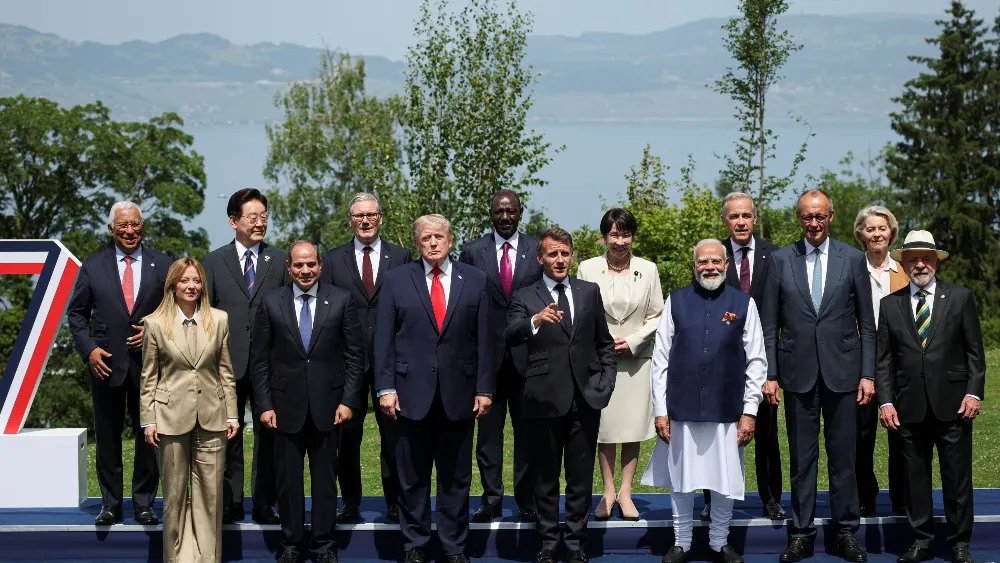
The European Union is considering tearing out a page from the United States’ playbook when it comes to dealing with China’s export dominance and the growing trade deficit experienced by its 27 member states.
At an EU meeting in Brussels on Thursday, the trade bloc’s leaders reportedly discussed the economic threat posed by a deluge of China-made goods; in 2025, the EU’s trade deficit with China reached a whopping 360 billion euros ($413 billion). They were expected to debate the merits of taking action against China and develop a plan before asking the European Commission to engage the country.
“Our trading relationship with China has reached a point that requires a reset. Not confrontation, but rebalancing,” EU trade chief Maros Sefcovic said following a meeting of EU foreign ministers earlier in the week. “The status quo is not sustainable—not economically or politically.”
That rebalancing may be prompted by a well-worn U.S. tactic: tariffs. In recent months, several leaders, including French President Emmanuel Macron, have advocated on behalf of a “European equivalent of Section 301,” the trade provision President Donald Trump is now using to justify new duties of up to 12.5 percent on dozens of U.S. trade partners.
Additionally, the EU could impose sector-specific tariffs on metals, chemicals, automobiles and green energy products—a move the U.S. has made with its global duties on steel and aluminum—or anti-dumping and anti-subsidy duties, which can be applied to companies that are found to export goods at artificially lowered prices or receive unfair subsidies from their government. The EU has already taken such measures against 172 entities, the majority of them China-based.
The bloc is also reportedly weighing deploying its so-called “trade bazooka,” or Anti-Coercion Instrument, a retaliatory trade tool developed in 2023 that allows Europe to levy stiff economic sanctions, like tariffs and export controls, against trading partners that engage in unfair or undermining trade practices—though that extreme option is considered unlikely.
According to a report from the Financial Times on Wednesday, Germany, Poland, Belgium and the Netherlands have thrown their weight behind a proposal from France which would allow the bloc to impose duties on China—and quickly.
The issue was also a prime topic of discussion at the G7 summit in Évian-les-Bains, France, earlier this week. Following the congregation of world leaders including Macron, German Chancellor Friedrich Merz, Italian Prime Minister Giorgia Meloni, U.K. Prime Minister Keir Starmer, Canadian Prime Minister Mark Carney, Japanese Prime Minister Sanae Takaichi and President Donald Trump, a joint statement was released highlighting the importance of addressing trade disparities.
“We note with concern that global imbalances have been persistent and have widened in recent years, creating risks for our shared objective of balanced global growth and financial stability,” they wrote, stopping short of naming China outright. They added that they were committed to achieving “balanced and durable growth that supports our economic security and resilience.”
“We reaffirm our shared concerns regarding non-market policies and practices (NMPPs) and their adverse impacts, including persistent market distortions, global structural excess capacity and resulting imbalances, harmful spillovers in global, regional and domestic markets and growing economic dependencies,” the statement said.
In recent months, European leaders have been evincing growing concern about the issue, with Macron among the most outspoken.
The French leader has fingered America’s tariff regime for rejiggering the sourcing map. During 2025, U.S. tariffs on China hovered at 47 percent, leading to what Macron described as a disruptive shift in China’s export model. Faced with a downturn in U.S. orders, China “massively” rerouted shipments of goods to the European market, creating issues for its industrial base—“literally killing a large part of European industry,” he said earlier this year.
Germany, which represents the EU’s biggest economy and export market, has waffled over hitting China with sanctions or duties, worried about retaliatory measures. But in recent months, it’s taken a harder-line stance, with Merz in February pointing out to Chinese President Xi Jinping the glaring trade imbalance between the countries that has persisted for two years, amounting to 90 billion euros ($103.1 billion) in 2025. “We want to reduce these imbalances, which have arisen primarily from overcapacity in China,” he said at the time.