dailynewsnblog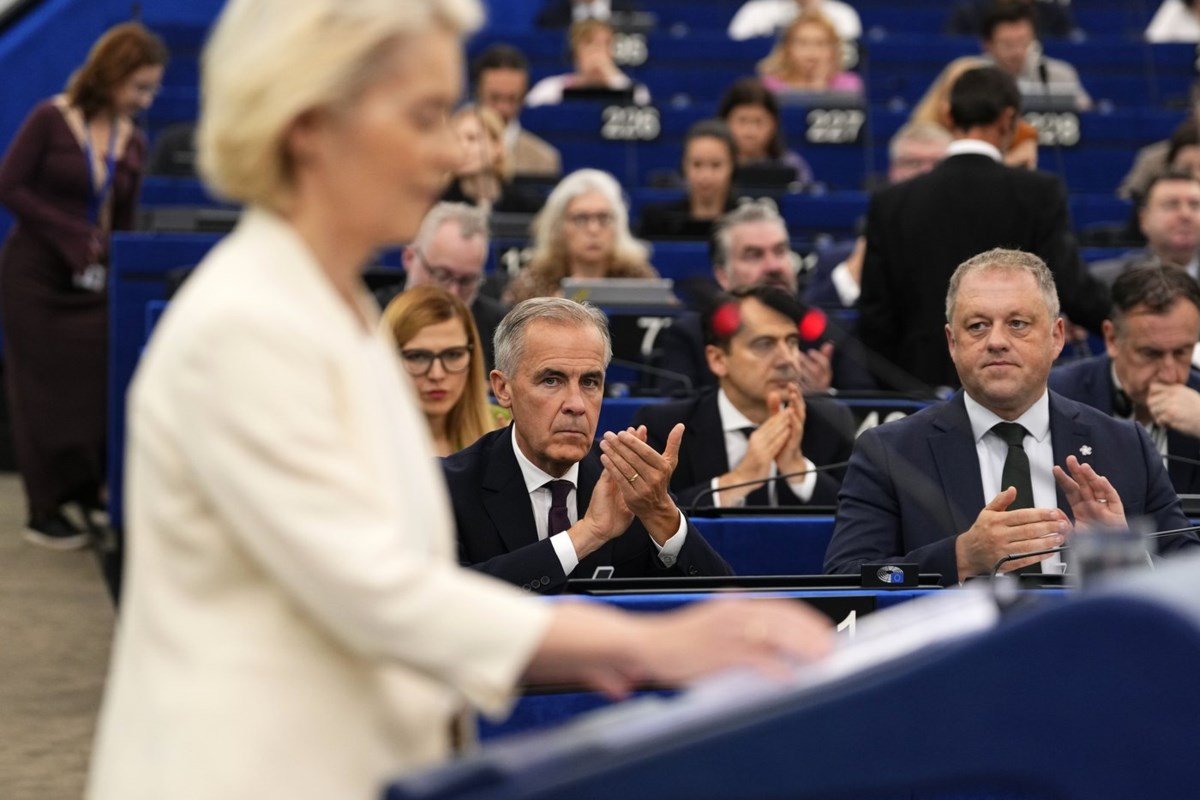

STRASBOURG, FRANCE — European Commission President Ursula von der Leyen said Wednesday she wants Canada to become the first “associate member” of the European Union, though Canadian officials downplayed the significance of the term.
STRASBOURG, FRANCE — European Commission President Ursula von der Leyen said Wednesday she wants Canada to become the first “associate member” of the European Union, though Canadian officials downplayed the significance of the term.
Prime Minister Mark Carney listened in the front row as von der Leyen laid out key pillars for stronger co-operation between Europe and Canada in her state of the union address to the European Parliament in Strasbourg, France.
She said the two sides must “urgently reimagine” their partnership and move beyond a free-trade agreement to bring the relationship to the “highest level possible.”
“I would like to work with you on opening the door for Canada to be the first associate member of the EU,” von der Leyen said, drawing a standing ovation from most members in the chamber.
Carney nodded, rose from his seat, approached von der Leyen and embraced her. He briefly waved to the chamber before returning to his seat.
Carney is set to deliver an address to the European Parliament on Thursday, at the invitation of European Parliament President Roberta Metsola.
“We share one ocean, one set of values, one way of seeing the world,” von der Leyen said. “And we will now build our shared future as well.”
Carney is in France this week to secure a stronger alliance with Europe focused primarily on trade, defence and people-to-people ties — the latest move in his effort to reduce Canada’s reliance on the United States.
But Jonathan Wilkinson, Canada’s incoming ambassador to the European Union, suggested the term “associate membership” isn’t yet firm.
Speaking to reporters after von der Leyen’s speech, Wilkinson said the two sides have been talking about how to define an enhanced partnership but they’re still “a ways away” from finding the term to describe it.
“What we’re focused on is actually driving results in the specific sectors that we’re actually focused on. Eventually we will get to the issue of what’s the best way to describe it,” Wilkinson said in Strasbourg.
“You’ve heard Prime Minister Carney describe it as an ‘alliance of the future,’ you heard that from President von der Leyen. You’ve heard her also mention the idea of associate membership. We’re not there. It’s an opportunity for us to talk about that, but we’re really much more focused on getting concrete results.”
Wilkinson said details of the partnership are expected to be announced at the Canada-EU Summit in Montreal this October. He sidestepped questions about whether he knew in advance von der Leyen was going to invite Canada to be an associate member in her address.
He said Canada is not looking to become a full member of the European Union “because that is a sovereignty issue,” but instead is looking at ways to get as close as possible with European partners without sacrificing self-determination.
“We certainly had conversations about that beforehand,” Wilkinson said. “We knew that was going to be on the table. We talked to them about ‘alliance for the future,’ which she used.”
The Wall Street Journal, citing sources, first reported last week that Canada was exploring membership in the EU, but Carney threw cold water on that report.
Speaking to reporters during the Toronto International Film Festival, he said Canada was not looking to become a member of the European Union but rather was seeking a “unique alliance” with the economic bloc.
Carney received a red-carpet reception earlier Wednesday at the European Parliament building, where he was greeted by Metsola and von der Leyen.
There was applause as he entered the chamber and he received a standing ovation from many parliamentarians after Metsola formally introduced him.
“Mark, your presence here is a symbol of the enduring friendship between our people,” von der Leyen said in her address, which lasted more than one hour. “Our cultural, historical and personal links run deep within the fabric of our societies.
“We see the world with the same eyes, from AI to climate change, from the Arctic to geopolitics. And we have stood together on Ukraine, on defence, on raw materials and on supply chains.”
In her speech, von der Leyen said Europe and Canada would move from a free-trade agreement to “an alliance for the future,” while deepening co-operation on the Arctic, energy, critical minerals, and batteries.
In a statement, the Prime Minister’s Office didn’t offer any clarity on associate member status but rather focused on von der Leyen’s other remarks about forming a partnership.
Carney was not made available to take questions from reporters Wednesday.
“We welcome President von der Leyen’s proposal that Canada and the European Union move beyond the (free trade agreement) to an alliance for the future,” a spokesperson from his office said.
“This is a unique, positive approach that we will define together.”
Carney stayed in the chamber for more than an hour after von der Leyen’s address, listening to speeches from other political party leaders.
Terry Reintke, leader of the Greens in the European Parliament — which has seven per cent of the seats — began her remarks by quipping that she hopes to see Carney in the chamber in the future.
“You’re very welcomed in this house. And I hope you’re already feeling comfortable among the member states sitting here because we hope to see you there very often,” Reintke said.
Ireland’s Minister of State for European Affairs Thomas Byrne sat beside Carney throughout the morning.
He began his speech reflecting on their ancestry, as their respective grandfathers came from the same county in Ireland.
“Your presence here today is a visible reflection of the deep bond shared by the European Union and Canada,” Byrne said.
“Thank you, President von der Leyen. Your proposal significantly advances the relationships between the European Union and our great friend, Canada.”
This report by The Canadian Press was first published Sept. 16, 2026.
Nick Murray, The Canadian Press