dailynewsnblog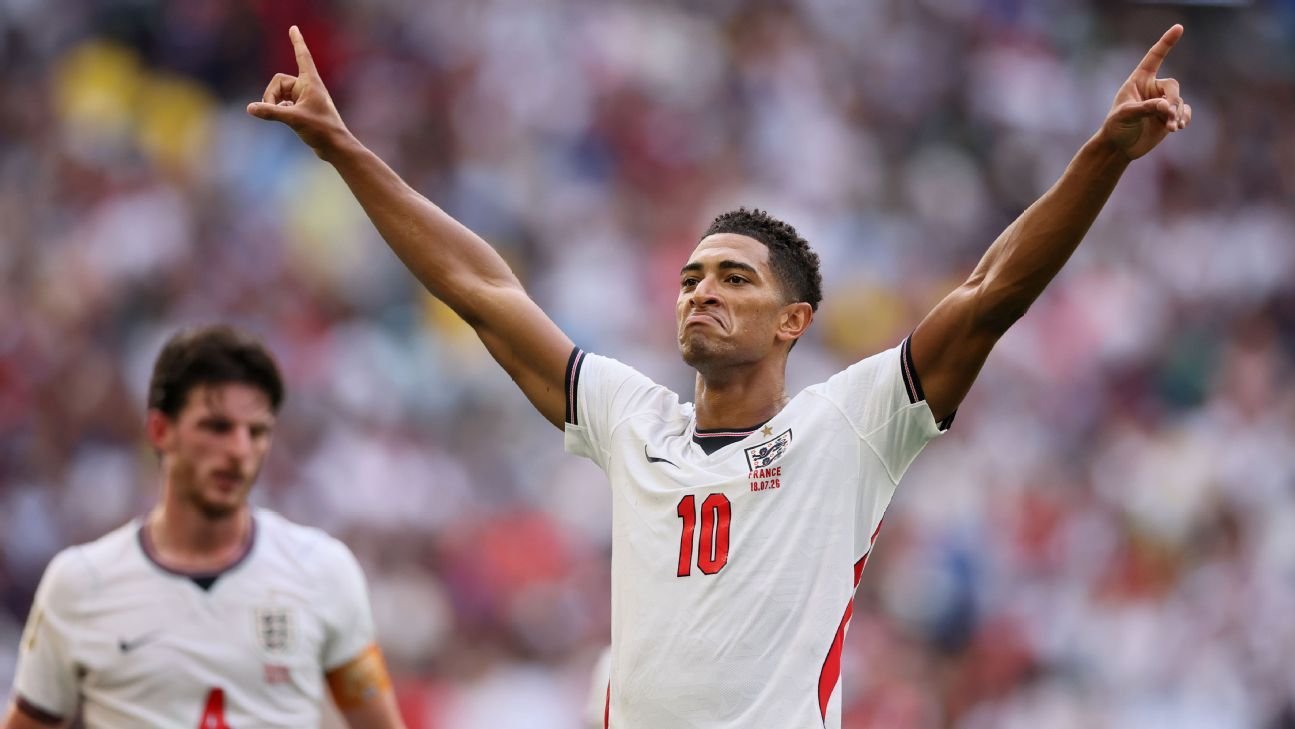
MIAMI GARDENS, Fla. — It began with boos and ended with bronze. What happened in between was one of the wildest matches in World Cup history. So much for nobody wanting to play in it.
In truth, France only appeared to be interested for the second 45 minutes, having been 4-0 down at the break in a farcically bad display that represented a complete abrogation of any responsibility to take this third-place playoff seriously.
They roused themselves sufficiently to expose England’s soft underbelly, in a similar vein as Argentina in the semifinals, as Kylian Mbappé led the charge and moved France to within one goal with 24 minutes left. But Bukayo Saka completed his hat trick before substitute Jude Bellingham scored a dazzling solo goal to seal the 6-4 win and England’s best men’s World Cup finish since 1966.
No coach can ever be entirely happy with a 6-4 scoreline — and you’d fancy France to win the second set had there been one — but Thomas Tuchel began Saturday evening having his name jeered as the teams were announced before the game, and he ended it as technically England’s most successful manager at a World Cup in 60 years.
This is a tangible achievement he can point to when arguing against the ferocious criticism that followed his decision-making in England’s semifinal defeat to Argentina.
“It is the first medal in 60 years, the best World Cup on foreign soil, so I hope the players can be proud of that in some time,” Tuchel said postmatch. “… The low and the drama about what happened against Argentina was too low, but listen, that is part of it. The best thing you can do is react on the pitch and get the next win. Everything else is just talking, and talking doesn’t get you points. You have to endure it, be strong and keep believing.
“I am glad that we showed the reaction. We wanted it, and it was very impressive.”
Of course, it came as a product of the curious competitive outlier that is the third-place game. Does it matter? Can anything meaningful be read into it? After all, it is a contest between two teams trying to hide their disappointment at being dumped.
Both teams made seven changes, but only England started with any sort of intensity. Yet once Didier Deschamps — in his final match after 14 years managing France — made a quartet of halftime substitutions to remind his players this was in fact a World Cup game, it was incredibly entertaining.
You attack, we attack. Nobody tackle, nobody defend. Play a high line and live with the consequences. It was PlayStation soccer on the easiest setting: keep running with the ball, beating players, getting a shot away. There were 38 shots, 19 each, 20 in total on target. Bellingham’s goal was worthy of winning almost any game, let alone one that felt like a tournament afterthought.
The wave was a giveaway. Refreshingly absent for much of this World Cup, it took just over 10 minutes to appear here. Shirts spotted in the crowd represented Norway, Spain, Colombia, Croatia, Mexico, Brazil and the United States. They interchanged chants of “Mbappé” and “Bellingham.”
The cynical view is that this is how good England can be when the pressure is off. Declan Rice scored after only three minutes before Ezri Konsa doubled their lead and Saka added two more.
France helped with their high line and dismal defending. But England attacked with a ruthlessness and vigor that only enhanced the feeling of what might have been had they retained their conviction for the whole game against Argentina.
And if we are to credit their first-half performance, we should criticize their showing in the second. England dropped deep, lost their physicality and threatened to blow a four-goal lead in the most ludicrous of situations.
But Bellingham’s 79th-minute introduction helped stem the tide. He played a raking pass out to the left where Djed Spence was brought down on the overlap to give Saka the chance to complete his hat trick from the penalty spot and put England 5-3 up.
After Ousmane Dembélé extended the basketball feel with a fine riposte, Bellingham went on the sort of jinking, driving run that singles him out as one of the best in the world.
The medal ceremony felt a little hollow. France left the field, and English FA chair Debbie Hewitt gave Harry Kane and most of the players a big hug as they received the bronze medal. They posed for a team photo, unsure whether to crouch or kneel for the assembled photographers. Nobody ever quite seems to know the protocol on a day like this.
Still, what entertainment it was. Nobody who was here will forget it. But nobody will want to be part of it again.