dailynewsnblog
Credit:
NASA/JPL-Caltech
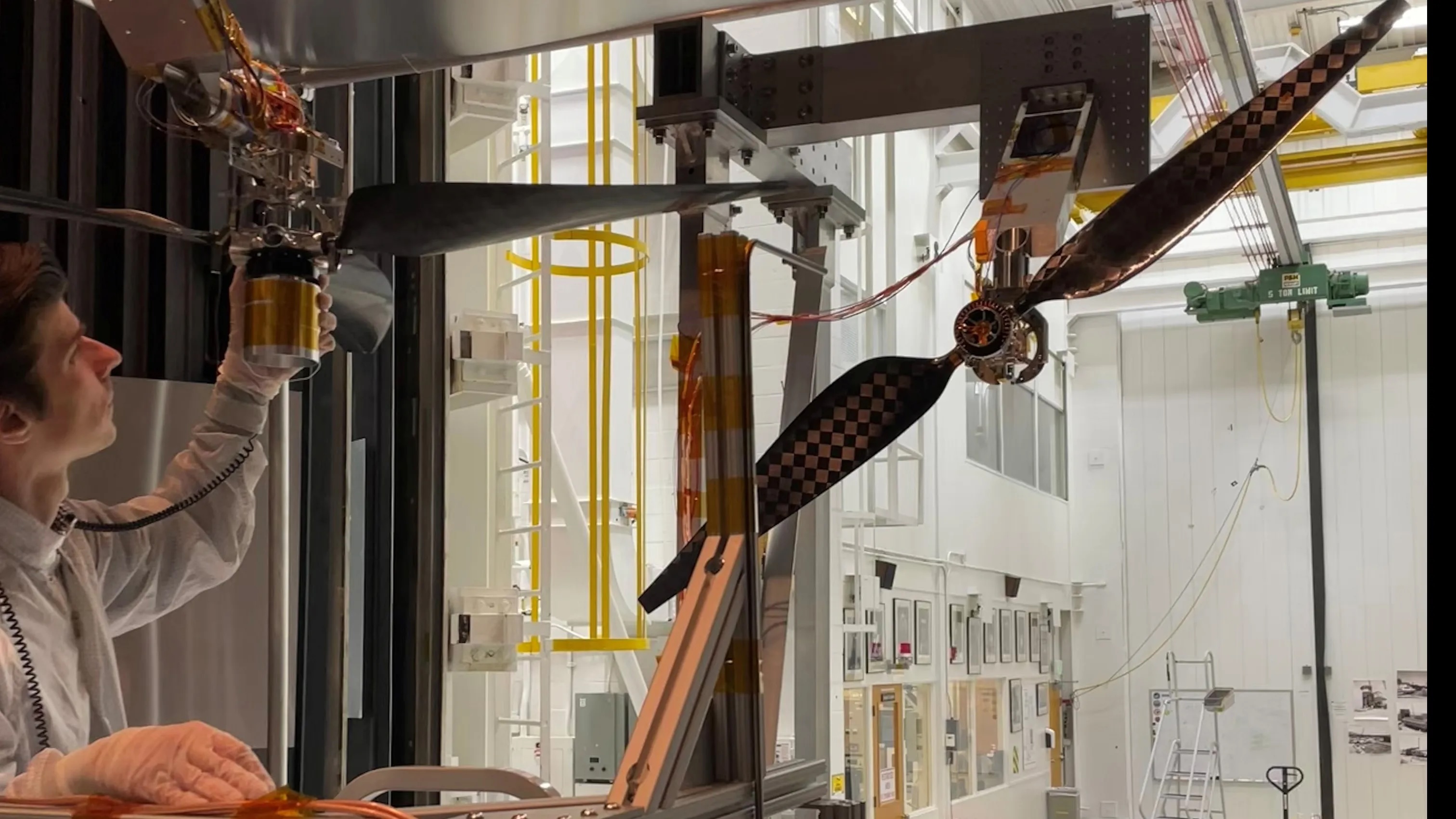
Engineer Jaakko Karras inspects a next-generation Mars helicopter rotor blade prior to testing it at supersonic speeds in the 25-foot Space Simulator at NASA’s Jet Propulsion Laboratory in November 2025.
Credit:
NASA/JPL-Caltech
The first series of tests used a three-bladed rotor design that could be flown on missions after SkyFall. A second test campaign used the actual two-bladed design that will fly on SkyFall. These blades are slightly longer, so they reached the same supersonic speed at a lower rpm. The faster spin resulted in a 30 percent boost in lift capability.
The team pushed rotor tip speeds to Mach 1.08, boosting the Mars vehicle’s lift capability by 30 percent. This breakthrough allows future missions to support heavier scientific payloads, including advanced sensors and larger batteries for extended flight.
“We thought we’d be lucky to hit Mach 1.05, and we reached Mach 1.08 on our last runs. We’re still digging into the data, and there may be even more thrust on the table. These next-gen helicopters are going to be amazing,” said Shannah Withrow-Maser, an aerodynamicist from NASA’s Ames Research Center.
At the same time that engineers are preparing to send more helicopters to Mars, NASA is working on a more massive rotorcraft named Dragonfly destined for Saturn’s moon Titan. Dragonfly will weigh nearly a ton, but flying on more distant Titan poses fewer challenges than on Mars because its atmosphere is thicker than Earth’s.
The only payloads on the Ingenuity helicopter were two cameras: a black-and-white imager for navigation and a higher-resolution color camera. Its longest flight in 2022 covered less than a half-mile and lasted 161 seconds. The aircraft had to land and recharge its batteries using solar arrays, and it used the nearby Perseverance rover as a base station to communicate with ground teams on Earth.
The SkyFall mission won’t have a rover nearby. The helicopters will have to communicate with mission controllers through orbiting relay satellites or a direct-to-Earth link. Future rotorcraft will use larger batteries to enable longer flights. Scientists would like to mount more sophisticated instruments on Mars helicopters to search for things like ice in the Martian soil. All of this will require heavier vehicles.
Breaking the sound barrier without breaking hardware moves us a step closer to fully exploiting this new mode of planetary exploration.