dailynewsnblog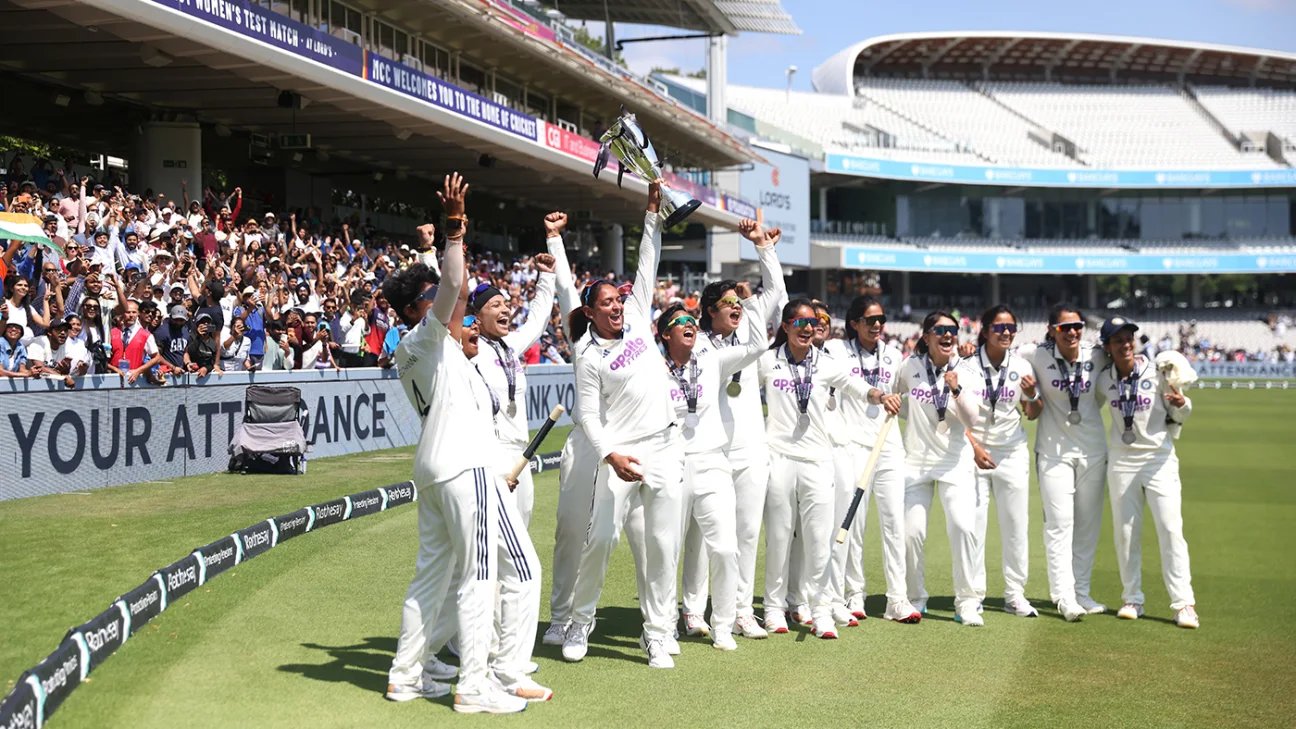
They were queuing round the block at the back of the Lord’s pavilion – four or five people deep, straining with their cameras primed, eager for a glimpse of the women cricketers within. Suffice to say, however, there was only one team that these particular fans were hankering for.
These numbers weren’t quite the equivalent, but they weren’t to be sniffed at either: a new women’s Test record of 37,846 across the whole game. And when, in the moments after the trophy lift, Kranti Gaud carried her newly-earned silverware across to the Grandstand to parade it before a sea of India shirts, the roars of acclaim confirmed the degree of cut-through that the visitors, in particular, have achieved during a momentous few weeks for women’s cricket in this country.
The fact that Knight was speaking, in a sweaty Lord’s squash-court, at the precise same moment that Brendon McCullum, England’s newly sacked men’s Test coach, was addressing the media up at Edgbaston was simply too ridiculous to be passed off as a coincidence. It was just the latest example of the sport’s limited oxygen supplies being wasted on a conflagration in the men’s set-up that has long since escaped the governing body’s control.
It all began innocently enough, with a careless night out in the wake of the Lord’s Test on June 7. From that moment on, however, the transposition of the men’s narrative squarely onto the women’s window of opportunity has been stunning and absolute, like the sort of man-marking that Thomas Tuchel might hope to employ on Lionel Messi in Atlanta later this week.
“How witless was it that the end of 142 years of gender-based injustice should be overshadowed once again by a bunch of male cricketers and their own inept timing?”
“We have been juggling with a few of the other announcements that have taken place over the last 24 hours, plus the Men’s [Football] World Cup, Wimbledon, and the fact that we have got another men’s squad assembling tomorrow [Monday] for the ODI,” Gould said. “So it’s to our regret that this comes out on day three of the Test.” He also added that he hoped that both Knight and Tammy Beaumont would get the send-offs they deserved on the final day. Instead, both ended up playing their final innings during England’s third-evening collapse, long before the Baz shockwaves had dissipated.
And sure, England’s performance during their long-awaited Test debut at Lord’s didn’t exactly warrant the clearing of an entire news agenda. Remarkably, and concerningly for their hopes of competing in next summer’s Ashes, this fourth loss in five matches means they still haven’t won a home Test since the summer of 2005. And yet, even that stat paled compared to the only lag that really mattered in this week of weeks. How witless was it that the end of 142 years of gender-based injustice should be overshadowed once again by a bunch of male cricketers and their own inept timing?
It should be said that MCC, the body that attracted so much ire in 2023’s seminal Independent Commission for Equity in Cricket (ICEC) report, played its part in this occasion as well as anyone could have hoped. Not only was the pavilion packed with members throughout the four days, it was the scene on the first day for a series of tributes to the trailblazers who had gone before, including the unveiling of six new portraits in the Long Room, and the aural promise that a sculpture dedicated to women’s cricket will soon be in the works.
Operationally, the T20 World Cup was hard to fault either, with record crowds at most venues and nearly 100,000 more ticket sales than anticipated. It was the ECB’s senior (men’s) management who fell chronically short of fulfilling its side of the bargain. So much of the chat in the lead-up to this summer had been about the blessed legacy of 2017 – a World Cup-winning windfall, overseen by the outgoing Knight in front of a packed house at Lord’s, that the governing body hadn’t remotely seen coming, but went out of their way to exploit.
And if, in the intervening nine years, Knight and her generation of ex-amateur players with unimpeachable motives within the sport, had done an inordinate amount of the heavy lifting – including work behind the scenes with the PCA to broaden the game’s professional footing – it had been done, in part, on the promise that this summer would be a showcase of the progress made.
As Australia, and now India, made abundantly clear, there were significant barriers to the ultimate progress that England might have targeted this summer. A direct emulation of the Lionesses’ twin Euros triumphs, and last year’s World Cup win for the Red Roses, was always going to be a long shot, especially – as Gould pointed out – amid the competing demands of the FIFA World Cup and Wimbledon.
And yet, more than 300,000 tickets for women’s cricket were sold in a single month, which should have been ample proof that it deserves its place in the national sporting conversation. Instead, it could barely get a word in edgeways in cricket’s own circles. It was a depressing reminder of the distance that the sport has yet to travel.
Andrew Miller is UK editor of Cricinfo. @miller_cricket