dailynewsnblog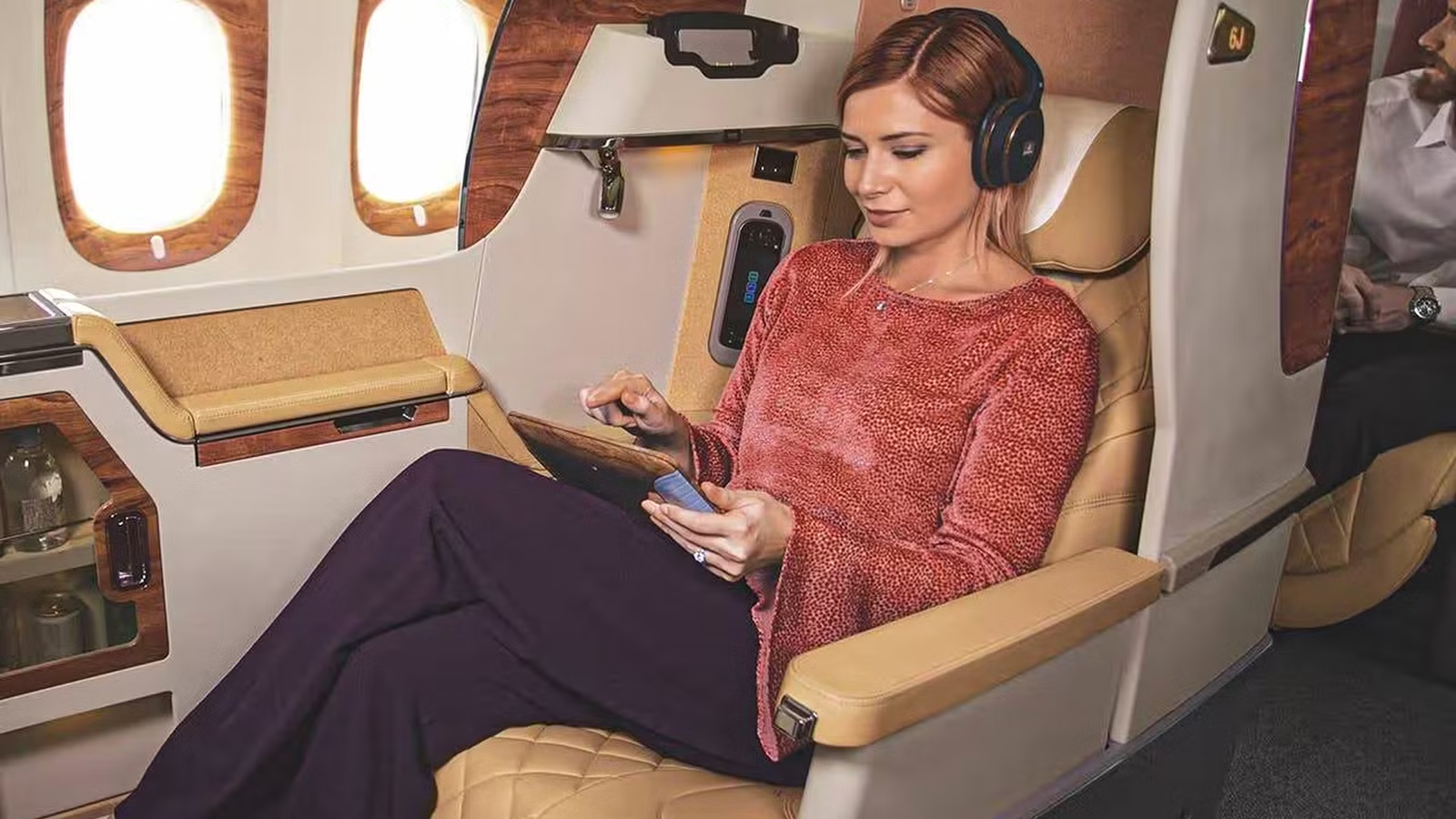
Few airlines have been successful in maintaining an uncompromised premium customer experience quite like  Emirates, but even the greats make mistakes. Emirates is currently delivering a massive, multibillion-dollar fleet modernization strategy designed to comprehensively overhaul its long-haul passenger experience. This guide looks deep into this massive investment program, outlining how the Gulf carrier is re-engineering its fleet to preserve its competitive edge in the global premium travel sector, in the face of growing opposition from all directions.
For over a decade, the airline maintained a highly criticized, high-density premium configuration on its primary twin-engine fleet, a choice that steadily bled premium market share to regional rivals offering superior privacy and direct aisle access. Compounded by multi-year delivery delays of next-generation aircraft types, the carrier decided to ditch the factory-fresh fleet replacement for the time being to embark on a huge, in-house technical retrofit to extend the operational competitiveness of its widebody fleet well into the next decade.
A Configuration Well Past Its End Date

The business class cabin of the Boeing 777-300ER has been the most conspicuous vulnerability in the global product strategy of Emirates. International rivals quickly transitioned to four-abreast configurations that guaranteed direct aisle access for every passenger, but the Dubai-based carrier stubbornly maintained a dense, seven-abreast 2-3-2 layout. Those paying premium fares have had to endure the indignity of the infamous middle business seat or climb over sleeping neighbors, creating a highly visible disparity between the twin-engine fleet and the flagship Airbus A380 experience.
The structural compromise proved financially costly, acting as a direct channel through which premium market share bled to aggressive regional competitors. Most notably,  Qatar Airways capitalized on this operational deficit by introducing its revolutionary Qsuite product, a private suite configuration that instantly redefined premium expectations across the Middle Eastern and transatlantic aviation corridors. As corporate travel policies and high-net-worth individuals increasingly needed direct aisle access as a baseline prerequisite for premium flight expenditure, the seven-abreast configuration became an active liability, eroding the carrier’s pricing leverage on high-yield business routes.
To address this legacy deficiency, the carrier is allocating a substantial amount of capital, $5 billion to be exact, to eliminate the middle seat across its twin-engine fleet. The concept is replacing the outdated configuration with a modern four-abreast layout to correct a historical product miscalculation that outlived its market utility by several years. This massive effort is not entirely a cosmetic interior refresh, but a mandatory structural course correction required to restore complete consistency across the premium network and protect the airline’s premium brand equity against aggressive market erosion.
Getting The Job Done Quickly

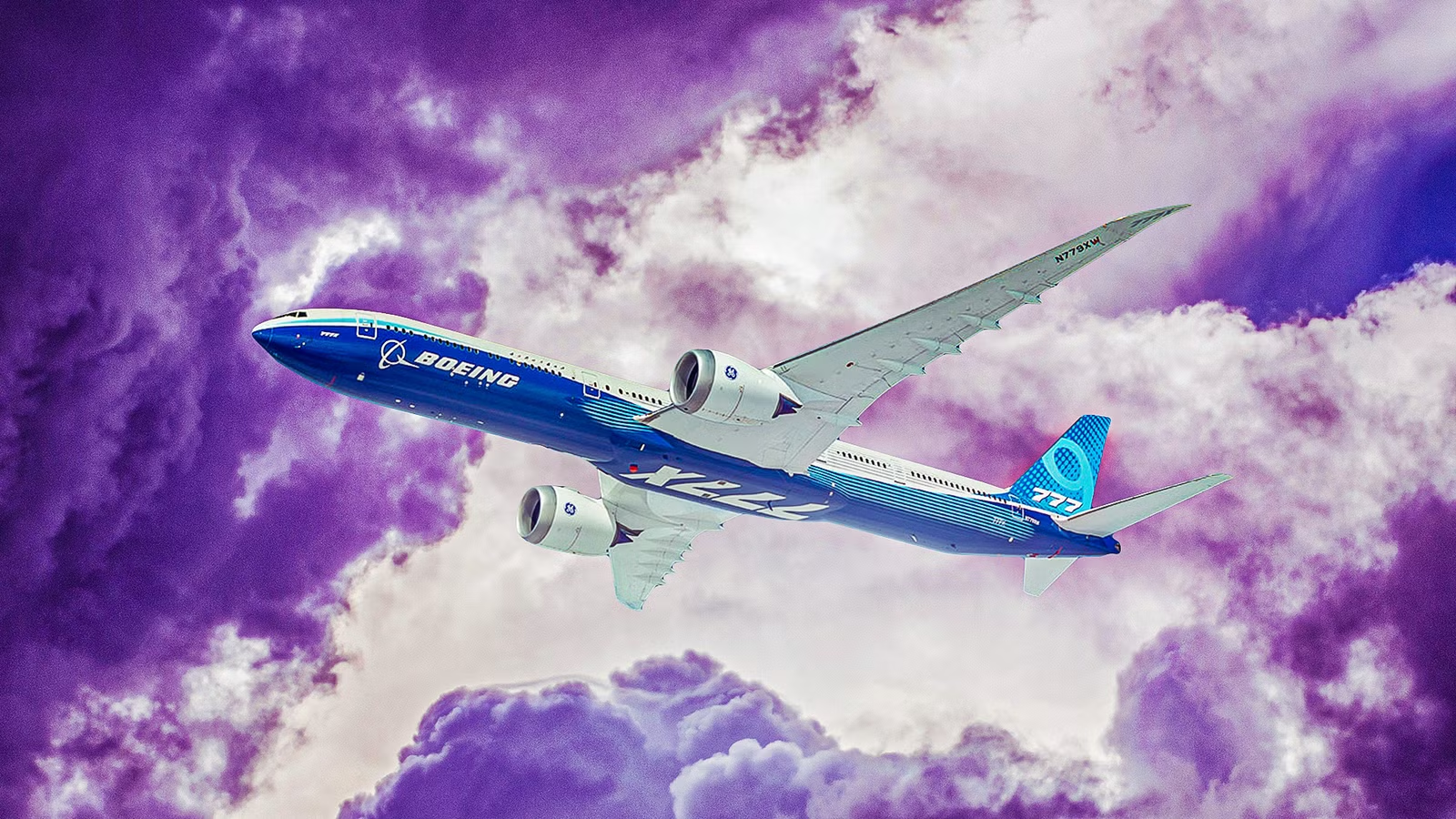
Sir Tim Clark, the president of Emirates, orchestrated a sweeping change toward an in-house modernization program after repeated manufacturing delays pushed the delivery timeline of the factory-fresh Boeing 777-9 deep into 2027. Faced with a five-year delay on the next-generation twin-engine widebody, the airline had no choice but to extend the lifespan of its current airframes to avoid severe capacity shortfalls.
The prolonged manufacturer backlog carried a substantial financial penalty, forcing the airline to scrap its initial factory-installation cabin development plans entirely. Abandoning these early development cycles cost the airline between €20 million and €30 million ($21.8 million to $32.7 million) in dead engineering capital, as the planned onboard technologies became obsolete before the airframes could ever leave the factory floor. To prevent further strategic stagnation, the engineering division established a highly organized, continuous assembly line inside its dedicated maintenance facilities to seize control of its product timeline.
The velocity of this in-house industrial line is an unprecedented feat of line maintenance engineering within the commercial aviation sector. Operating a continuous nose-to-tail schedule at the engineering center in Dubai, the technical team recently passed a major milestone by completely rebuilding its 100th aircraft, split between 47 superjumbos and 53 twin-engine jets. Maintaining an aggressive production cadence that completely strips and retrofits a single Boeing 777 in only 18 days, and an Airbus A380 in 22 days, the facility delivers two completed long-haul airframes back into commercial service every month.
Built On Heritage

The centerpiece of the premium cabin transformation is a highly customized iteration of the S Lounge platform manufactured by Safran. Using this platform suggests an effort to establish immediate product commonality across disparate aircraft types in the fleet, instead of growing this progressively. Now using a heavily modernized variant of the staggered, four-abreast configuration, Emirates can more easily bridge the product gap between its double-deck superjumbos, the newly delivered Airbus A350aircraft, and the retrofitted twin-engine fleet.
There seems to be a distinct historical irony in this product selection, as the core architecture of the new seat is not an entirely novel design. Instead, the platform is a highly refined, technologically advanced evolution of the exact Safran architecture that first debuted on the upper deck of the carrier’s Airbus A380 fleet in July 2008. To get the product to modern standards, the carrier worked closely with design houses to replace the polarizing faux burr wood trims of the past with a refined palette of cream leather stitching, brushed bronze laminates, and subtle ghaf tree motifs.
Cabin Dimension Or Feature | Legacy 2-3-2 Product Specifications | Retrofitted 1-2-1 Safran Specifications |
Seat Configuration | Seven-abreast (2-3-2) | Four-abreast (1-2-1) |
Direct Aisle Access Availability | Limited to 71% of seats | Guaranteed for 100% of seats |
Fully Lie-Flat Bed Length | 72 inches (183 centimeters) | 78 inches (198 centimeters) |
Inflight Entertainment Resolution | Standard High Definition | 4K Ultra-High-Definition HDR OLED |
Dedicated Device Charging Rate | Under 15W standard USB | 67W USB-C Fast-Charging |
Privacy Door Integration | Non-existent | Fixed privacy shells (no sliding doors) |
It is clear that the Safran S Lounge platform delivers a massive improvement in ergonomic utility and personal space, but it remains a transitional stopgap rather than the ultimate flagship product. The carrier is explicitly holding back its true next-generation business class product, the doored Safran Unity suite, for factory-fresh installations on the delayed Boeing 777-9 fleet. Nevertheless, the retrofitted seat provides a competitive intermediate product, complete with built-in room-temperature personal minibars and table-height storage consoles that eliminate the awkward ergonomics of the previous generation.
Getting The Experience Right

Moving away from a high-density, seven-abreast configuration to a spacious four-abreast layout leaves network planners to confront a brutal reality regarding cabin floor spacing. The staggered 1-2-1 layout takes up significantly more area per passenger, and the airline must absorb a severe capacity density penalty across its modified airframes. Ripping out the middle seat means that the space that once accommodated a high volume of travelers must now be sacrificed to satisfy the modern expectation of premium isolation.
The exact metrics of this spatial re-engineering highlight the high commercial cost of corporate product alignment. On a standard three-class 777-300ER, the total business class seat count drops from 42 premium berths down to 38 or 40 seats. This reduction is a deliberate yield penalty, as the airline is voluntarily eliminating up to 10% of its sellable premium inventory on high-density routes in exchange for the ability to charge higher baseline fares.
To protect its highest-yielding international corridors from product-driven passenger defection, the carrier is prioritizing these modified airframes on premium international routes. Early deployments of the four-class aircraft have been carefully targeted at key financial and high-traffic gateways, such as the Dubai to Tokyo Haneda and London Stansted routes. The network management team can directly shield its most valuable corporate accounts from rival products while slowly rolling out the upgrade across the remaining global network through the process of deploying the 1-2-1 product to these hyper-competitive environments first to get a better gauge of passenger data.
Bringing Technology Into The Modern Age

The cabin modernization program extends far beyond mechanical seat frames, driving a profound transformation of the digital and electrical infrastructure of the aircraft. Supporting the high bandwidth and power demands of modern corporate travelers, engineers are working on a complete nose-to-tail electronic rewire during the 18-day hangar visits. The project replaces older, heavy analog cabling with advanced fiber optic networks capable of delivering unprecedented processing speeds to every passenger berth.
At the vanguard of this digital architecture is the implementation of the Panasonic Astrova inflight entertainment platform, making the carrier an early adopter of this hardware. Business class passengers are provided with an expansive 20 inches (50 centimeters) 4K HDR OLED screen, which delivers exceptional contrast ratios and deep color accuracy that completely outclasses previous liquid-crystal displays. The Astrova platform features a unique modular chassis design, allowing technicians to swap out display panels and power nodes rapidly during routine overnight maintenance without needing to remove the underlying seat structure when technology upgrades become available.
Complementing the visual displays is a comprehensive electrical modernization that completely addresses the long-standing problem of slow device charging on long-haul sectors. The airline has relocated power ports from awkward floor-level receptacles to prominent, table-height consoles, embedding individual induction wireless charging pads directly into the bronze trim. Furthermore, each seat is wired with a high-output 67W USB-C fast-charging port capable of powering demanding corporate laptops, while a fleet-wide installation of low-latency Starlink hardware replaces sluggish older networks to deliver seamless gate-to-gate connectivity.
A New Look For Emirates

The true strategic scope of the $5 billion investment becomes apparent when observing the integration of the entirely new premium economy cabin segment, alongside the updated business class. Rather than treating the retrofit as an isolated business class fix, the carrier is using the fleet overhaul to establish a highly lucrative four-class ecosystem across its primary widebody assets. In the engineering hangars, technicians are developing complex structural modifications, which include tearing out sections of the lower deck on the 777 and the upper deck on high-density A380 airframes to integrate the new cabin tier.
Upgrades have yielded significant passenger experience improvements across all classes, including the integration of 24 Recaro PL3530 premium economy seats covered in anti-stain cream leather and equipped with mechanical leg rests. Further down the fuselage, the economy cabin is completely refreshed with lighter Safran Z400 frames featuring eight-way adjustable headrests and upgraded 13.3 inches (33 centimeters) Astrova screens. To offset the physical absence of the famous upper-deck horseshoe lounge on the single-deck 777 frame, engineers built a compact, walkthrough mid-cabin refreshment station directly into the galley area to provide premium self-service catering during long cruise phases.
Ultimately, this massive in-house modernization program is a definitive victory of corporate agility over manufacturer stagnation, securing the carrier’s market relevance for the next ten years at the very least. Turning a severe manufacturing crisis into an opportunity to completely standardize its long-haul passenger experience, the airline has shown that it will not surrender to external impacts. The massive expenditure stands as a clear financial testament that in the modern premium aviation sector, the cost of correcting a historical design mistake is secondary to the cost of losing strategic dominance.