dailynewsnblog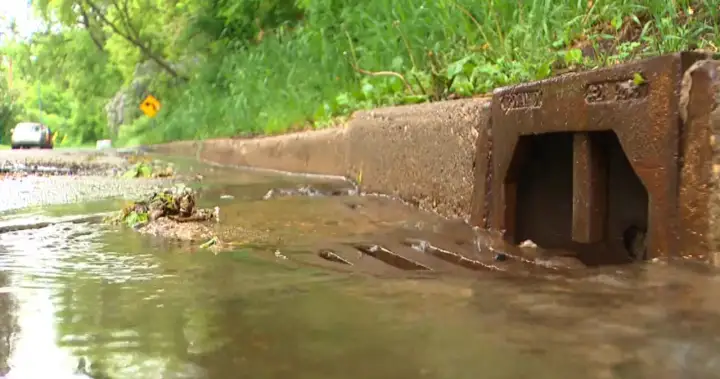
Another round of storms has brought renewed flooding to Edmonton’s roads, as crews continue repairing sinkholes and replacing infrastructure damaged by what’s now been nearly two months of heavy rainfalls.

The region needs a stretch of dry weather to allow its stormwater system to recover, EPCOR said on Tuesday, after a days-long heavy rainfall event in June to more recent thunderstorms dumping a deluge in a short period of time.
“The cumulative effect of those is that the system, essentially, doesn’t have time to recover completely — i.e., drain the water away from stormwater management facilities,” said Craig Bonneville with EPCOR’s project planning department.
The city-owned utility provider said saturated ground is no longer absorbing water as it normally would, sending larger volumes of runoff into drains and contributing to flooded underpasses, sinkholes and washed-out roads.
Recent flooding has affected major routes, including underpasses on Yellowhead Trail and Whitemud Drive, and led to sinkholes popping up around the city.
“The only thing that will help us out here is, really, the weather to take a turn and give us an opportunity to get our system operating not under these emergency scenarios,” Bonneville said.

Alireza Bayat, a professor of civil and environmental engineering at the University of Alberta who specializes in underground infrastructure, said the recent storms have highlighted weaknesses in Edmonton’s aging stormwater network.

Get daily National news
Get daily Canada news delivered to your inbox so you’ll never miss the day’s top stories.
“These pipes, we don’t see them, but we depend on them every day,” Bayat said. “The infrastructure we have, we built in the 1960s, 70s — now this same infrastructure that has to deal with 2026 rains and climate.
“We are putting too much on the infrastructure — so at some point, it’s passing its capacity.”
He said extreme weather events often expose infrastructure that has not been adequately maintained.
“Always, these types of events find the weak points — and the weak points are typically unmaintained points,” he said.
While replacing aging infrastructure takes time, Bayat said municipalities must focus on getting the most out of existing systems through maintenance and operational improvements.
“We are left right now with the infrastructure we have, so we have to use them better, maintain them better,” he said.

The city said in the last week alone, parks and road services has received more than 1,400 calls about flooding and storm damage.
In 2019, Edmonton city council approved a $1.6-billion program aimed at making the city’s stormwater system more resilient.
“What used to be a one-in-100-year flood is now one-in-10-year flood,” Mayor Andrew Knack said when explaining the reasoning for 20-year program.
In hindsight, he admits the flood resiliency should have been started decades earlier.
The city has spent about $350 million so far on projects including dry ponds and maintenance work on pipes and manholes.
Much of the program’s work is still scheduled for future years as Edmonton continues adapting its stormwater infrastructure to handle increasingly frequent periods of heavy rainfall.
© 2026 Global News, a division of Corus Entertainment Inc.