dailynewsnblog
America’s fascination with flight stretches back to the Wright brothers’ first powered flight in 1903. World War Two further cemented aviation’s place in the national identity, transforming aircraft manufacturing, military service, and pilot training on an unprecedented scale. Aviation became a defining part of American technological achievement and industrial strength.
Today, that legacy lives on through commercial air travel, military aviation, general aviation, and homebuilding. Each year, hundreds of thousands gather at EAA AirVenture Oshkosh to celebrate the enduring American passion for flight, innovation, and the freedom of the skies.
EAA AirVenture 2026: The Most Exciting Place To Be For Aviation Enthusiasts

Wittman Regional Airport (OSH) in Oshkosh, Wisconsin, is roughly 1.5 hours north of Milwaukee by car and is the annual home of the EAA AirVenture airshow, commonly known simply as “Oshkosh.” Wittman has a total land area of 1,450 acres (586.8 hectares) and four runways, the longest (18/36) being slightly over 8,000 feet (2,438 meters). Once a year, the surrounding airspace of this otherwise relatively quiet airport teems with aircraft, military, commercial, and private, while its four runways become some of the busiest strips of concrete on earth and its grounds become a veritable tent city.
The event that draws aviation enthusiasts from around the globe is EAA AirVenture, and the scale of the operation is immense. During the week-long event, roughly 10,000 aircraft arrive at the airport grounds or perform flyovers for 734,000 attendees, a recordfor the airshow, which runs from July 20 to 26. The EAA Aviation Museum welcomed 38,000 visitors during the week (roughly one-third of its total annual attendance), and event staff parked more than 68,400 cars over the course of the event.
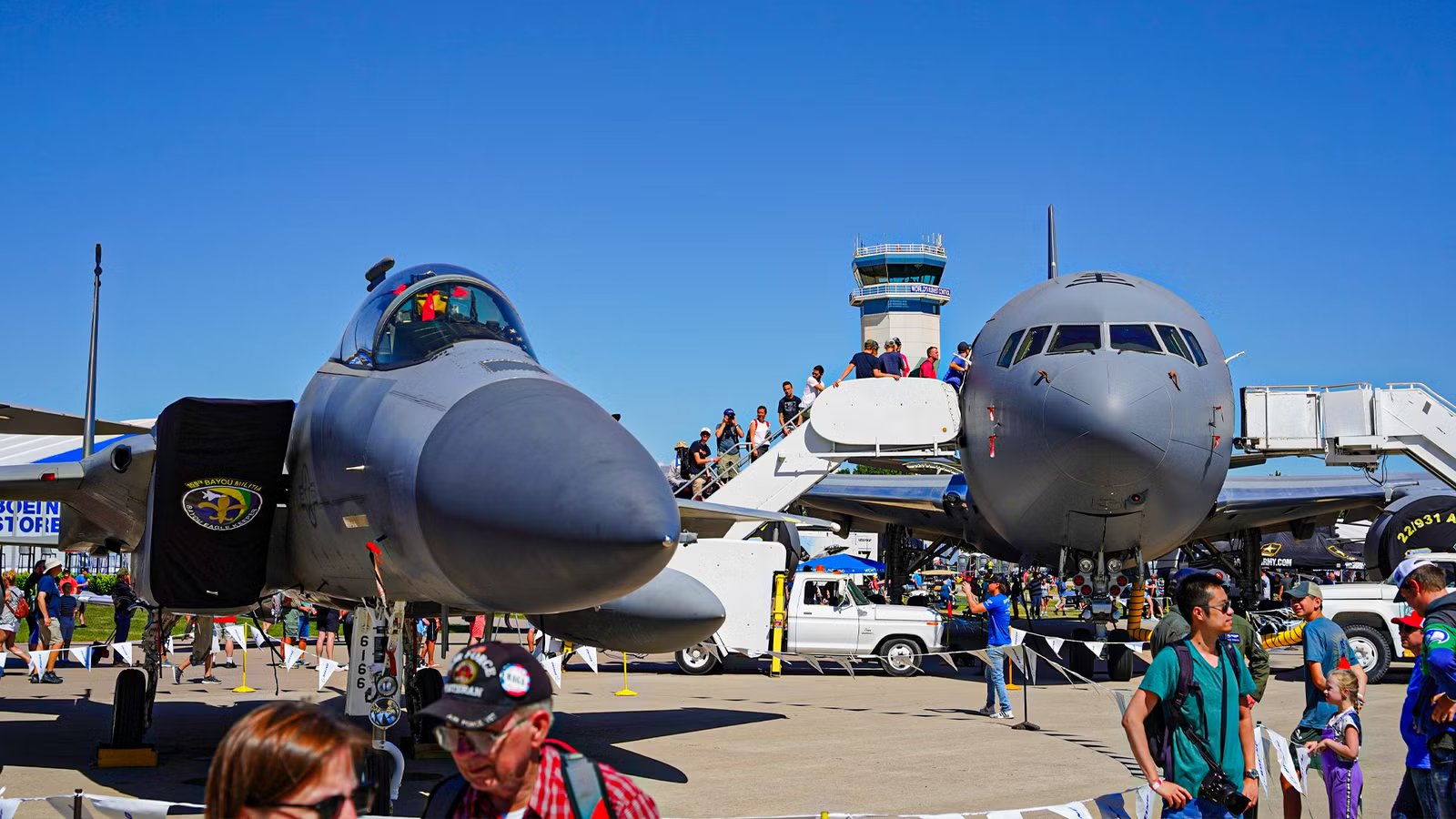
Once on the grounds, visitors can see the most advanced fighters, fully restored vintage warplanes, including fighters and bombers such as the  Boeing B-17 Flying Fortress and the Supermarine Spitfire. Homebuilt, experimental, and highly maneuverable, brightly colored stunt aircraft are also on display, and owners are available to discuss how they operate.
In addition to the planes, there are exhibit hangars, where leading aeronautics manufacturers and avionics suppliers display contemporary aircraft and equipment. According to EAA, there are seemingly countless forums and workshops where “Hundreds of innovators, industry leaders, authors, experts, and legends share their accumulated knowledge with engaged audiences, making the Forums Plaza the most comprehensive collection of aviation knowledge available in one location.” The workshops cover topics such as metal, wood, composite, and fabric construction; welding techniques; and instructions on how to build a personal hangar.
The Towers And The Teams: Bringing In The Birds At The Largest Airshow On Earth

The immensely busy airspace around Wittman Regional Airport requires a sizable, highly trained crew of air traffic controllers. This year, the airshow was supported by a team of 64 of these professionals, who were dispersed across roughly five locations and worked varying shifts, managing inbound and departing aircraft in addition to other assignments.
When pilots first approach Wittman, a forward-stationed team of controllers on a low hill about six miles from the airport gives instructions and assigns a runway. The pilots then land on their assigned runways under the direction of either Oshkosh Tower North or Oshkosh Tower South, which handle inbound planes landing on Runways 09/27 and 18/36, respectively. Inside the towers, controllers use binoculars and radar to monitor each aircraft’s location and altitude.
Each controller at Oshkosh is selected from a pool of applicants strictly limited to air traffic controllers within the United States. According to the Federal Aviation Administration, those selected for the airshow are divided into teams of four, each led by a veteran team leader with three or more years of experience and supported by another senior member. These seasoned controllers are accompanied by an additional team member with two to three years of experience and a “rookie.”
It is important to note that each “rookie” has extensive experience and is a Certified Professional Controller at their home facility. Nicholas Luce, a six-year veteran of the Oshkosh show, described his first year: “. . . I was shell-shocked . . .” He elaborated, “I remember when it was over, thinking, ‘I don’t even know what just happened.’ Then in the second and third year you start to get it.” His reaction is understandable, considering that this year, controllers logged 15,527 aircraft operations between noon on July 16 and noon on July 27—an average of about 101 takeoffs and landings every hour the field was open.
From Humble Origins, The History Of EAA AirVenture

The first gathering that would become the world’s largest airshow took place in September 1953 as a minor part of the Milwaukee Air Pageant. At the time, it was known as the Experimental Aircraft Association’s Fly-In Convention. The event was held at Curtiss (now Timmerman) Field and attracted only a handful of airplanes, primarily homebuilt and modified aircraft, with fewer than 150 people recorded in attendance.
By the end of the 1950s, the event had moved to Rockford Municipal Airport in Illinois, where the EAA Fly-In would remain for the next ten years. During its time in Rockford, the event became a gathering for homebuilders and a family-friendly event, a hallmark that remains today. During this decade, historic warplanes, antique planes, and aerobatic performers became regular features of the EAA event.
By 1969, it was clear that the Fly-In Convention had outgrown Rockford Airport, and sites were again being considered for a new home. At the time, Steve Wittman, an aviation legend and an EAA member since its founding in 1953, suggested the airport in Oshkosh, Wisconsin. The site had ample space for the influx of spectators and two noncrossing runways, allowing greater movement of arriving and departing aircraft. By late 1969, the EAA board had approved the move to Oshkosh.
Throughout the 1970s and 1980s, the convention grew rapidly in national prominence, with attendance rising into the six-figure range year after year and eventually establishing the event as aviation’s premier annual gathering. While the airshow offers enthusiasts a premier place to see unique aircraft, it also generates substantial economic activity. A 2025 study by the University of Wisconsin–Oshkosh estimated that AirVenture generates around $257 million (£194 m) annually for the five surrounding counties, underscoring the show’s growth and local economic impact.
Americans And Their Fascination With Flight

It is possible that the enthusiasm for flight in America stems in part from the fact that the first powered flight took place in the United States on December 17, 1903, at Kill Devil Hills near Kitty Hawk, North Carolina. It was at this site that Orville Wright piloted the first Wright Flyer. The flight lasted just 12 seconds, during which he traveled 120 feet (36.5 meters), reaching a top speed of 6.8 miles per hour (10.9 km/h).
From that point onward, aviation became increasingly woven into the national psyche. By the end of World War II, the Army Air Forces Training Command had produced approximately 200,000 pilots, while the United States had manufactured roughly 300,000 aircraft. Young men from across the country went off to learn to fly in order to serve a larger purpose. Beyond this, by 1943, approximately 1,342,500 men and women were employed directly for aeronautics manufacturers, with an additional 650,000 Americans working for industry subcontractors and suppliers. Together, they supported the production of overwhelming airpower for the European and Pacific theaters.
The breadth and depth of the aeronautics industry established during the war would have a lasting influence on the United States. Major manufacturers such as Lockheed Martin, Boeing, and Douglas Aircraft would go on to play leading roles in both military and civilian aviation, touching American lives both practically and in popular culture. Since the conclusion of WWII, Americans have continued to encounter aviation through air travel, military service, and the logistics of everyday commerce, all of which depend heavily or in part on flight.
This deeply rooted thread of aviation, woven into contemporary American history, helped establish a culture in which flying became more than a means of transportation or an instrument of military power. For generations of Americans, it has also represented technological achievement, personal freedom, and the pursuit of adventure. That legacy may help explain why hundreds of thousands of people gather in Oshkosh every year to celebrate aviation.
EAA AirVenture Oshkosh Remains A Celebration Of America’s Enduring Passion For Flight

EAA AirVenture Oshkosh is far more than an annual airshow. It marks the culmination of decades of American aviation history, celebrating the aircraft, pilots, engineers, and enthusiasts who have shaped the nation’s relationship with flight. From historic warbirds to experimental homebuilts, the gathering brings together nearly every facet of aviation.
As attendance continues to draw hundreds of thousands of visitors, Oshkosh remains a testament to flight’s enduring appeal. Its remarkable scale reflects not only aviation’s technological achievements but also the passion that continues to inspire generations of Americans to look skyward.
Catch what other trackers miss
Emergency squawks, holds, NOTAMs — live signals, no signup.
Open tracker
Catch what other trackers miss
Emergency squawks, holds, NOTAMs — live signals, no signup.
Open tracker