dailynewsnblog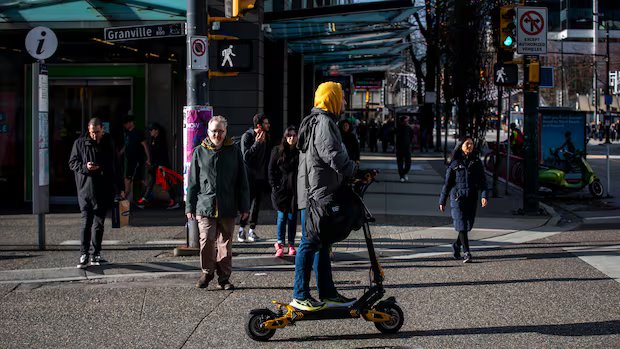

Listen to this article
Estimated 4 minutes
The audio version of this article is generated by AI-based technology. Mispronunciations can occur. We are working with our partners to continually review and improve the results.
E-scooter-related injuries among children are on the rise, according to new data from B.C. Children’s Hospital, as the devices grow in popularity across the province.
The hospital says its emergency department saw 81 visits related to e-scooter use among children and youth from April 1, 2025 to March 31, 2026 — more than double the 37 visits recorded the year before.
Under provincial rules, e-scooter riders must be at least 16 years old, but B.C. Children’s says the highest proportion of emergency visits (54 per cent) were among children aged 13 to 15.
Dr. Shelina Babul, director of the B.C. Injury Research and Prevention Unit at the hospital, says many parents are simply unaware of the rules.
“I think there’s a lack of understanding, lack of education around who should be riding e-scooters,” she said.
“Speed is the biggest factor and not wearing a helmet. Just yesterday I saw someone on their e-scooter with their helmet in their backpack.”

New federal data reveals e-scooter injuries requiring hospitalization are surging among young people under the age of 17. In the last year, 81 young patients were admitted for e-scooter injuries. The year before there were just 37. Nearly all were male. Dr. Shelina Babul from the B.C. Children’s Hospital tells us what they’re seeing regarding hospital visits and e-scooter injuries.
B.C. Children’s says 35 per cent of the emergency visits involved fractures, while 26 per cent of the patients had bruises and abrasions and 17 per cent had concussions.
E-scooter rule enforcement
B.C. has been testing the use of electric kick scooters on public roads under a four-year pilot project that now includes 36 communities, including Vancouver, Burnaby, Victoria, Kelowna and Prince George.
The pilot allows e-scooters in participating communities but only under specific rules. Riders must be at least 16, wear a helmet and use an e-scooter that cannot travel faster than 25 km/h.
Riders can face a $109 fine, impoundment or other penalties for breaking those rules.

But road safety advocates say the rules only matter if they are clearly understood and enforced.
“Obviously enforcement is not great,” said Margie Sanderson with the advocacy group Vision Zero Vancouver.
“As we see micromobility as a new alternative to driving growing in popularity, it just shows that we need more than ever infrastructure design that keeps our road users safe,” she said.
She said riders should not be forced to choose between mixing with vehicle traffic or riding on sidewalks alongside pedestrians.
Some local authorities restricting e-scooters
Last month, Burnaby adopted bylaw changes banning e-scooters on many major roads unless riders are in a separated cycle lane or multi-use pathway. The city also banned e-scooters in local parks unless a park, or part of a park, has been specifically designated for them.
The Fraser-Cascade School District, which serves parts of the eastern Fraser Valley, also banned e-scooters on school property due to injuries and public safety concerns.
Police have also started ticketing parents in some cases.
Last week, North Vancouver RCMP said they ticketed the parent of a 12-year-old after the child was injured when the e-scooter they were riding crashed into a car.
The Vancouver Police Department previously told CBC News that e-scooters were “not currently an enforcement priority.”
In an emailed statement Monday, a spokesperson said they plan to review education opportunities and enforcement strategies around e-scooter use after FIFA World Cup events conclude.
Maintaining e-scooter injury record
Fraser Health says it’s also seeing signs of a sharp increase in e-scooter injuries but tracking the full scope of the problem remains difficult.
Dr. Emily Newhouse, a medical health officer with the health authority, says emergency department data does not capture every e-scooter injury clearly because those records are built first for patient care, not for producing statistics.
“There isn’t any formal coding for e-scooters in our emergency department health records,” she said.

Regardless, she says Fraser Health has seen a clear increase in e-scooter injuries over the last few years and most cases appear to involve someone falling off an e-scooter rather than collisions.
Newhouse is asking parents not to assume that just because an e-scooter is available for purchase, it is safe for a child to ride.
“We wouldn’t necessarily give our kids a gas motorcycle but we’re giving kids devices that are quite powerful,” she said.