dailynewsnblog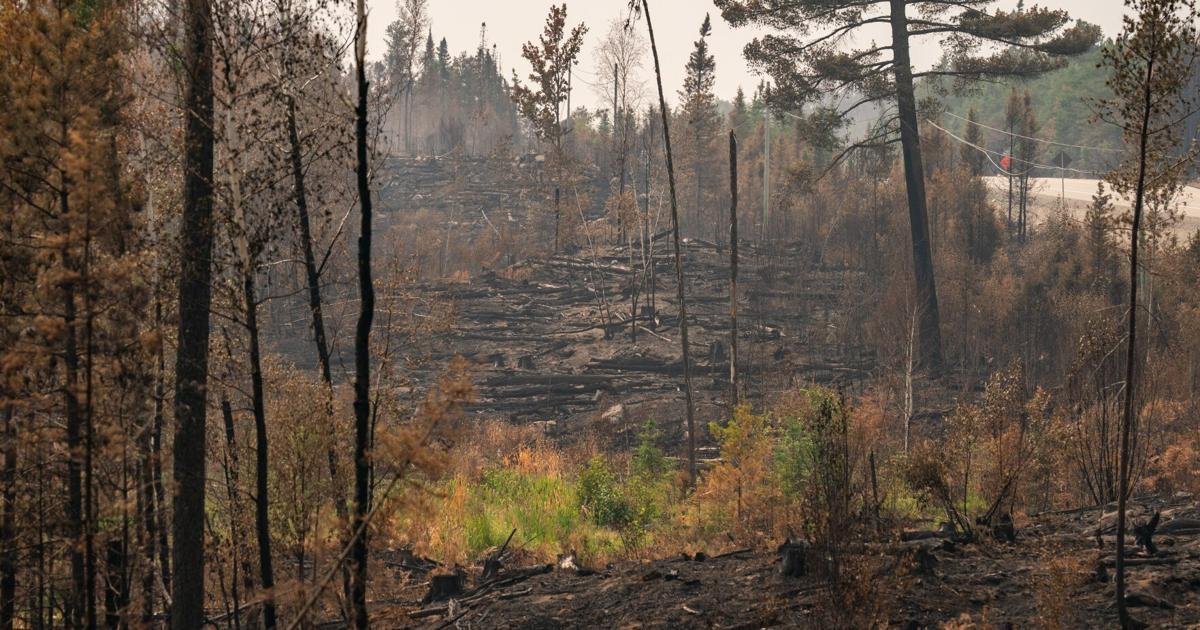
THUNDER BAY, Ont. — Premier Doug Ford landed in smoky northwestern Ontario on Saturday, finding a city stretched to the limits at the front-line of the battle against raging wildfires, while questions mount over Queen’s Park and Ottawa’s responses to the crisis.
The devastation from those wildfires is on display as close as 150 kilometres west of Thunder Bay, where hundreds of metres of forest area have been burnt to the ground, with countless charred, broken tree branches lying on the scorched earth.

Premier Doug Ford responded to criticism about the province’s efforts to fight wildfires in northern Ontario. “By no means have we even stalled for a minute on this,” he said at a news conference in Thunder Bay on Saturday.
Arlyn McAdorey for the Toronto Star
“I understand it’s a terrible scenario right now,” Ford told reporters in the city of just over 130,000 on the shore of Lake Superior. “There’s 655,000 hectares that are burning across our province, but we’re doing absolutely every resource we can possibly throw at this.”
Premier Doug Ford visited Thunder Bay, where many evacuees fleeing northern Ontario wildfires have sought shelter. Ford was joined by government officials in the city as the province faces criticism for its emergency response. (July 18, 2026)
The Canadian Press“By no means have we even stalled for a minute on this.”
The premier’s comment was in response to one of several questions about criticism from some evacuated communities that have said those forced to flee their homes in the middle of the night did not get enough warning, or that their earlier pleas for help had been ignored.
Dale Wirta, owner of Cushing Lake Resort, said he called his neighbour at Thousand Lakes Resort as the fires swallowed the surrounding area in quiet devastation.

Dale Wirta, owner of Cushing Lake Resort, with his dog, Koda. Wirta’s resort was destroyed by the northern Ontario wildfires. He said he received “zero notification that the fire was even close.”
Dale Wirta
They had been unaware of the fire creeping onto their property early this week, perhaps saved only by Wirta’s warning call.
He received “zero notification that the fire was even close,” he said.
“I went to bed, then got a text at about 10:15, saying that the fire had jumped and wasn’t that far from us,” he said. “The fire was extremely close at that time.”
In a panic, Wirta raced from cabin to cabin, his fist pounding against their doors in attempts to wake everyone up.
“Forty-five minutes after getting that text, Thousand Lakes Resort was on fire.”
Those escaping the campgrounds did so in scenes akin to an apocalypse movie, with fire on both sides of the road and smoke distorting their vision as they navigated by following the red tail lights of the vehicle directly in front of them, he said.
Back at the campground, Wirta was still hopeful that his property would survive.
“We were told that fire crews and property protection crews were coming in,” he said. “They never did.”
As a result, by Wednesday morning, Wirta’s resort was no more.
“We lost everything,” he said. “We lost over 50 trailers, 12 cabins, two garages, the main lodge, restaurant, bar, convenience store, living quarters … everything is gone.”
All of this could have been avoided, he said, criticizing the Ministry of Natural Resources’ hesitancy to order a fire ban beforehand.
“MNR dropped the ball,” he said. “People have lost everything. And it could have all been prevented.”
‘Not a soul attempted to get ahold of us’
Robert Laforge, the owner of Lac Des Mille Lodge, had a similar experience.
Roaring wildfires had already reached the mainland where the campgrounds are located before the ministry agreed it was time to evacuate, Laforge said Saturday, despite his repeated attempts for two weeks after spotting smoke billowing over Byers Lake on June 30.
“They felt like they had it under control,” Laforge said. “Not a soul attempted to get a hold of us to let us know the danger that we were possibly in.”
The criticism has raised a larger, big-picture question: is Ontario — and is Canada — ready for a new normal of raging seasonal fires?

Thunder Bay has become a hub for people from across the region forced to flee, many wondering
Grand chief says destroyed community feels like a ‘sacrifice’
For Linda Debassige, the answer is a resounding no.
“I think it’s bleak. I think it’s concerning,” said Debassige, grand chief of the Anishinabek Nation, which represents 39 First Nations.
Among those communities is Collins First Nation, also known as Namaygoosisagagun, which was burnt to the ground earlier this week.
Videos taken by teens narrowly escaping the remote community as it was overtaken by fire went viral earlier this week.
“They had to flee this raging inferno with no notice and all by themselves,” Debassige said. “They not only had to cross the lake to get to the mainland, they also had to travel down many kilometres of bush road just to get away from the fire once they got to the mainland.”
Like others who spoke to the Star, Debassige said Collins First Nation leadership had warned the ministry of the rising risk, to no avail.
Speaking of the viral videos from the evacuation, Debassige said it feels like that community was a “sacrifice” that spurred quicker evacuation orders for nearby communities.
Because Collins First Nation exists in a “grey area” as a “near-band” waiting for official recognition from Ottawa, it receives no support from the federal or provincial governments unlike other first nations, Debassige said.
“They’ve built this community on their own over time, and now they’ve lost everything from their equipment to their water plant to their school to their community building to their homes,” she said.
“It would be nice for them to say, ‘We failed you. We’re sorry. Yes, we should have had early intervention, we should have been monitoring the situation a lot more closely,’” Debassige said.
Nishnawbe Aski Nation Grand Chief Alvin Fiddler, in a social media post Saturday, urged Ford to engage with First Nations leadership: “It’s our people that are being impacted the most by these wildland fires. If you are going to make the effort to come up, it can’t just be for a photo op.”
Natural resources minister: ‘We did our best’

Devastation from the wildfires can be seen about 150 kilometres west of Thunder Bay.
Arlyn McAdorey for the Toronto Star
Ontario’s Natural Resources Minister Mike Harris defended his government’s response on Saturday, but said it will consider how to improve.
“The challenge in Collins is that fire actually started very close to the community,” Harris explained. “We did our best, obviously, to come and survey what was going on, but there was so much smoke it made it almost impossible for our teams to come in and really assess how close the fire was.”
As of Saturday morning, 191 wildfires were burning in Ontario, with 73 not under control, Ford said. At least 10 communities have been evacuated and three are on alert, he added.
More than 950 wildfires are scorching Canada from coast to coast, the national wildland fire…
Ford visited first responders and evacuees in Thunder Bay, he said, though little information was made public.
With Ontario’s natural resources, emergency response and forestry ministers, local Liberal MP Patty Hajdu and the city’s mayor standing behind the premier, Ford touted the cross-government co-operation unfolding while insisting there were no holds barred in the wildfire response.
Hitting back at criticism from opposition parties, he said “I’m going to make it real slow” for them.
“Even though they know there’s base funding, right? And then anything over on top of that, there is no limit,” Ford said in defence of his government’s spending on wildfire response.
“Last year, we spent 271 million … and if it’s $500 million this year, so be it. I’ve made clear direction to our ministers. I don’t care what this costs.”
Still, Ford said, “our focus continues to be sending resources to the areas where fire suppression is most likely successful.”
And while Alberta and Yukon are offering help and requests for support have been made to other jurisdictions, Harris acknowledged American states, British Columbia, Nova Scotia and the Northwest Territories are all dealing with their own fires.
Harris offered some cautious optimism about the outlook for the coming days.
“I don’t want to give a definitive guess, but things are trending in a very positive direction,” said Harris. “Even over the last 24 hours, we’ve seen fire activity start to slow a little bit.”
“What we really need to see is some of those sustained rains, but without the lightning strikes, because the overwhelming majority of fires that we’re seeing now were actually caused by a storm that came through about a week ago,” the minister added.
That news would certainly be welcome for Thunder Bay, which has found itself stretched thin as it receives people fleeing from wildfires hundreds of kilometres away.
Thunder Bay ‘over capacity’ amid evacuations
Thunder Bay Mayor Ken Boshcoff said Saturday his city was at “overcapacity” and would have to start sending incoming evacuees elsewhere in the province.
But before that, in a final effort, the city is preparing to open up a local hockey arena to receive people.
“It’s a huge demand all at once, and it looks like there’ll be even more coming,” said the mayor, who insisted he had no complaints and thanked the province for its help. “The options are limited, so yes, it will be used.”