dailynewsnblog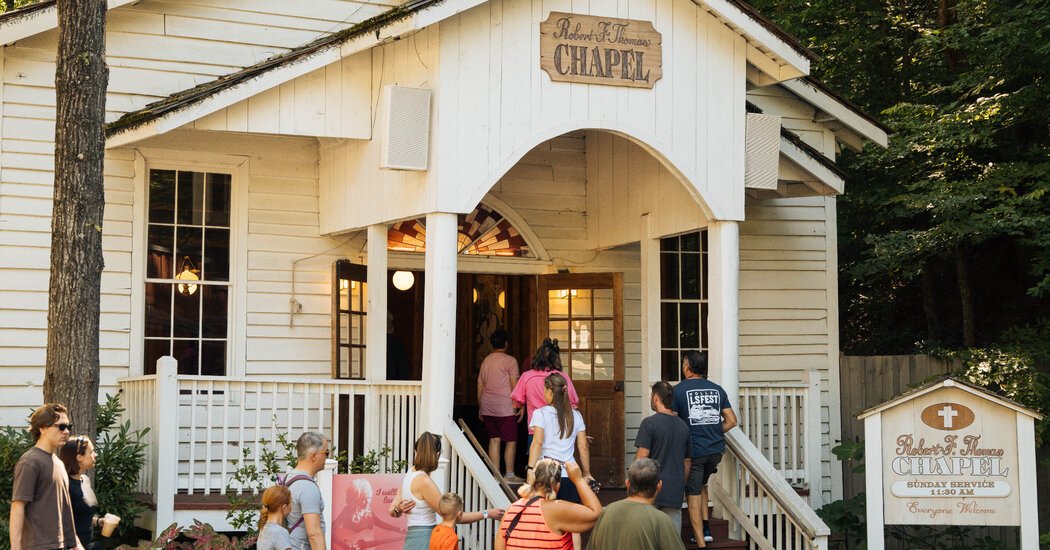
For years, Mary Berry attended a small Baptist church in the rural Kentucky community where her family has lived and farmed for generations.
She taught Sunday school. She brought food to hundreds of potlucks. At one point she served as a deacon alongside a janitor, a tenant farmer, and the community’s doctor. Everyone knew everyone, and if differences of opinion were sensed, they were not discussed.
As the local economy suffered in the early 2000s, however, so did the congregation. Disputes arose over cultural and political topics that had never been at issue before. A pastor was ousted over his stance on same-sex marriage. Ms. Berry left, too.
“As I got older and began to see the loss of the cohesive agrarian culture I grew up in, I began to see what we were really losing was that sort of gathering where all kinds of people gathered as equals,” Ms. Berry, the daughter of the poet and farmer Wendell Berry, recalled this week. “It wasn’t perfect, but it was pretty darn good.”
She was speaking days after the death of Dolly Parton, a woman who was also shaped by a small rural church in Appalachia.
Since her death in Nashville last week at the age of 80, tributes have poured in from conservative Southern Baptists and progressive Unitarians, from twice-on-Sunday churchgoers to people who avoid institutions altogether.
What many of them seemed to be mourning was not just Ms. Parton as a performer, but as a Christian who represented for many an idealized style of faith, and in particular, Southern or Appalachian faith: folksy and unpretentious, oriented around Jesus and rollicking old-time music, and centered in small rural congregations that prize community over ideology.
Those small churches “are very place-based, deeply rooted institutions” said Jessie Wilkerson, a professor at the University of Tennessee in Knoxville and a historian of Appalachia.
Ms. Parton’s lifetime saw the rise of megachurches, which have replaced many more intimate congregations like the one she was born into. About one in three Protestant churchgoers now attends a church that attracts at least 1,000 people on a weekend, according to the Hartford Institute for Religion Research.
Those large churches, including those anchored by a central congregation that plants multiple campuses throughout a region, have damaged many independent congregations with fewer resources.
Ms. Parton’s grandfather was the pastor of the House of Prayer, a small Pentecostal church in Sevier County, Tenn. She was singing in the choir by age 6, and was baptized in the Little Pigeon River at 12. Her faith has infused countless songs, even as she wrestled with the occasional contradictions between what she called her “three passions”: God, music and sex.
“Rural southern Christianity, especially at that time, seemed much warmer than what we see in American life now,” said Russell Moore, an editor at large and columnist at Christianity Today magazine, who was raised in a Baptist church in rural Mississippi and now lives in Nashville. “You actually did have people in community, meaning people knew when someone was sick, and could bear with other people’s failings.”
But he cautioned against idealizing the era. “The shadow side of that was often propping up horrific sin, such as what we see in Jim Crow racial oppression,” he said. “We can’t talk about one without seeing the other.”
More scholarship is needed about the role of small churches in the racial conflicts of the 20th century, said Anthea Butler, an emerita professor at the University of Pennsylvania who studies race and American religion. In her view, the widespread nostalgia for a Dolly-style Christianity is primarily about the experience of belonging to any kind of close-knit church that offers deep relationships and sets the rhythms of the week.
“People have forgotten all these hymns, people don’t think about having Sunday dinner after church, these communal activities in spaces that are small but feel homey,” she said. “All we see are big church things, big church scandals.”
In South Carolina, Alphaeus Anderson was leading the University of South Carolina Upstate Gospel Choir in a performance of Ms. Parton’s classic “9 to 5” on Tuesday when the singers noticed people in the audience checking their phones with urgency. The news was breaking that Ms. Parton had died.
The coincidence had Mr. Anderson thinking about his own upbringing playing gospel music at First Baptist Church of Fairforest, S.C., a Black congregation where the pastor was also a powerful gospel singer, and prayer often blended into music.
Mr. Anderson’s parents still attend the church, and he visits on holidays. But the congregation has gotten much smaller and older over the years.
“No youth, no church,” he said. “A few more birthdays, and not just my home church but the rich legacy they’ve instilled in us will disappear with them.”
Like many Americans, Ms. Parton came to describe herself as spiritual but “not that religious.” As an adult, she was not known to attend public services regularly.
About 45 percent of white Southerners who identify as Protestant go to church no more than once a year, according to an analysis of 2018 data from the General Social Survey by Daniel K. Williams, a historian at Ashland University in Ohio. Gallup found that churchgoing by Black adults dropped by almost 20 points between 2000 and 2020.
“In the Bible Belt, churchgoing is important, but faith, and especially evangelical faith, transcends church boundaries,” Mr. Williams said.
Despite her move away from organized religion, the archetype of the country church remained a touchstone for Ms. Parton — one she felt wistful enough about to build a version for her fans. She oversaw the installation of a one-room chapel on the grounds of Dollywood, her flagship amusement park in Pigeon Forge, Tenn. A staff chaplain presides over Sunday services.
For Silas House, a novelist who grew up in a congregation in eastern Kentucky about 90 minutes from Ms. Parton’s hometown, the small rural church of his childhood was a paradoxical institution. Its members taught him the “radical empathy” of Jesus, he said. But he also knew from a young age that if they knew he was gay, that empathy could be withdrawn.
Ms. Parton’s public persona as someone who consistently embraced gay people and was also “quite Jesus-y” was a balm to him in later years when he didn’t feel comfortable attending church.
“For a lot of people including myself, Dolly became what we wanted out of Christianity,” Mr. House said. “She was one of the people who allowed me to come out, and one of the people who allowed me to retain my faith.”
Over the years, many Christian denominations and individual churches and believers have moved to embrace gay people. Mr. House is now an active member of an Episcopal congregation in Lexington that sponsors the city’s Pride parade.
In 2018, he published a novel about an evangelical pastor in Nashville who faces a reckoning as he begins to shift his opposition to homosexuality. He got a letter in the mail from Ms. Parton, addressed to him and his mentor: “It’s a wonderful and much needed story,” she wrote. “God bless you both.”