dailynewsnblog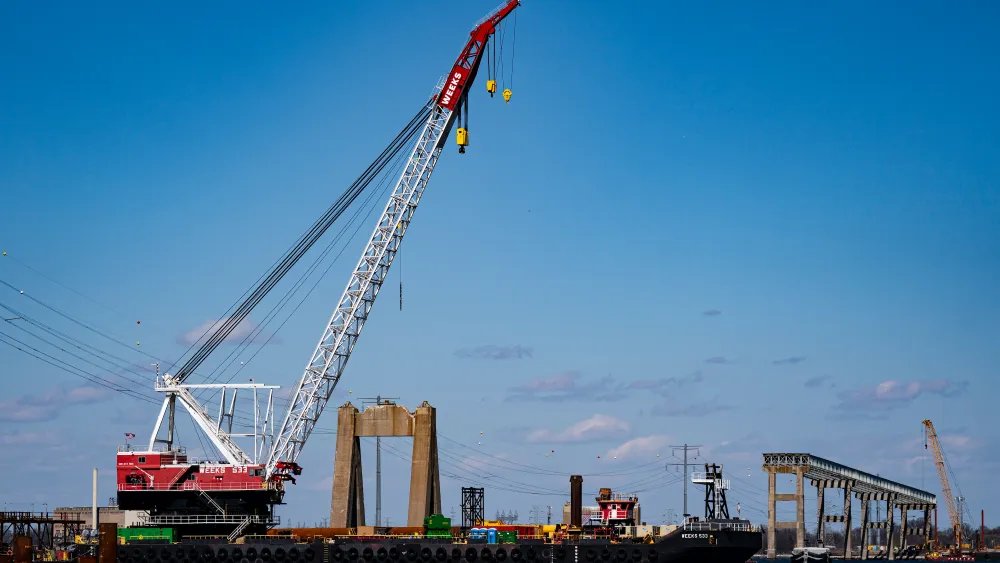
The Department of Justice has filed criminal charges against the operators of the container vessel that crashed into Baltimore’s Francis Scott Key Bridge in March 2024. That accident caused the bridge to collapse, killing six construction workers.
The indictment names Singapore-based Synergy Marine Private Ltd. and its India-based subsidiary Synergy Maritime Private Ltd. as co-defendants, alongside Radhakrishnan Karthik Nair, a 47-year-old an Indian national who was the technical superintendent for the M/V Dali container ship involved in the accident.
Synergy could face fines of up to $10 billion, said Kelly Hayes, U.S. attorney for the district of Maryland, at a news conference Tuesday. If convicted, the U.S. could also seek restitution and forfeiture from Synergy, she said.
Federal prosecutors levied 18 counts against the defendants, including obstruction of an agency proceeding, conspiracy to defraud the U.S. government and misconduct or neglect of ship officers resulting in death. Additionally, the DOJ is accusing the parties of willfully failing to immediately inform the U.S. Coast Guard of a known hazardous condition and making false statements during the investigation.
“The collapse of the Francis Scott Key Bridge was a preventable tragedy of enormous consequence,” said Acting Attorney General Todd Blanche, in a statement. “This indictment is a critical step toward holding accountable those whose reckless disregard for maritime safety regulations caused this disaster.”
Blanche indicated that the incident inflicted more than $5 billion in economic damages and released pollutants into the Patapsco River and Chesapeake Bay.
Shipping traffic to the Port of Baltimore shut down for weeks as local response teams cleaned up containers and debris from the bridge from the river.
The indictment also charges Synergy with violations of the Clean Water Act and other environmental laws due to river pollution from debris from the wreckage of both the ship and the bridge.
Synergy is denying all charges.
“This was a maritime casualty that should be assessed through the full factual, technical and regulatory record, rather than through selective mischaracterizations in a criminal indictment,” said Synergy Marine in a statement. “Synergy will vigorously defend itself against these inaccurate allegations.”
At the briefing, Hayes said Nair was believed to be in India, but that “we are going to enforce all of and use all of our available law enforcement tools” to bring him to the U.S. to face trial.
On the morning the 900-foot Dali vessel navigated out to sea from the Port of Baltimore, it lost power twice in a four-minute span, causing it to crash into the Key Bridge.
Stemming from the NTSB’s findings, the indictment alleges that a loose wire in a high-voltage switchboard likely caused the first power loss.
The systems on the Dali were originally designed with reliable redundancies and automatic restart capabilities so the ship could quickly regain power after a blackout. But shortly after the vessel regained power, it lost power again.
According to the indictment, the defendants allegedly altered the ship and relied on a flushing pump to supply fuel to two of the Dali’s four generators. However, the flushing pump was not designed to automatically restart following a blackout, and the Dali’s generators could not operate without a fuel supply, so the ship ultimately experienced the second blackout.
The indictment alleges that if the Dali used the proper fuel supply pumps, the vessel would have regained power in time to safely navigate under the Key Bridge.
In late 2024, Grace Ocean and Synergy Marine settled a more than $100 million lawsuit the Justice Department levied against them for damages related to the crash.
Maryland’s settlement does not resolve the state claims against the vessel’s shipbuilder, Hyundai Heavy Industries. In its final report issued in November 2025, the NTSB found Hyundai Heavy Industries to be at fault in causing the M/V Dali’s loss of power and its allision with the Francis Scott Key Bridge. The state intends to pursue those claims.
Last year, Grace Ocean and Synergy Marine filed a lawsuit against Hyundai Heavy Industries, accusing the South Korean firm of negligence in designing and manufacturing the switchboard.
The Key Bridge is anticipated to be fully rebuilt and opened by late 2030. The reconstruction project is expecting to cost between $4.3 billion and $5.2 billion, more than doubling initial estimates of $1.7 billion to $1.9 billion.