dailynewsnblog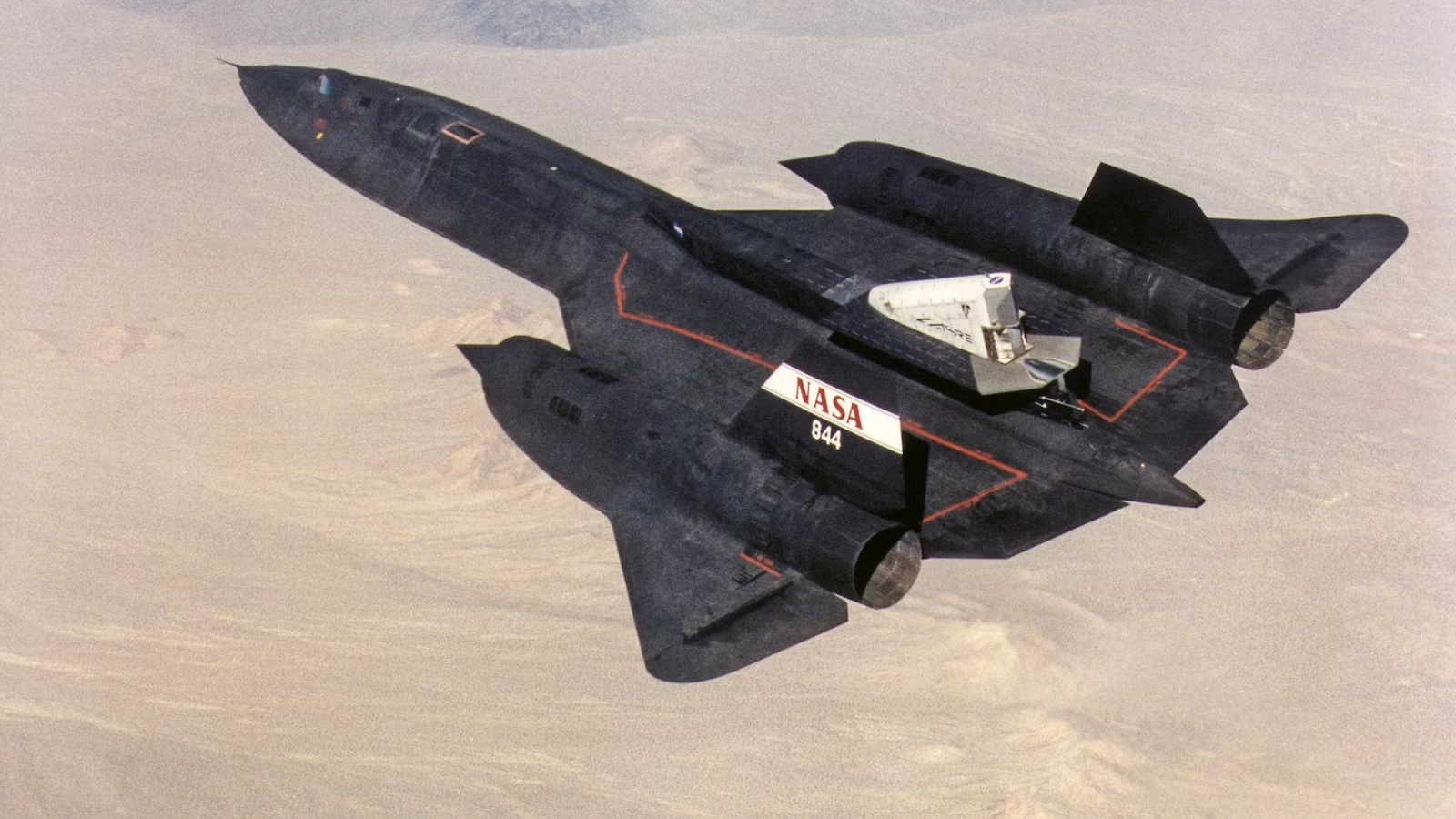
The Lockheed SR-71 Blackbird spy plane is the stuff of legends. While it was reported by the pilots that flew it to have been engaged thousands of times, it was never brought down in combat. In fact, the US Air Force (USAF) even used the Blackbird as a target for its most advanced fighter jets and missiles, including the F-15 Eagle and the Navy’s F-14 Tomcat.
In certain favorable conditions, these jets could successfully intercept the SR-71, but it was a struggle with the odds stacked against them. The exercises also led to improvements, as they revealed that the F-15’s radar had not been tuned for these sorts of engagements. Early on, the SR-71 could simply be invisible to the Eagle pilot. Still, these are historical exercises, and the results would likely be very different if it were rerun today.
Why USAF & USN Practiced Shooting SR-71s

The Lockheed SR-71 Blackbird was the fastest air-breathing manned aircraft to ever enter into service. It was designed to fly at around 80,000 feet (24,400 meters) and outfly the interceptor aircraft and missile defenses of the Cold War. A common figure floated around online is that some 4,000 Soviet and other missiles were fired at the aircraft, but none ever impacted. In the end, the SR-71 retired in 1998 without ever having been shot down.
But those missiles were from Soviet forces, and other forces (e.g., Libya) using Soviet equipment. What about US-made fighter jets? Were they theoretically able to engage the Blackbird? Former Blackbird pilot Colonel Richard H. Graham has written a book on the SR-71 and helps to answer this question. The book is entitled The Complete Book of the SR-71: Every Aircraft, Pilot, and Story from 1963.
The purpose of the exercises was to provide the fighter jets with practice at detecting, tracking, locking on, intercepting, and simulated firing of their then-advanced “F-14 Phoenix missiles and the F-15’s Sparrow missiles at a high altitude, high-speed target.” Sometimes the best way to prepare for the enemy is to train against harder targets.
When Tomcats & Eagles Could Engage SR-71s

According to Graham, the US Air Force had two fighter jets that could engage the Blackbird under certain conditions. These were the F-14 Tomcat and the F-15 Eagle. Both scored simulated victories, but only under conditions stacked in their favor. When the SR-71 was flying as intended in a threatened environment, it was almost impossible for the fighter jets to achieve a proper firing solution. The Tomcat Chase missions took place over the Pacific Ocean, while the F-15 Eagle Bait missions took place over the Nellis Air Force Base area in Nevada.
Catch what other flight trackers miss
Emergency squawks, holds, NOTAMs — live signals, no signup.
Open tracker
Catch what other flight trackers miss
Emergency squawks, holds, NOTAMs — live signals, no signup.
Open tracker
In the book, Graham writes of flying his Blackbird during a training sortie. “Don [the backer Reconnaissance System Officer] and I, as well as many other crewmembers, had flown numerous ‘Tomcat Chase’ and ‘Eagle Bait’ sorties against our best fighters – the Navy’s F-14s and the Air Force’s F-15s.” The intercepts were conducted in a controlled environment rigged to favor a successful outcome for the fighter jets.
He explained, “To maximize scarce, high altitude/high-speed intercept practice for the fighters against the SR-71, we stacked the deck in their favor to avoid a multitude of missed intercepts, and consequently, wasted time.” But even then it was incredibly difficult for the American fighter jets to successfully engage the Blackbird. Graham remembers that under the highly controlled flying conditions, the Tomcats and Eagles had “extreme difficulty” achieving an SR-71 victory. The fighters were able to lock on the SR-71 only after the Blackbird crew turned off their defensive countermeasures.
Why Blackbirds Were Invisible To F-15 Radar

The Aviation Geek Club quoted another SR-71 pilot, Dave Peters, who adds some more context. He said, “One of the interesting discoveries from those missions, especially the Eagle Bait, was that they [F-15s] couldn’t even find us when everything was shut down and we told them exactly where we were.” Peters then explains that the Blackbird pilots realized that the F-15 Eagle had a “speed gate on their radar at 1500 kts” while the SR-71 was “casually warping along from 1850 to 2000.”
For the F-15’s radar, Peter’s explains, “we didn’t exist.” Peter retired in 1986, but the exercises continued. He said that the Navy’s F-14 Tomcats could detect the Blackbird, but that “they couldn’t do anything until we modified and gave them times, route of flight, speed, and altitude beforehand so they could have a pre-planned setup.”
1980s Vs. 2020s | Early F-15 Eagle | Modern F-15EX Eagle II | Significance against SR-71 |
|---|---|---|---|
Maximum speed | Mach 2.5 | Mach 2.5+ | Little changed |
Radar | AN/APG-63 pulse-Doppler | AN/APG-82 AESA | Massive improvement |
Fire-control processing | Early-generation computer architecture | Modern digital mission computer/open architecture | Much better against high-speed targets |
Primary BVR missile | AIM-7F/M Sparrow | AIM-120D/D3 AMRAAM | Massive improvement |
Off-board cueing | Limited | Extensively networked | Potentially transformative |
Overall engagement | Extremely difficult | Potentially substantial kill opportunity | Table flips |
The interesting thing was that the F-15’s radar issue was more of a software issue than a fundamental inability of the radar to detect the SR-71 flying at Mach 3. The F-15’s old APG-63 radar was a pulse-Doppler radar that could distinguish aircraft from ground clutter. Because the F-15 was designed for a different threat environment, the signal processor was programmed not to treat that return as a legitimate target in that operating regime.
Returning The F-15’s Radar

One radar issue was closing velocity. If the two aircraft were flying head-on, then the F-15 might be flying 600 knots and the SR-71 might be doing 1,900 knots with a closing velocity of around 2,500 knots. Here, the issue is different from ground-based radar. It’s not the speed of the SR-71; it’s the speed of the SR-71 and the F-15. The original Eagle Bait exercises exposed a problem with the F-15’s fire-control-system speed gate.
The computed closing velocity wasn’t great enough for a head-on SR-71 intercept. Because this was a programming issue, software changes solved the problem. Put another way, the exercises did what they were designed to, find issues and then fix them. The later APG-70 radar incorporated a programmable signal processor that specifically enabled major changes through software rather than hardware modification. But even after the SR-71 was built into the assumptions of its radar software, the F-15 still struggled to engage the SR-71.
The F-15 could then see and track the SR-71 under more circumstances, but it still struggled to intercept it. Much of the issue was altitude. The F-15 might be flying at 25,000 feet (7,600 meters), while the SR-71 might be at 80,000 feet (24,400 meters), requiring the missile to climb 55,000 feet (16,700 meters). Also, at that altitude, the thin air made maneuvering difficult for the missile’s control surfaces. Put another way, it’s not just the F-15; it’s the missile too.
Why Modern Radars Struggle With Drones

A modern analog to the F-15’s early Doppar radar issue is radars not detecting drones as they approach bases. In many cases, the limitation has not necessarily been the radar’s ability to receive a return, but its ability to distinguish that return from clutter. But radars have been set to filter small, slow-flying objects and birds out of clutter to keep the false alarm rate manageable. The radar software is designed to focus on fast objects, such as missiles and aircraft.
One of the issues with drones suddenly appearing over bases in 2024 and 2025 is that they fly within the clutter suppression parameters of the radars, basically as birds. Another issue has been their low altitude. A particularly thorny issue is a hovering drone. Radars are designed to look for moving objects, but a hovering drone is almost stationary relative to the radar.
The military can lower the detection threshold, but this risks producing false-alarm saturation with birds and other flying objects routinely triggering alarms. One technique being explored/used is micro-Doppler, which can detect small propellers spinning hundreds or thousands of times a minute. The F-15 problem was almost the opposite. It involved a high-velocity/closing-speed processing limit; the drone problem generally involves low Doppler, weak returns, and clutter rejection.
F-15EX Is Vastly More Capable

It should be stressed that while first-generation F-15 Eagles struggled with engaging SR-71s, that doesn’t mean it would hold true today if the Blackbirds were still flying. The modern F-15EX is dramatically more capable and carries far more capable missiles than its 1980s counterparts. An F-15EX with AIM-120D3 going against an unmodified SR-71 would likely have a credible and probably substantial kill opportunity.
The scenario becomes much more problematic if the SR-71 were to be modernized with air defense capabilities while maintaining the same Mach and altitude. Yet another complication is that in the 1980s, F-15 Eagles were largely lone warriors. Today’s F-15EX is a networked node benefiting from substantial off-board cueing. This also helps increase the odds of a successful intercept.
The F-15EX is still recognizably an Eagle, but its combat system is generations removed from the aircraft that participated in Eagle Bait. Its AESA radar, electronic warfare system, digital processing, datalinks, and modern missiles fundamentally change the engagement. The SR-71’s defense might be to change course and deny the F-15EX a good firing solution in the first place. The Blackbird may never have been shot down, but if it were to fly again now, the odds would likely flip.