dailynewsnblog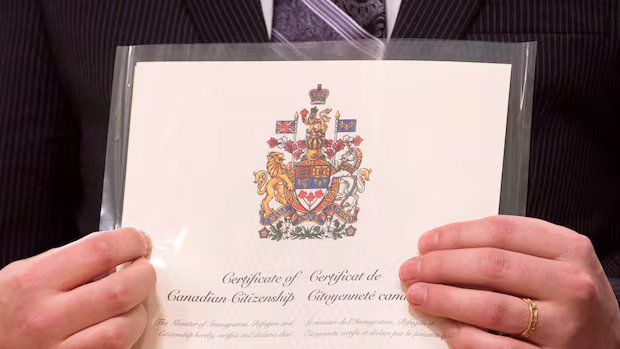
Applications from people around the world seeking Canadian citizenship certificates have been rising rapidly in recent months, fuelled by thousands of applications from the United States, CBC News has learned.
The number of people who have already received certificates as a result of Parliament’s adoption of “Lost Canadian” legislation late last year rose nearly 50 per cent between April 1 and May 31, according to new data obtained by CBC.
Bill C-3 allows citizenship for those who can prove they’re descended from a Canadian ancestor, even if that ancestor left the country several generations back. It was adopted after the courts ruled that limiting citizenship to the first generation born outside of Canada was too restrictive.
Between mid-December — when Bill C-3 went into effect — and May 31, some 6,100 citizenship certificates were granted by Immigration, Refugees and Citizenship Canada (IRCC) to those who now qualify.
That is up from 4,075 certificates issued as a result of Bill C-3 from mid-December until March 31.
Another 17,390 people have received certificates as a result of having a Canadian parent. Prior to the bill’s adoption, those who were born outside Canada had to have a Canadian parent to qualify for citizenship.
Tip of the iceberg
The certificates allow the 23,490 newly recognized Canadian citizens to apply for Canadian passports and live and work in Canada.
Elections Canada, however, says they can’t vote in federal elections unless they’ve lived in Canada at some point in their life.
People born in the U.S. account for nearly half of those recognized between mid-December and the end of May. According to the data from IRCC, 3,110 Americans have qualified for Canadian citizenship certificates as a result of Bill C-3, while another 8,125 Americans have been granted certificates because one of their parents was born in Canada.
However, that’s just the tip of a very big iceberg.
The number of citizenship certificate applications waiting for a decision has exploded. In April, around 56,000 applications were waiting to be processed. That climbed to 70,400 in May.
Now, the IRCC’s website says 121,800 people are waiting for a decision. Those applications could be for anything from seeking recognition as a citizen under Bill C-3 to requesting a routine replacement of a lost or stolen certificate.
At the same time, the estimated wait time for a decision has doubled from 12 months in May to 25 months as of Aug. 10.
Estimates of just how many people could qualify for Canadian citizenship as a result of Bill C-3 vary widely.
Some point to a span of over 100 years in the 1800s and 1900s when hundreds of thousands of Canadians — particularly from Quebec — flowed over the border to jobs in the U.S.
The parliamentary budget officer has estimated that 115,000 people could be affected by the change in the law.
Last October, Immigration Minister Lena Metlege Diab told the House of Commons immigration committee that she didn’t expect a flood of applications for citizenship certificates once Bill C-3 went into effect.
“We anticipate volumes in the tens of thousands over time,” she said. “We do not expect any surge.”
Taous Ait, spokesperson for Metlege Diab, said IRCC took steps beforehand to prepare for the implementation of Bill C-3 and is working to process applications as quickly as possible while protecting the integrity of the citizenship program.
“We’re closely monitoring application volumes and trends and will adjust our operations as needed to manage demand as efficiently as possible,” Ait said.
IRCC has not changed its requirements for documents, she added, but has taken steps to make the requirements clearer on its website and in other information for the public.
Demand soars for genealogical records
Meanwhile, Canada’s archivists are reporting a sharp rise in the number of requests for the genealogical records needed to prove someone seeking a Canadian citizenship certificate under Bill C-3 has an unbroken line of descent from a Canadian ancestor.
Alyssa Hyduk, president of the Association of Canadian Archivists, says her members are swamped, with some institutions seeing requests jump by 100 to 300 per cent.
Some are for documents that go back hundreds of years, she added.
“I think across the board there is this overwhelming feeling of just, of overwhelm and burnout …it’s really having an impact,” Hyduk explained.
“These requests are taking up so much of archivists’ time that other reference requests — the [ones from the] rest of the public that we’re trying to still serve and do all our jobs — those are being set back too.”
Hyduk said the requests, most of which appear to be coming from the United States, are often complicated, as the records pre-date Confederation or are located in small church archives.
“We are at the point where [we’re] going through boxes and boxes of material to find a single document sometimes,” she said. “You are going through reels of microfilm to find ship manifests with one name.”
“And these aren’t searchable documents,” she added. “We can’t go to Ctrl+F and find a last name. We have to read the handwriting. We have to figure it out.”
Archivists need more funding, says group
Mab Coates-Davies, executive director of the association, says the requests can also take an emotional toll on archivists.
“It is personal, it’s emotionally charged, it’s about family history,” she said. “There’s so many reasons that people, you know, might be looking to leave the States right now or planning for future moves.
“And so, there is that human element to it that archivists are feeling and experiencing, and frankly, IRCC isn’t on that front line in terms of the documentation.”
Another problem archivists are facing is the list of documents that IRCC will accept keeps evolving, said Hyduk. When the association met recently with the department, IRCC didn’t want to provide a definitive list of documents, saying it was likely to change.
The association is calling for more funding for archives across the country to keep up with the demand for records created by Bill C-3.
Coates-Davies said the flood of requests also began just as the Carney government’s budget cuts ended Library and Archives Canada’s $1.5-million-a-year Documentary Heritage Communities program, one that many small-and-medium-sized archives across the country have counted on for funding help.
“This funding package was just cut and then our workload skyrocketed,” Coates-Davies said.

Another wave looms?
During an association meeting last week, some archivists were also bracing for a new wave of requests for genealogical records.
In June, IRCC suddenly suspended an estimated 100 certificates that had already been issued after flagging problems with the documents submitted with the applications. The concern from archivists is that some people who’ve already applied to IRCC will be sent back to archives to find more genealogical records.
The IRCC says 83 of the suspensions have been resolved and the certificates restored. It has sent procedural fairness letters to another 17 people whose certificates were suspended and given them 60 days to submit the documents necessary to prove their Canadian ancestry.
If they fail to provide acceptable proof, their citizenship certificates could be revoked.
New Democrat immigration critic Jenny Kwan said she has been getting letters and inquiries from people affected by the suspension letters and has written to Metlege Diab, calling for answers.
“It really makes no sense whatsoever, what’s going on,” Kwan said. “And the minister is completely ignoring that reality right now.”