dailynewsnblog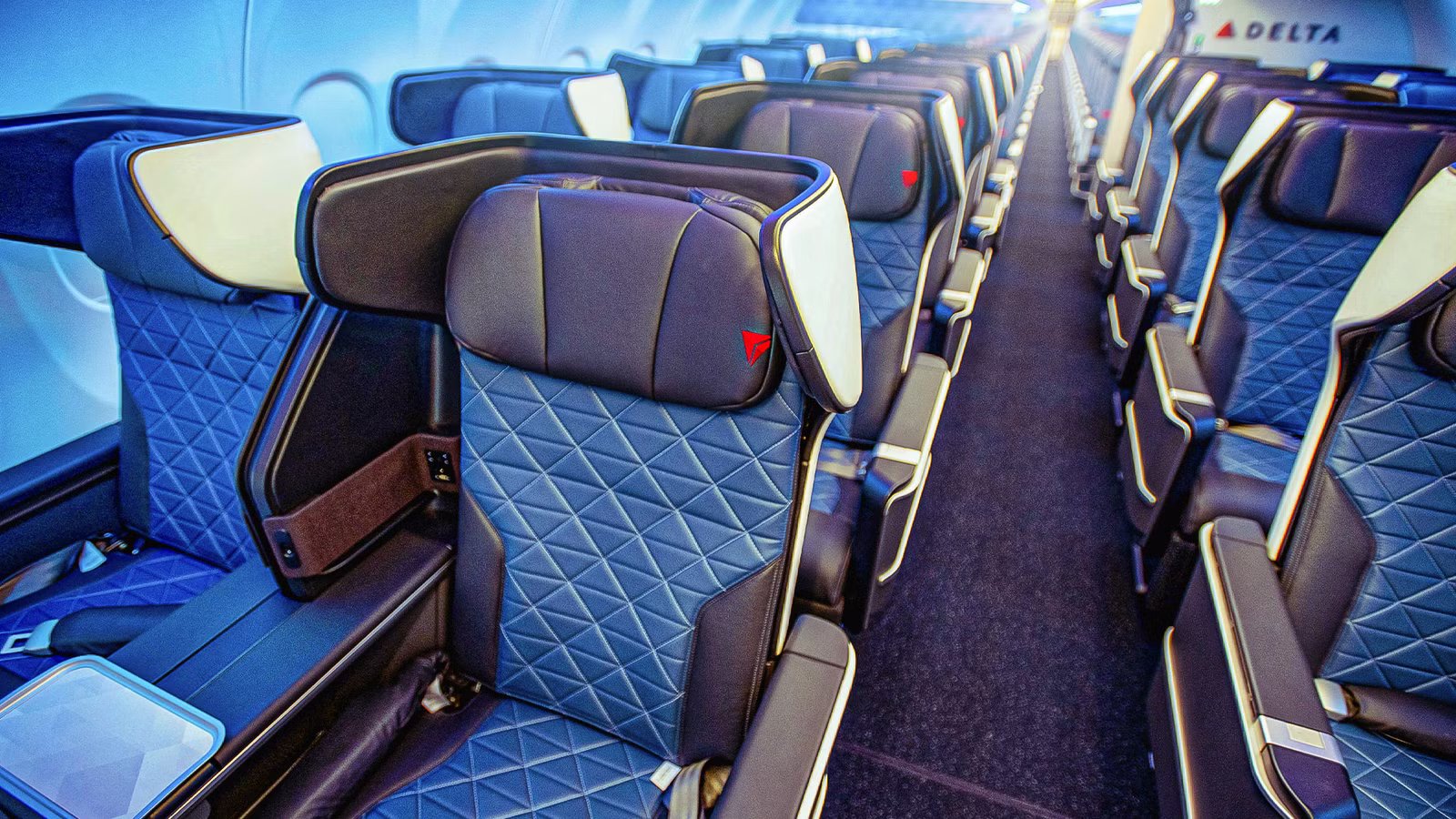
In recent years, airlines have been expanding their premium offerings on transcontinental services: JetBlue’s Mint-equipped Airbus A321 fleet and  American Airlines‘ A321T have already built a strong presence in the premium transcontinental market, while
  United Airlines is launching its new A321neo “Coastliner” configuration for similar transcontinental operations this summer. As more US carriers continue to invest in premium narrowbody aircraft with fully flat beds, pressure is growing on
  Delta Air Lines to deliver a comparable product.
Delta actually announced plans for a similar premium-heavy configuration onboard the Airbus A321neo years ago already. However, things are not going as planned and delays are causing the introduction of the new lie-flat business class product to be pushed backwards until at least 2028. To avoid the new A321neos that were planned to feature the new cabin and replace older Boeing 757s, to stand idle indefinitely, Delta has opted to put the jets into service with an unconventional temporary configuration.
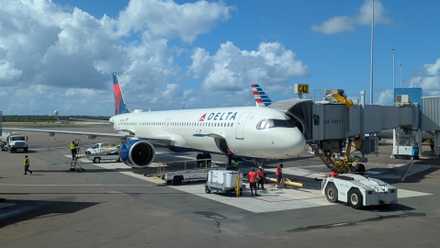
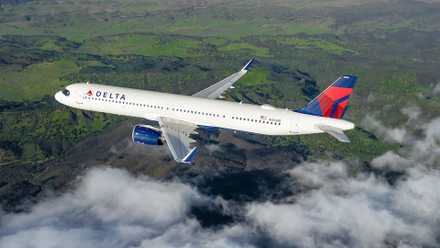
The Atlanta-based carrier is temporarily deploying up to seven brand-new A321neos with 44 domestic first-class recliner seats, creating what is likely the most extreme premium-heavy narrowbody cabin ever flown by a US airline. However, this is not a bold experiment or a permanent new cabin strategy. Instead, the layout is a creative workaround caused by supply chain and certification delays affecting the lie-flat Delta One suites originally planned for these aircraft.
This Is Why Delta Is Operating Domestic Flights With 44 First Class Seats

Since early May 2026, Delta Air Lines has been operating seven brand-new A321neos with a massive Delta First Cabin. With 44 seats, these aircraft have more than double the number of seats typically installed on the aircraft. This expanded First Class cabin occupies the first 11 rows in a 2-2 layout, featuring the same seats as in other domestically configured aircraft. In total, this new configuration will seat 164 passengers, with 54 passengers in Delta Comfort and another 66 in Delta Main.
The reason the Atlanta-based airline introduced such an odd configuration is the delayed delivery of its new Delta One flatbed suites for the aircraft. While it is not clear when the new suites will be delivered, the odd 44-seat configuration is definitely only a temporary solution. Mauricio Parise, vice president of Customer Experience Design at Delta, said the following relating to the airline’s latest configuration: “Rather than wait, we chose to implement a creative solution to ensure our customers had access to some of our newest aircraft in time for the summer travel season.”
As of writing, the aircraft is scheduled to fly on transcontinental routes between  Hartsfield-Jackson Atlanta International Airport (ATL) and Los Angeles (LAX), San Francisco (SFO), Seattle (SEA), and San Diego (SAN) starting June 7. Between Atlanta and Los Angeles, the airline will also continue to operate widebody aircraft featuring both Delta One Suites and the Delta Premium Select cabin.

Delta’s 44-Seat First Class A321neos Debut Confirmed: Here’s Where They’ll Fly
Coming to four premium transcontinental routes as early as May.
This Is What The Temporary Product Will Look Like

While the airline’s temporary solution can’t truly replace the new Delta One lie-flat seats, each seat still features a personal IFE screen, a generous recline, power sockets, and USB charging ports. The seats used by Delta are highly customized  RECARO Cl4710 seats, designed with privacy in mind, including privacy dividers between seats as well as headrest privacy wings. According to Delta, distinct service procedures have also been created for the aircraft to ensure customers experience Delta First service in the expanded cabin, as they do in the current A321neo configuration.
|
Seat Count On Delta Air Lines’ A321neo Aircraft |
||
|---|---|---|
|
Cabin Class |
Premium-Heavy |
Regular |
|
First Class |
44 |
20 |
|
Delta Comfort |
54 |
60 |
|
Delta Main |
66 |
114 |
|
Total |
164 |
196 |
However, with only one lavatory for 44 passengers, and the need to prepare an equal amount of high-quality meals in a small narrowbody galley, it will be interesting to see whether Delta can deliver on its desired service level. This also makes the new cabin a real stress test of what is possible onboard the single-aisle jet. To mitigate these potential service quality issues, Delta is installing an additional oven onboard the aircraft and is rostering an additional flight attendant, with a total of three flight attendants dedicated to first class.
Nearly 40 Inches Of Pitch: Delta Air Lines Unveils Seat Map Of New Premium-Heavy Airbus A321neo
A new narrowbody is coming.
Why Delta Didn’t Add Premium Economy To The Aircraft Instead

While Delta and most other US airlines have introduced a premium economy cabin on their long-haul international flights, passengers who fly frequently within the United States have likely noticed that premium economy is not available on most domestic-configured aircraft. On long-haul flights, premium economy is typically used to bridge the gap between economy and business class. On flights lasting eight to 12 hours, passengers value wider seats, increased legroom, greater recline, and improved meals and service more than on a short two-hour flight.
Since most US domestic flights are relatively short, many passengers have a lower willingness to pay for the additional comfort. As a result, a lack of demand is the primary reason for the absence of premium economy on US domestic flights. Besides, the domestic first class product offered by US airlines often provides a comparable or slightly better experience than premium economy on these shorter flights. Because of this, adding a premium economy could create an unnecessary overlap between cabin classes.
Furthermore, instead of installing premium economy, US airlines have created upgraded economy sections that offer more legroom while keeping the same seat design. Examples of this include Delta Air Lines’ Comfort+, United’s Economy Plus, and American’s Main Cabin Extra. The seats on these products typically provide several extra inches of legroom and benefits such as early boarding or complimentary drinks. At the same time, the seats are almost identical to standard economy seats, meaning they cost little to install, yet passengers regularly pay up to hundreds of dollars extra per flight. From an airline perspective, this is pure ancillary revenue, something that is extremely profitable for airlines, thanks to its high contribution margins.
First Look: Inside Delta’s Massive 44-Recliner A321neo Ahead Of May 20 Debut
With nearly half the cabin dedicated to first class, Delta is committing to luxury.
This Is Delta’s Narrowbody Fleet In 2026

According to Planespotters.net, Delta has a total of 1,000 active aircraft in its mainline fleet as of May 2026. Of these aircraft, 821 are narrowbody aircraft, mostly used on domestic and short-haul international routes. This fleet is almost evenly mixed between Airbus and  Boeing aircraft, with roughly half of the fleet being Airbus jets and the other half being Boeing jets. In total, the airline operates five different aircraft types, with eleven subtypes.
Delta’s sizable narrowbody Airbus fleet consists of almost all variants available today. The oldest aircraft in the fleet are the 45 A320s, at an average age of 29.3 years, followed by the 57 A319s at 24.3 years. Much younger is the airline’s sub-fleet of A321s with an average age of 5.2 years and comprising both the A321 and A321neo. The carrier operates 127 and 97 aircraft of these subtypes, respectively, and has another 102 A321neo on order.
Interesting to note is that Delta has not placed an order for any A321XLR variants, a type both American and United view as crucial in their long-term growth strategy. In addition to this already substantial Airbus fleet, Delta is also the largest operator of the Airbus A220. With the airline currently operating 45 A220-100s and 40 larger -300s, while expecting delivery of 60 additional -300s.
|
Delta Air Lines Narrowbody Fleet May 2026 |
||
|---|---|---|
|
Aircraft |
Number in Fleet (#) |
Average Age (Years) |
|
Airbus A220-100 |
45 |
6.4 |
|
Airbus A220-300 |
40 |
2.8 |
|
Airbus A319-100 |
57 |
24.3 |
|
Airbus A320-200 |
45 |
29.3 |
|
Airbus A321-200 |
127 |
7.4 |
|
Airbus A321neo |
97 |
2.2 |
|
Boeing 717-200 |
80 |
24.6 |
|
Boeing 737-800 |
77 |
24.7 |
|
Boeing 737-900ER |
163 |
10.4 |
|
Boeing 757-200 |
74 |
28.2 |
|
Boeing 757-300 |
16 |
23.3 |
|
Source: Planespotters.net |
||
The airline’s Boeing fleet consists of three aircraft types and a combined five subtypes. Perhaps the most notable aircraft is the Boeing 717-200, which Delta still operates 80 of, making it one of the largest and only operators of the type. The 717s in Delta’s fleet have a respectable average age of 24.6 years. Another type, of which Delta is one of the last remaining operators, is the Boeing 757. The airline still operates a total of 100 757 aircraft, divided over 74 -200s and 16 -300s. Together with United Airlines, Delta operates almost 90% of the entire global 757 fleet.
In addition to the 717s and the 757s, a larger part of Delta’s narrowbody fleet consists of the Boeing 737. More specifically, of 162 Boeing 737-900ER aircraft, with Delta being the world’s largest operator of the type, and 77 Boeing 737-800 aircraft. While the -900 fleet only has an average age of 10.4 years, the -800 is significantly older at 24.7 years. From 2027 onward, Delta is also expecting the first of 100 Boeing 737 MAX 10 deliveries, ordered by Delta back in 2022.