dailynewsnblog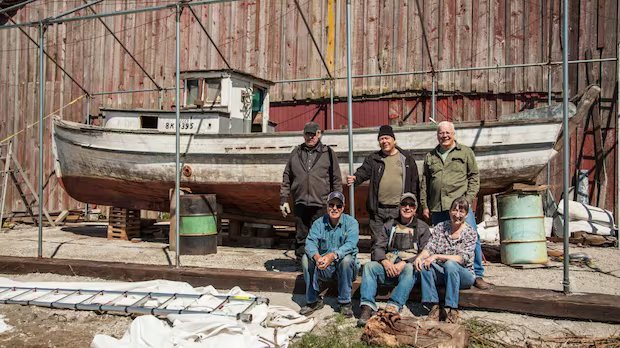
A historic fishing boat that reflects the impact of Japanese internment on B.C.’s coast is nearing the end of a long restoration project in Delta — but the community group behind it says the vessel still has no permanent home.
The Delta Fishing Heritage Society has spent more than a decade working on the Persian Fisher, a wooden salmon gillnetter believed to have been built in the 1930s.
“It’s a classic example of a salmon fishing vessel of its age,” says the society’s president John Stevens. “It’s representative of the rich fishing heritage of Delta, capturing some of the romance and hardship of life and times on a salmon gillnet fisher.”
He says their research indicates the 31-foot boat was built for a Japanese Canadian fisherman named Nobua Teshima, who at the time worked for a canning facility on the shores of Richmond’s Sea Island.

Teshima’s boat was confiscated by the Canadian government in the early 1940s, says Stevens.
It was one of more than a thousand fishing boats taken from Japanese Canadian owners after Canada declared war on Japan following the attacks in Pearl Harbor, says Michael Abe, project manager with Past Wrongs, Future Choices.
The third-generation Japanese Canadian says the boats were seized from fishing communities along the coast, many of them were collected and gathered at Annacis Island on the Fraser River to be sold off to canneries or non-Japanese fishermen — often without the consent of their owners.
“The dispersion of ownership of boats built by Japanese Canadians was opportunistic not only eliminating them from the fishing industry but allowing non-Japanese to acquire these boats at bargain prices,” he added.

Before the war, Abe says, Japanese fishers were a major force in B.C. ‘s fishing industry, holding the majority of fishing licences along the B.C. coast, particularly along the Fraser River and in communities such as Steveston.
“They were making a good living,” he said, adding that their success also made them targets of racist policies, some of which banned them from using motorized fishing boats back in the 1920s.
For Abe, any public display of the Persian Fisher should make it clear that the boat is not only an artifact of Delta’s fishing past, but also part of the history of Japanese Canadian dispossession.
“[Teshima’s] boat was built to support a family for generations and that was taken away so quickly through unjust policies.”
A long restoration process
After it was confiscated, Stevens says the Persian Fisher was later bought by a cannery owner and passed through several owners before ending up in the port of Ladner in Delta. It was retired in 1977 and stored for decades before its last owner donated it to the Delta Fishing Heritage Society in 2014.
Since then, the society president says, a small group of mostly older fishermen have been trying to restore it.
The society has put roughly $15,000 into the work so far, relying on volunteer labour and a provincial heritage grant of $17,500 they received last year.
The boat is about halfway restored, with much of the exterior complete, says Stevens.
He says the goal is to return the vessel to its 1940s-era appearance and place it somewhere public in Delta.
But the Ladner resident says the project has been slowed by a shortage of people with wooden boat restoration skills and years of uncertainty over support from the City of Delta.
“Our members are all getting pretty old,” said Stevens, who is 76. “There’s not many people that know how to work on wooden boats anymore, too. That’s also an issue.”

He said the society had an agreement with city staff to display the vessel near city hall but the pandemic derailed all the arrangements.
“The city still hasn’t recommitted to any of that,” says Stevens. “The question still remains … where are we going to put it?”
The society says they want the Persian Fisher displayed along the Ladner waterfront, potentially as part of the Ladner Village revitalization work.
Bev Yaworski, a longtime Ladner resident, said the boat deserves to be displayed and viewed. She says it not only celebrates fishing history, but also explains the treatment of Japanese Canadians during the Second World War.

“Those are mistakes that we need to keep remembering so that we don’t make those mistakes again,” she said.
Yaworski said her group has been encouraging residents to write to the council and support the project.
In a statement, the City of Delta said the society previously asked for support finding a site for the Persian Fisher on city-owned property but no suitable location was found at the time.
It says it will continue to speak with interested groups to see “what’s best suited for these spaces.”
For now, the Persian Fisher remains under a tarp at a local barn.