dailynewsnblog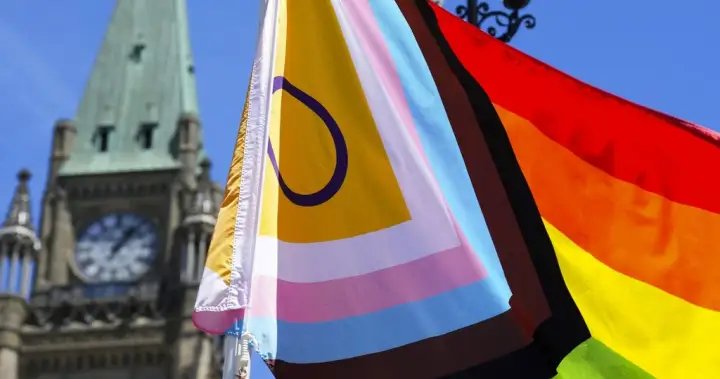
Earlier this week, Prime Minister Mark Carney and MPs from other political parties came together to raise the Pride flag on Parliament Hill.

But an advocacy group that helps LGBTQ refugees come to Canada and the U.S says the federal government’s new border law is putting people at risk of being sent back to countries where they face persecution.
Devon Matthews, Rainbow Railroad’s chief program officer, said her organization is concerned about its working relationship with Ottawa as the federal government reduces the number of refugees it admits and cuts the organization’s funding.
She said it’s also alarmed by a new law requiring that refugee claims be made within a year of the claimant’s first arrival in Canada.
“It has nothing to do with the reasons why someone may have waited or why someone doesn’t meet the one-year bar,” Matthews told The Canadian Press.
“It actually is purely just a technical eligibility requirement that doesn’t serve to actually give the opportunity for the person to speak to the intricacies of why they may have had to wait.”
A former Middle Eastern international student who lived as an openly gay man in Canada is among those left in limbo by the new law.
The former student told The Canadian Press he filed a refugee claim after photos of his time here in Canada were discovered once he returned home, putting his safety at risk.
But he said that because he studied in Canada for two-and-a-half years starting in 2022, he has been told his refugee claim is ineligible under the new border law, C-12.
The Canadian Press has agreed not to name him or his home country due to risks facing his family members still there.
“I was supporting the LGBTQ community and I was in a lot of events and some stories from social media that leaked out in my society back there,” he said.
“So some incidents and … some pictures had fallen into bad people’s hands and they threatened to inform the police and to beat me up. So it happened more than once, and when the last time happened I felt that I can’t live like that and I will be living in fear.”
Several Middle Eastern countries have morality laws that punish LGBTQ people with prison terms. The refugee claimant said his family would also face social and economic repercussions because of his orientation.

Get breaking National news
Get breaking Canada news delivered to your inbox as it happens so you won’t miss a trending story.
“When you get discovered as a LGBTQ person, that’s it, that’s the end of your life. You can’t work, you can be arrested in your home,” he said. “And of course, the scandal for the family, because it’s not something that’s accepted.
“So I ran because if that happened, I would spend my life in jail. Or even if they didn’t put me in jail for a long time, that’s it for my career, that’s it for my life.”
He said his refugee claim was proceeding smoothly and had been approved for file review — a less intensive examination for low-risk refugee claims.
But when C-12 passed earlier this year, he became one of roughly 30,000 people who received letters saying their refugee claim may no longer be eligible because they first entered Canada more than a year before making their claim.
The one-year rule applies to refugee claims made on or after June 3, 2025 and retroactively to first arrivals on or after June 24, 2020.
While refugee claims filed by people in this situation will not be sent to the Immigration and Refugee Board for review, they are still eligible for a pre-removal risk assessment, or PRRA. The PRRA has a historically low approval rate because it tends to be the primary appeal avenue for rejected claims at the IRB.
The PRRA process is primarily paper-based but interviews can be requested if an officer needs more information.
Immigration Minister Lena Diab told a Senate committee hearing in February that when it’s clear people should be able to stay in Canada based on documented evidence, “they get a ‘yes’ right away.”
The government has said it introduced the one-year rule in part because some people were making asylum claims in order to stay in Canada after their temporary visas expired.
Diab told the Senate committee that 37 per cent of refugee claims made between June 3, 2025 and Oct. 31, 2025 — roughly 19,000 documents — would be deemed ineligible under the one-year rule.
Suzy Newing, the Middle Eastern former student’s lawyer, said her client’s ineligibility is being challenged in court on constitutional grounds arguing that he has a right to an oral hearing — which is not guaranteed in the PRRA process — and anti-discrimination provisions.
She said there are a variety of reasons why an LGBTQ+ person might not make a refugee claim within a year of first arriving in Canada.
“For example, perhaps they came to Canada before recognizing or expressing or coming to terms with their sexual orientation, and then they start to express that here. That might not necessarily happen within one year of coming to Canada,” Newing said.
“They might have known (their orientation) all along, but managed to hide it in their country of origin. And then the one-year bar essentially forces the timing for when they would come out to their family members, because that’s often when the risk materializes … when individuals would come out to their family members when they’re here in Canada.”
Many Federal Court challenges of refugee claims being deemed ineligible under the new law have been referred to file review, so a judge is expected to rule broadly on the constitutionality of the one-year rule.
The Middle Eastern refugee claimant will now have to wait for either a PRRA or a court decision to learn whether he will be allowed to remain in Canada.
He said that even if he is allowed to stay, his trust in Canada has been shaken.
“Now I feel like I’ve been attacked by everyone, by the government, by the Canadian people and they just want people to leave,” he said.
“Kicking those people out, you are killing them because they are not returning back to live happily and fine and everything. You are pushing them back to their deaths.”
Matthews said Rainbow Railroad saw its largest-ever number of requests for help in 2025 — more than 20,000, a 51 per cent increase over 2024. She said the organization is on track to receive even more pleas for help this year.
Matthews said Rainbow Railroad is considering increasing its political activism in response.