dailynewsnblog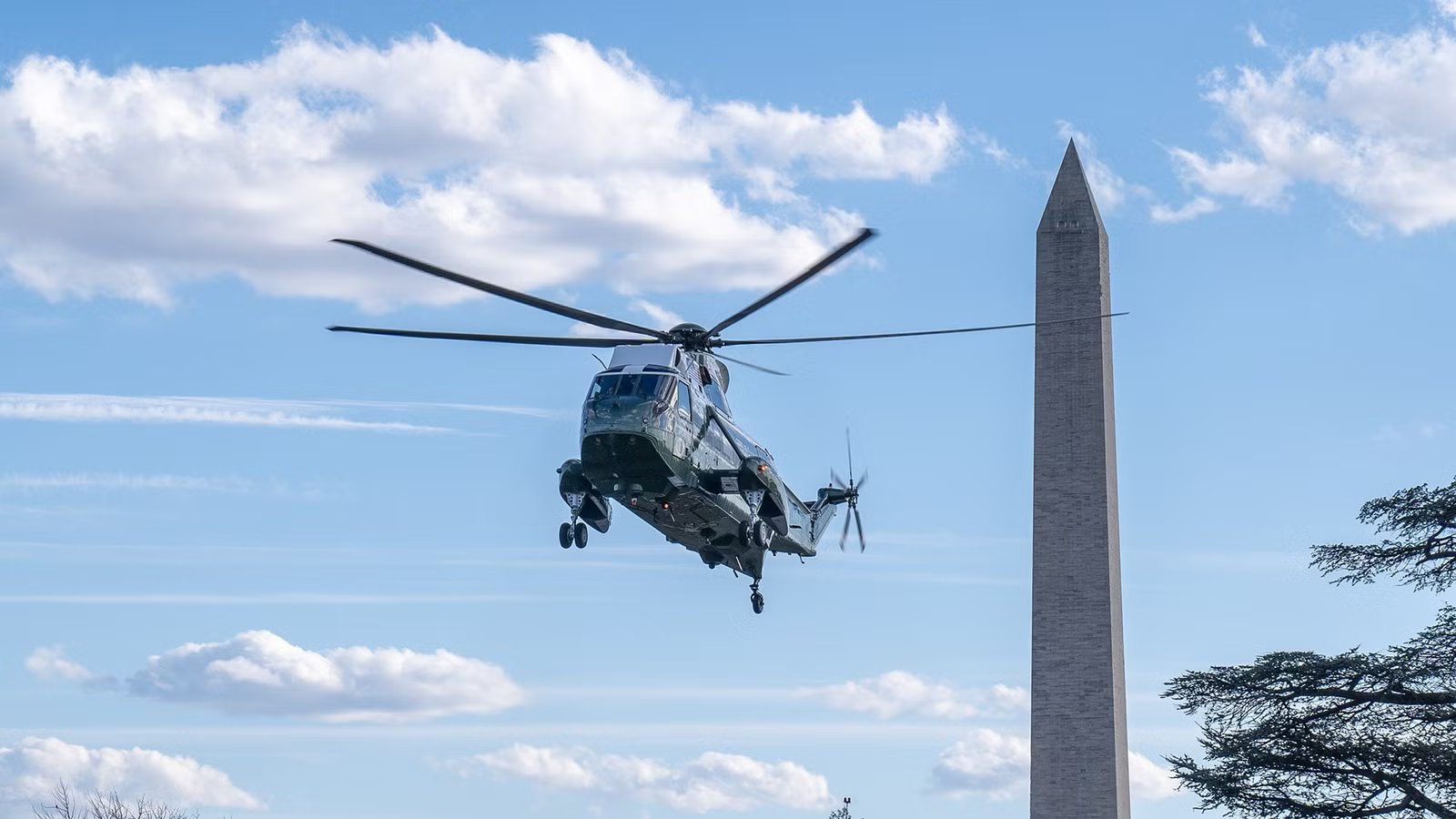
A military helicopter that was transporting the US President Donald Trump came close to a passenger jet earlier this month when the Sikorsky VH-3D Sea King helicopter, known as Marine One, failed to reach air traffic controllers before departing. The report, as published by Reuters, outlines that the helicopter pilots failed to reach air traffic control due to communication issues.
The incident, which occurred on August 4, happened when the helicopter was departing, and another American Airlines plane that was departing for Pensacola (PNS) was promptly rerouted out of caution.
Communication Issues Played Into Why The Helicopter Didn’t Advise Air Traffic Control

On August 4, the president was departing the White House on Marine One, and concerns were raised when it was identified that the passenger airplane was allowed to depart from  Ronald Reagan Washington National Airport (DCA) at the same time as Marine One was in proximity. Usually, when the President is traveling, commercial air traffic is typically halted.
In the report by the NTSB, the Marine One crew attempted on two occasions to advise ATC, for which a three-minute notice of departure is required. These communications were hampered, and as a result, the Marine One crew also attempted to contact controllers at Joint Base Anacostia Bolling; however, this remained unsuccessful.
Further investigation identified that there was interference with an antenna, and since then the procedure and the antenna have been relocated, which since have shown no further communication issues.
Communications ‘Have Been Spotty’

As described by the NTSB, Marine One crew had previously mentioned that communications had been spotty, and this clearly interfered with the flight on August 4. Marine One and ATC happened to meet on July 30 to discuss these concerns, including the interference that is needed for the three-minute-to-liftoff call.
The close call with the  American Airlines Envoy Air E170 service to Pensacola breached FAA rules that require aircraft to remain separated by a minimum of 1.5 miles (2.4 km) horizontally, and up to 500 feet (152 meters) vertically in and around airports. This instance saw Marine One, separated by just 0.82 nautical miles (1.51 km) horizontally, and 700 feet (213 m) vertically. At the time of the incident, the Pensacola inbound flight and another regional flight were rerouted out of caution.
Stricter permanent restrictions surrounding helicopter operations were implemented after the fatal January 2025 midair collision that occurred above the Potomac River when an American Airlines regional jet collided with an Army helicopter, killing everyone onboard.
Temporary Safety Bubble Implemented Whenever Marine One Operates

Washington National frequently halts takeoffs and landings when required to create a safety bubble for the presidential helicopter operating on a conflicting route. There is a three-minute warning that is required by Marine One to advise the control tower before the helicopter lifts off from the White House or nearby area.
Known as Ronald Reagan Washington National Airport (DCA), the airport is the closest airport to the nation’s capital and is one of two airports owned by the federal government. The airport serves more than 100 nonstop destinations, and remains a hub for American Airlines. The airport is home to the Coast Guard Air Station Washington, and remains the 27th busiest airport in the United States, with last year recording more than 24.8 million passengers across 297,737 flight operations according to the FAA. It has three runways, as detailed below:
01/19 | 7,169 feet (2,185 m) |
|---|---|
15/33 | 5,204 feet (1,586 m) |
4/22 | 5,000 feet (1,524 m) |
Air traffic controllers will then implement a pause on all commercial departures and arrivals that would interfere with the helicopter’s path. The airspace rules restrict routing paths to low-flying military helicopters from other commercial aircraft in the Washington, D.C. area. Officials continue to meet to discuss concerns and improve signal frequencies, while also maintaining backup notification channels and further tower coordination in a bid to prevent future close calls.