dailynewsnblog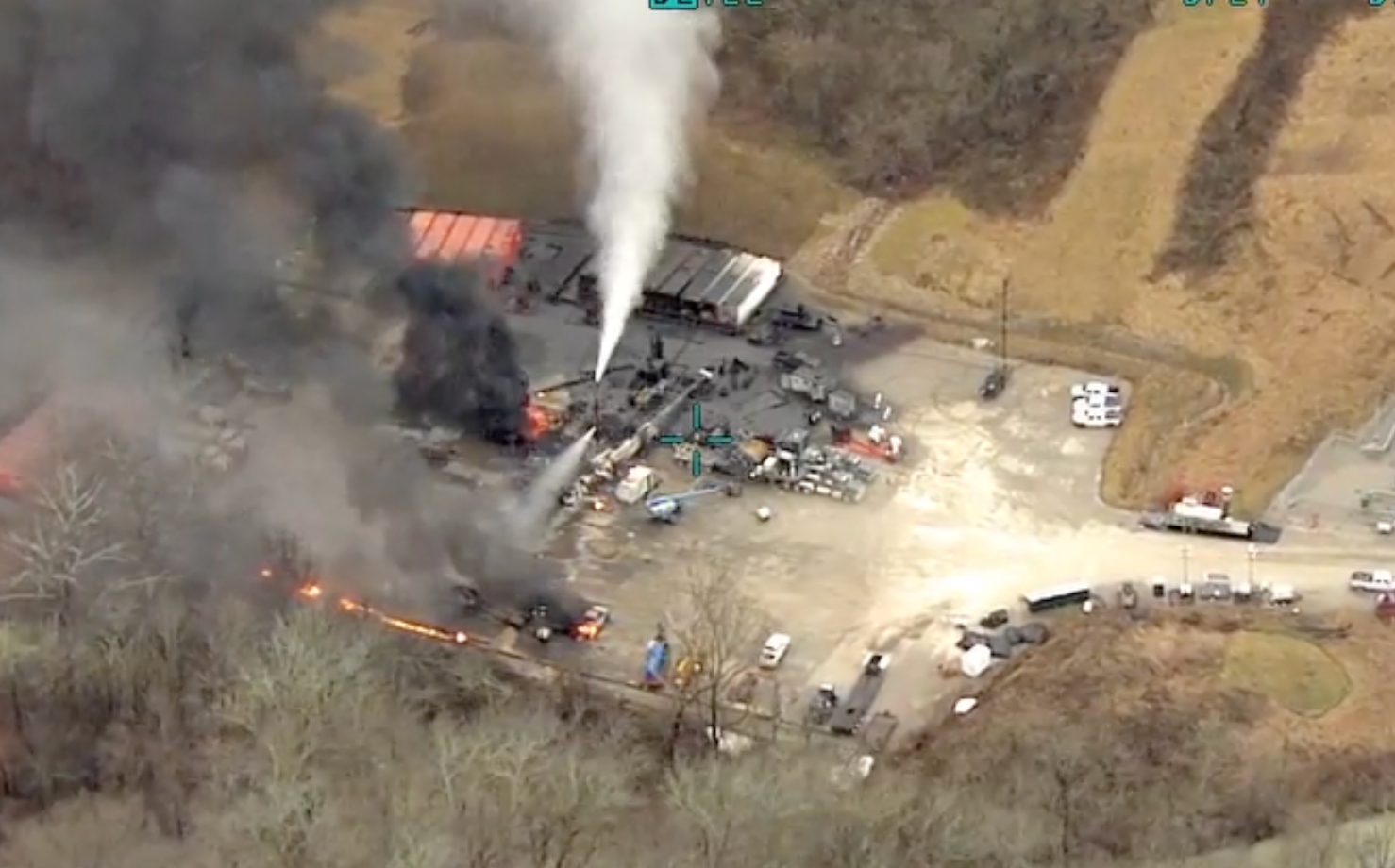
The Tyee is reporting on why the federal government wants to promote and subsidize a national network of data centres.
But a top advisory body to Carney’s Liberal government has also quietly identified another policy goal that wasn’t mentioned in the hotly anticipated “AI for All” road map. One of the top “public policy benefits to Canada” of constructing a national network of data centres is creating new markets for Canadian natural gas producers.
Apparently the Liberals discount peer-reviewed science that says the global warming emissions from burning natural gas are higher than those from clean energy sources like wind or solar.
The drilling and extraction of gas from wells and its transportation in pipelines results in the leakage of methane, the primary component of natural gas. Methane is 34 times stronger than CO₂ at trapping heat over a 100-year period and 86 times stronger over 20 years. Studies as well as field and aerial measurements have shown that high rates of methane leakage can be found throughout the natural gas system.
Environmental Impacts of Natural Gas
A regular IN-SIGHTS reader sends me well-reasoned information about important subjects. The Tyee article led to a lengthy email, parts of which follow:
Step back a few years, before the oil and gas lobby finally exterminated those pesky ridiculous Conference of Parties clown shows. It was obvious that the public mood towards annihilating all planetary life merely to profit Big Oil and Gas had shifted.
OK then. Is now a good time for energy alternatives? Could we try renewables? Why not?
Why not? Up popped a deeply concerned volunteer army of industry experts. At first the game was dirt simple—green energy is unreliable. It’s intermittent. If [gulp] the wind doesn’t blow or the sun doesn’t shine oil and gas are safer and cheaper. Green energy is way too expensive as a start up. Forget renewables. The real transition requires LNG. Lots of “green” LNG.
However… among heedless Europeans, Africans and SE Asian geeks many realized that if you combined solar and wind in the same location then stored accumulating power using batteries as back up, well that’s 24/7 power and it’s cheaper energy to boot!
Wait! No! Stop!
The wheels are coming off the gravy train! What to do? Create a new technology. One that is absurdly energy-dependent and hyper-reliant on massive energy consumption.
Next, without mentioning that AI is designed to depopulate the workplace permanently, declare the data centre a humanitarian necessity!
Next, providing nowhere near sufficient justification, spend enormous sums promoting energy gluttony with the help of our forever timid (subsidy-dependent) Canadian corporate media. A collection of mice that would never dare challenge such an heroic agenda. As expected, media repeated precisely what they were told, uncritically.
The finished product? It was not backroom deals among a small circle of like-minded amigos. It was necessity that determined energy policy. Not global conferences, not wishful neo-hippies yapping in chat rooms. Necessity dictated that only lots of gas, gushing forth from a new energy superpower, could sustain behemoth data centres.
As expected, until recently no one dared to challenge the scam with proof to the contrary.
Except China, by example.
Not only did the Chinese hypothesize that gas-powered centres decidedly were not necessary—they proved it.
https://www.theguardian.com/world/2026/jun/09/worlds-first-wind-powered-underwater-datacentre-starts-operating-in-china
A datacentre off the Shanghai coast uses less power and water than a land-based equivalent.
The world’s first wind-powered underwater datacentre has started operations off the coast of Shanghai as China presses forwards with solutions for energy challenges created by the country’s artificial intelligence boom.
The Shanghai Lingang undersea datacentre demonstration project, which launched in May, has a capacity of 24 megawatts. It is a joint effort between HiCloud Technology and China Communications Construction, a state-owned company.
Located more than 6 miles (10 km) off the coast of Shanghai, the datacentre is submerged 10 metres below the surface of the water and is powered by a nearby offshore wind farm. According to the Chinese government, the datacentre reduces power consumption by more than one-fifth compared with land-based datacentres.
That is because as well as being powered by renewable energy, its overall energy demands are less because of the natural cooling effect that comes from being submerged in seawater.
========================================================================
Is anyone in Canadian media or policy circles paying any attention to innovations elsewhere?
Of course not.
What else aren’t we seeing, talking about, or doing?
https://www.nature.com/articles/s44287-025-00161-x
Amid geopolitical crises and economic challenges, it is crucial to reassess the future role of fossil fuel resources, particularly oil and gas fields. A promising opportunity now exists to repurpose these fields for geothermal energy, helping to accelerate the energy transition while mitigating the risk of resource stranding.
More detail? There’s this…
https://geoconvention.com/wp-content/uploads/abstracts/2022/73300-the-feasibility-of-repurposing-oil-and-gas-wells-f-01.pdf
Summary
In regions where oil and gas extraction has been ongoing for decades, there is an inventory of wells that range from fully abandoned (plugged and wellhead removed) to suspended to operational.
In Alberta, there are over 450,000 wells (Alberta Energy Regulator, 2022) that have been drilled since the early decades of the 20th century (Figure 1). The financial states of companies that hold these assets have changed through time, and many previously owned wells are now “orphaned.” Orphan wells may range in status from abandoned to operational, but the most important aspect is the lack of a viable company that can be held responsible for the reclamation of the wells and surface disturbance (pad, roads, pipelines, etc.) (Alberta Energy Regulator, 2022). All wells have a liability associated with them to ensure safe and environmentally responsible abandonment and reclamation.
In Alberta, this liability is estimated at $100 billion (McNeill, 2018). Given the potential reclamation costs and reutilization possibilities of these and future wells, we outline the investigative process of reviewing, analyzing, and assessing suspended and active wells in Alberta for their geothermal potential.
https://ww3.rics.org/uk/en/journals/land-journal/mine-water-heats-homes-businesses.html
Project draws geothermal heat from former mine
A pioneering project to extract heat from water-filled mine workings shows that many of Britain’s 23,000 disused deep coal mines could help provide low-carbon heat for local networks
This project has demonstrated that our disused mining infrastructure can provide a secure source of heat that may be scaled up while reducing carbon emissions by around 1,800 tonnes per annum.
Offering lower-than-market prices for heat, the scheme enables customers to access low-carbon heat and removes the need for domestic boilers. More widely, mine water heat networks in disused coalfields can provide new business opportunities in building and operating networks.
Mine water heat networks use existing technology such as heat pumps, heat exchangers, and boreholes that can contribute to net-zero targets now, helping to decarbonize heat supply in former mining areas. We are also exploring other opportunities for this resource, such as cooling, thermal storage, and food production.
The northeast of England has several projects in planning, including a development of 1,500 homes at Seaham Garden Village and a 10 MW project for Sunderland city centre. These continue the region’s rich history of energy innovation, much of which was derived from coal. It is fitting that we are now able to explore new ways to use this as part of the low-carbon transition.
Impressive, no?
==============================================================