dailynewsnblog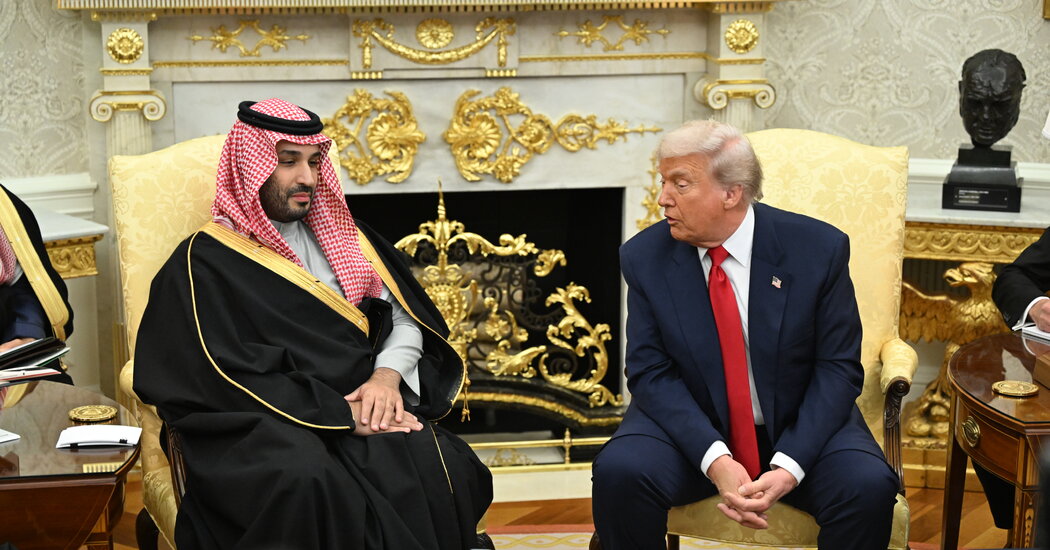
A deal to provide American nuclear technology to Saudi Arabia, expected to be announced on Wednesday, would represent a major triumph for the kingdom’s crown prince, who has been trying to seal such an agreement for more than five years.
Developing a civilian nuclear program has been a top goal of Prince Mohammed bin Salman, the de facto Saudi ruler, as he tries to diversify the kingdom’s oil-dependent economy. Yet talks over doing so had been delayed for years as American officials and experts raised concerns that the kingdom could use the technology to pursue a nuclear weapon, spurring a new Middle East arms race.
Prince Mohammed himself had repeatedly threatened to do so if Iran obtained a nuclear weapon.
The expected deal comes in the midst of a raging regional war between the United States and Iran that strained the U.S.-Saudi alliance. The civilian nuclear agreement could help put their relations back on more stable ground, and could deepen the kingdom’s reliance on the United States for decades to come.
Mr. Trump and Prince Mohammed clashed in May over U.S. aggression in the Iran war. The prince refused to let the U.S. military use Saudi airspace for an operation to escort commercial tankers through the Strait of Hormuz, which Iran’s forces essentially control.
Reaching an agreement is a “feat” for the kingdom, said Bader Al-Saif, a professor of history at Kuwait University, particularly because it no longer appears to be tied to Saudi Arabia recognizing Israel. During the Biden administration, American and Saudi officials had linked the prospect of a nuclear agreement to a broader deal that would include Saudi diplomatic recognition of Israel.
It was never clear that such a deal was possible, and the war in Gaza dashed any chance of Saudi-Israeli normalization in the near-term. Saudi officials sought to decouple the nuclear talks from establishing relations with Israel, and in 2025, the second Trump administration revived nuclear talks in which Israel appeared to play a much less prominent role.
“The deal has been in the works for years — it predates the Trump administration and speaks to the indisputable U.S. golden standard in nuclear technology,” Mr. Al-Saif said. “It will also cause the ire of Iran and Israel” and increase uncertainty over the regional balance of power, which is already fragile, he added.
The deal would need congressional approval, but as a practical matter, would likely pass, because Congress would have to assemble a veto-proof majority to override Mr. Trump’s initiative.
American and Saudi officials have engaged in on-and-off talks over the kingdom’s nuclear ambitions for nearly two decades. But those negotiations never reached fruition until now, with the two sides unable to reach an agreement on details such as whether Saudi Arabia would be allowed to enrich its own uranium and what oversight American officials would have over its nuclear program.
To get the deal done, Mr. Trump agreed that, after a joint study on the economics of producing nuclear fuel, Saudi Arabia may be allowed to enrich uranium or reprocess plutonium on their soil, U.S. officials said, speaking on the condition of anonymity to discuss sensitive diplomacy.
In the past, Saudi officials have repeatedly warned that they would go elsewhere for nuclear technology if they could not get American assistance — seeking bids from China, Russia, France and South Korea at various points in time. Yet they held back from signing a deal with another country, and their preference for American technology had become clear as they continued to seek it even at the cost of delaying their nuclear program for years.
The deal was first reported on Tuesday by The Wall Street Journal, which said that it is expected to last 30 years and would exclude other countries from involvement in the kingdom’s nuclear industry.
Ismaeel Naar contributed reporting from Dubai, United Arab Emirates.