dailynewsnblog
Three days before a teenage boy murdered Eleanor Doney in her front yard, a student at his Pickering school overheard him talking to other kids about his interest in serial killers.
He said he wondered what it would feel like to kill an eight-year-old.
Confronted by the school’s principal, the 14-year-old boy didn’t deny it. In response, the principal had him do a reading on the impact words can have and write a reflection.
A day before the stabbing, the principal called the school’s psychologist, Anna Pargana, who, in interviews along with emails and texts shared with the Star, recounted what she was told. The boy’s returned reflection seemed to twist the point of the reading completely — what the psychologist recalled was “very disturbing.”
Surveillance video from a neighbour shows a figure dressed in black with a briefcase approaching Eleanor Doney’s home in Pickering in May 2025.
SUBMITTEDSometime after that call, the boy brought a knife to school and was suspended, Pargana said she later learned from a colleague.
In the afternoon daylight of May 29, 2025, the boy repeatedly stabbed 83-year-old Doney — a retired school teacher who neighbours said had a love of gardening and whose family remembered her as a “woman of strong Christian faith” — then walked away.
Residents were warned to shelter in place as surveillance images of a boy in a dark trench coat, dress shoes, face mask and carrying a briefcase circulated online. It took more than five hours to locate and arrest the boy, who has since pleaded guilty to first-degree murder.
As the events before the murder unfolded, a key protocol used across the Durham District School Board to address threats of violence was said to be scheduled, but appears to not have happened prior to the murder, the Star has learned, despite urging from Pargana to intervene the day before.
It is not clear what, if any, supports were available to the boy or his family when he was suspended, what his guardians were told, or whether a safety plan was put in place.

Community members in Pickering started a memorial outside the home of Eleanor Doney in May 2025 after she was stabbed to death by a 14-year-old boy.
Sharif Hassan / The Canadian Press
“I was afraid something like this was going to happen,” Pargana said.
Both Pargana and a former administrator told the Star that despite information posted to school board’s website confirming school administrators have the power to invoke the Violence Threat Risk Assessment — or VTRA — protocol, in practice, the board requires prior sign-off by a member of the Positive School Climates team, which Pargana said is often being denied, sometimes, she said, without a satisfactory explanation.
Pargana’s account of how events unfolded ahead of Doney’s murder raises questions about schools’ ability to respond as communities grapple with increases in youth violence and ailing mental health.
Durham board responds
Pargana agreed to speak with the Star on the record after first raising her concerns internally and following recent news of the boy’s guilty plea. She said that, in her view, the reluctance to readily implement the VTRA protocol is leaving students, schools and their communities at risk. Pargana, who, following these events, came to an agreement to terminate her employment, was upfront about an acrimonious relationship between her and the board.
The psychologist had just started a medical leave on the day of Doney’s murder, following a separate incident in which an 11-year-old boy at a different Durham school had created a “kill list” of female classmates. In that case, Pargana also recommended the VTRA protocol be used and had that principal’s backing. But that request was refused at the board level, Pargana said. When she challenged that decision, she said, she was berated by a superintendent in a meeting with colleagues, prompting her to file a complaint and request the leave.
The Durham board declined to respond to specific questions about either incident, saying in a statement about the events leading up to Doney’s murder that it “strongly disputes the characterization of the board’s response to this matter as shared with the Toronto Star by the former employee.” The statement cited privacy obligations related to students, saying the board was limited “in the specificity it can provide publicly.”
The board also did not respond to specific questions about the VTRA protocol, including whether the requirement to receive board sign-off on VTRAs effectively prevents a nimble response.
“The Durham District School Board recognizes the profound impact this tragedy has had on students, staff, families and the broader community,” the statement said.
It continued: “The DDSB takes all reports of threatening or concerning student behaviour seriously. In this matter, the school and central staff worked with trained professionals to assess risk and respond to concerns that were raised according to established practice and protocols.”

Eleanor Doney was in front of her home in Pickering around 3 p.m. on May 29, 2025 when a boy approached and had a brief conversation with her before stabbing her repeatedly.
Steve Russell/Toronto Star
An imminent threat
VTRA protocols are used across GTA school boards, including the Toronto District School Board, York Region District School Board and the Halton District School Board, to assess and intervene before potential incidents of violence or self-injury. Administrators and school workers are trained on how to use the protocol.
“VTRA training instils the perspective that serious violence is an evolutionary process, meaning that pre-incident data is often available to help proactively identify and prevent the occurrence,” according to the Center for Trauma Informed Practices, whose executive director, Kevin Cameron, created and is the leading VTRA trainer for North America.
“Put simply, VTRA implies that nobody ‘just snaps.’”
The approach to threat assessment has evolved as the understanding and prevalence of violence in schools and in other settings has grown, prompted by the mass shooting at Columbine High School in Colorado in 1999 and the one that followed days later in Taber, Alta., the centre’s website says.
The idea is to bring together a multidisciplinary team of people — social workers, psychologists, police and the student’s caregivers among them — to investigate what is going on with the student by collecting information, providing immediate intervention as needed, then following up with any medical, psychological or other supports.
The benefits of the protocol, said Pargana, who is certified on VTRA, is it allows that team within each school to quickly safeguard the student and assess the risk before anything can occur.
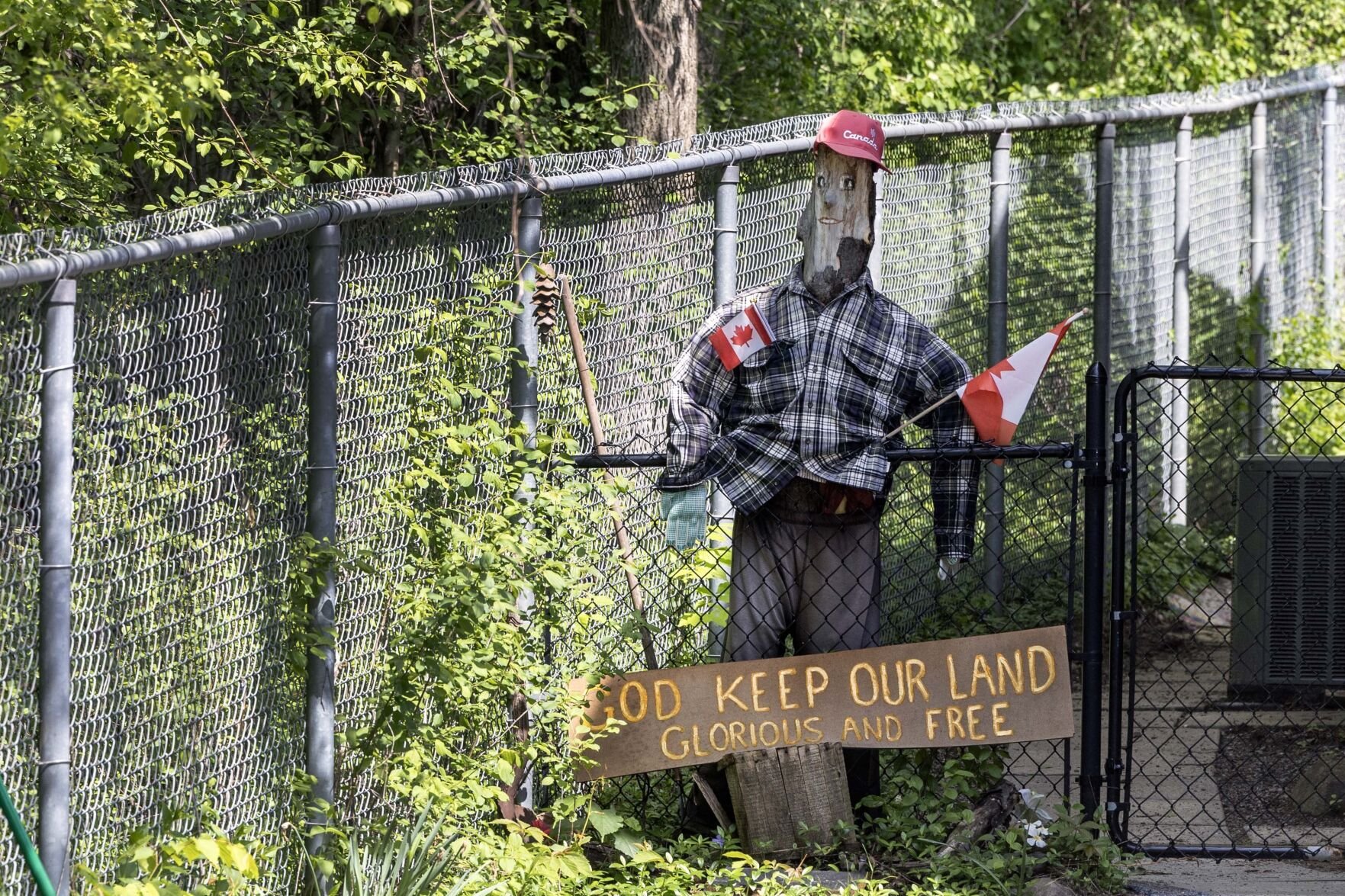
Neighbours identified the victim as Eleanor Doney, a retired school teacher who loved to garden and dress up a makeshift scarecrow at the edge of her front lawn.
Andrew Francis Wallace/ Toronto Star
“A threat is an indication of intent to do harm or act out violently against someone or something,” a flyer posted with notice to parents on the school board’s website says. “Threats can be verbal, written, drawn, posted online, inferred or made by a gesture. All threats must be taken seriously and responded to in a timely manner.”
VTRA also gives administrators extraordinary powers to gather information, the flyer explains, such as searching lockers and backpacks, as well as bypassing some confidentiality rules surrounding young people, allowing them to find out if the student has previously been arrested in the community or if the Children’s Aid Society has been involved at home.
Though suspension might seem logical because it removes the threat of a student immediately hurting someone within the school, Pargana said the VTRA protocol is clear that it is important to have eyes on the student.
The school board flyer says administrators have the power to enact a VTRA protocol, but in practice, Pargana said administrators are being told to contact board officials to sign off on any VTRA.
“A lot of people were getting very frustrated, because there seemed to be not a lot of reasons to enact the protocol, it was often, ‘No, that’s not concerning. We don’t need to do that,’” Pargana said of her experience with the Durham board.
The Star spoke with another former administrator in Durham, who asked not to be named because they continue to do work for the board, who agreed the requirement for board approval on VTRAs creates unnecessary roadblocks.
“It’s almost like jumping through hoops,” they said.
They noted administrators get board-approved training on VTRA, which they described as being akin to getting first-aid training. But then it is the board, they said, that stymies administrators from using it.
“What’s the point, in that sense?” they said, noting that VTRA interventions are meant to be swift to address imminent threats of harm.
“As an administrator, we have not much power.”
‘God forbid something happens’
Pargana’s phone buzzed the afternoon of Doney’s death.
The school psychologist recognized the 14-year-old boy right away from the surveillance images sent by a friend. Though he was never referred to her for psychology services, Pargana had noticed he often wore the same, unusual style of dress — a suit and trench coat — to school. There wasn’t anything inherently wrong with the clothing, Pargana said, but she wondered what other kids thought about it and what his experience at school was like because of it.

Anna Pargana is a former school psychologist associate with the Durham District School Board who is trained in identifying and intervening in threats of violence.
Facebook
“I was like, ‘Oh my god, this is him,’” Pargana recounted to the Star.
She described the school’s principal calling her the day before, on May 28, 2025, and telling her the boy had been overheard by another student at the start of that week. He had said he was “very interested in serial killers and wonders what (it) would feel like to kill an 8 year old girl,” Pargana recounted to her supervisor in an email following the call, which was provided to the Star.
The principal then explained she had confronted the student and assigned him a reading reflection. Pargana remembers the principal read her the returned assignment.
“The stuff he was saying was like the kids in the story who got hurt deserve to get hurt . . . because they should have been minding their business in the first place,” she said of the boy’s writing, which referenced “bratty children,” she told her supervisor.
Coupled with the prior threatening statements she was told about, Pargana said she advised the principal there were clear grounds for enacting the VTRA protocol.
The advice was met by frustration from the principal, Pargana said.
“I said to her: ‘I know, I know it’s frustrating and I know they’re going to say no, but you have to request the process because God forbid something happens.’”

The incident happened Thursday afternoon, when police say a woman was approached and stabbed repeatedly outside her home in Pickering.
The incident happened Thursday afternoon, when police say a woman was approached and stabbed repeatedly outside her home in Pickering.
The psychologist explained she was due to go on leave the next day and referred the principal to her supervisor, who was taking over her case load.
Following the murder, Pargana’s supervisor texted her, screengrabs of which were provided to the Star, to assure her the principal had reached out to the board and that a VTRA had been “scheduled.” When Pargana asked if the VTRA happened, the supervisor replied it was planned for the following Monday morning — a week after the boy’s first threatening comments were reported. It would be too late for Doney and her family.
The boy, who cannot be identified under the Youth Criminal Justice Act, is scheduled to be sentenced in July. As a youth offender, he faces a maximum 10-year sentence, with a maximum of six years to be served in custody, compared to adult sentences of life in prison with no parole eligibility for 25 years.





![Historic: Delta Launches Its 1st Flight on New Transatlantic Route This Weekend [Map]](https://dailynewsnblog.com/wp-content/uploads/2026/06/850-delta-air-lines-boeing-767-300-nieuwland-photography-_-shutterstock-simple-flying.jpg)