dailynewsnblog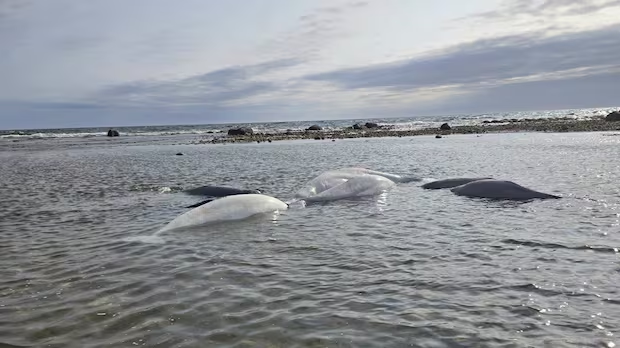
Conservation officers Vitalii Skrynnyk and Owen Jones are relatively new to Churchill, but they already have a whale of a tale.
After a night of receiving multiple calls to chase polar bears away from northern Manitoba town on the western shore of Hudson Bay, their tip line rang once more around 7:20 a.m. Monday.
The caller saw something large and white near the public beach behind the town complex. Skrynnyk, who is a sergeant, dispatched Jones to have a look.
What he saw was a pod of seven stranded belugas — three females and four calves — struggling in a pool of water about half a metre deep and 150 metres in radius.
It [was] like a nursing group … and they stay together,” said Skrynnyk, who arrived soon after Jones called to say what he’d found.
The belugas’ isolated pool was disconnected some 50 metres from the main water of the bay, which had gone out with the tide.
“Immediately arriving on scene, it was pretty clear that the birds had beat us there,” Jones said.
“They had been pecking at the belugas. There was, unfortunately, a little bit of blood present, and it was clear that these whales were injured, but the extent of their injuries were unknown until we could assess them further.”

He fired off a couple of bear bangers — loud, gunshot-like noisemakers — to chase off the birds “to buy us a little bit of time to evaluate the situation and figure out a plan.”
Without getting closer, Skrynnyk worried how badly the whales had been pecked.
“Scavengers, especially when it’s a dead animal, they go first for the face and the eyes. I wanted to make sure that there is no severe damage for these animals,” he said.
Another worry was that bears might come for an easy snack.
“Any type of dead animals, or in this case it was blood … it’s a very good attractant,” Skrynnyk said.
RCMP officers were called in to stand guard, and to keep curious people away. Skrynnyk then donned hip waders and made his way out.
He scanned for any critical injuries and saw none, but a couple calves were lying on their sides, and he was worried their breathing holes might get blocked.
Skrynnyk squatted, leaned in and rolled them onto their bellies. At 150 to 200 pounds, even the babies are big.
“But the water helped me,” he said.
The females remained calm and didn’t move too much, but the calves were distressed and extremely vocal.

“It was a very emotional moment, especially because … they’re very intelligent creatures, and they’re very sociable,” Jones said.
“To hear the calves, the newborns, crying like that, you know that they’re asking for help, they’re wondering what’s going on. So, it’s very important to us that we help them in any way that we can.”
The conservation officers estimated it would be another two hours before the tide came back in, “and there is no physical ability for us to move the animals,” Skrynnyk said.
He and Jones stayed nearby to watch over the pod, giving space but going back every 20 to 30 minutes to splash water on them.
Skrynnyk said he turned the newborns maybe three or four other times when they needed it.
“It’s probably one of the best things that I’ve done in my life,” he said, beaming with a smile.
While it was a poignant experience, the longer the whales remained and the calves cried, the more concerned the men became.
“If we can hear the whales, any polar bears in the area can hear the whales, too, right? So, that … just kind of added to our duties,” Jones said. “We were all on bear guard.”
The tide began to return about 90 minutes later. Skrynnyk slowly backed away, continuing to guard the whales while Jones scared off the persistent gulls.
“We made it this far. We weren’t allowed to let seagulls start landing on them now,” he said.
As the water from the bay reconnected with the pod’s pool, it slowly created a stream, and the whales began to move.
“They went directly aiming to the only possible spot where they could get out. And the last seagull was still trying to land,” Skrynnyk said.

People have since been approaching and thanking the conservation officers, and one mentioned that in his 30 years, he had never seen something like that.
“It’s a big feeling, how privileged we are,” Skrynnyk said about being able to get close to such intelligent animals and see them daily.
Roughly 55,000 to 60,000 beluga whales converge in western Hudson Bay and the Churchill River estuary each summer, where they’re known to playfully mingle with tourists on paddleboards and kayaks.
The warmer waters — relative to further out in Hudson Bay or the ocean — provide a safe haven for belugas to give birth, feed on abundant fish and moult their old skin. The estuary is also too shallow for their main predator, the orca.
Skrynnyk saw his first beluga swimming in the bay shortly after arriving in Churchill “and I was very excited.”
“And now we just go right now to the beach, and you will see like a couple dozen belugas like 100 metres from the beach. We get used to it. We get spoiled,” he said.
“Churchill, it’s a very unique place not only in Manitoba, but on the planet Earth.”