dailynewsnblog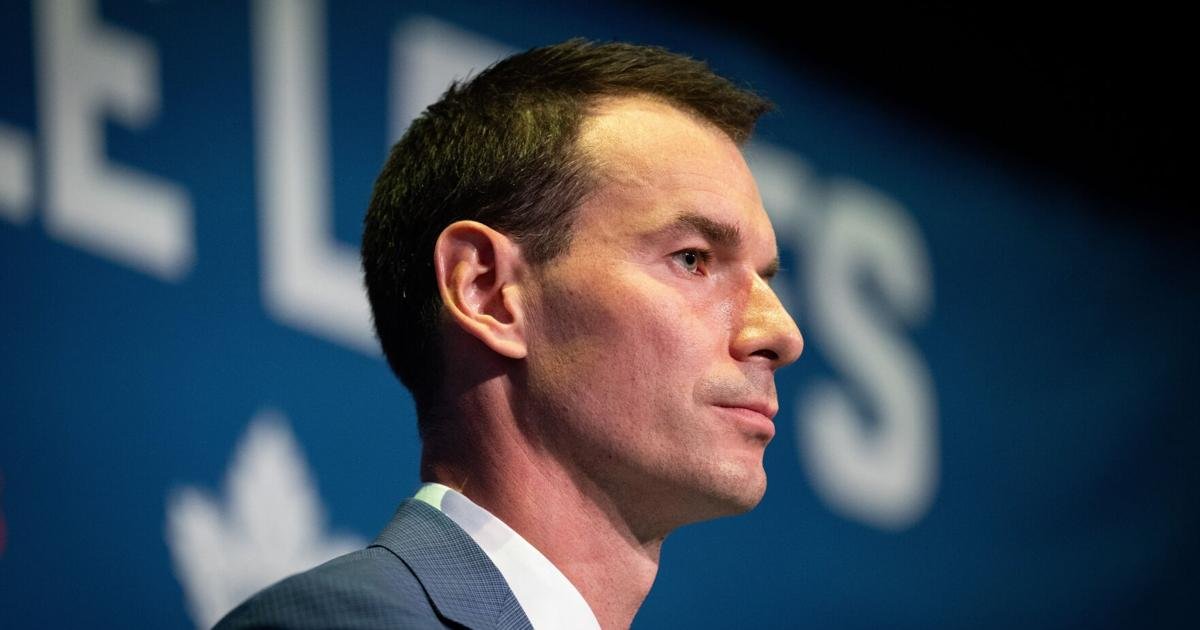
John Chayka’s rocky introduction as general manager of the Maple Leafs reverberated through hockey rinks and boardrooms across North America.
From New York to Saskatchewan and Raleigh, N.C. to Scottsdale, Ariz., people who know him and have worked with him couldn’t believe the words they were hearing to describe him: con artist, charlatan. One former executive told the Star he thought Chayka was a “douchebag.”
“That could not be further from the John Chayka I know,” said Scott Romanoff, co-managing partner of Franchise Equity Partners, the Manhattan-based company where Chayka was an operating partner leading the sports division.
“John is an incredible teammate, a well-rounded individual who was incredibly well-respected and liked from the most junior person on our team to the most senior,” Romanoff said. “You couldn’t ask for a better colleague.”
Still, there were harsh words for the young executive — a 36-year-old married father of three who doesn’t drink, smoke or really have any known vices — getting a second chance in the NHL with one of hockey’s most storied franchises after leaving the Arizona Coyotes in 2020 in spectacularly messy fashion.
Those who defend him believe Chayka is a misunderstood, talented executive who deserves a fair chance with the Leafs.
“When I heard those things said about him, I just shake my head,” said Gary Drummond, who was part owner of the Coyotes and president of hockey operations when he hired Chayka. “People were writing terrible things about him and have never met him, or hardly knew him.
“It’s more than a little bit annoying and disappointing.”
Who is the real John Chayka?
His path to the NHL started with a chance meeting between Chayka and Drummond at the 2013 Memorial Cup in Saskatoon. Drummond was part owner of the Regina Pats; Chayka, a graduate student at Western’s Ivey Business School, had been befriended by Tie Domi, the former Leafs pugilist. Chayka’s Stathletes, a hockey analytics company, was in its infancy and, beyond statistics, had a training and nutritional aspect to player development. Domi had Chayka work with his son Max, who was playing for London in the tournament. Chayka accompanied the Domis to the Memorial Cup.
“I got to meet John through the Domis, and I was taken aback by how impressive an individual he was,” Drummond said. “At a young age, how much knowledge he had about hockey, how much vision he had to improve player development … it was captivating. I was extremely impressed, to say the least.”
Drummond joined the Coyotes ownership group shortly after and, during a road trip to Buffalo, convinced then-GM Don Maloney and coach Dave Tippett to have dinner with Chayka.
NHL teams were beginning to tinker with analytics, measuring players’ performances beyond goals and assists by looking at possession time shot metrics and dropping fancy terms such as expected goals.
Chayka, co-founder of Stathletes, spoke that language. The Stathletes website says it works with 31 leagues in 34 countries, tracking more than 3,500 events per game on more than 30,000 players. Media, agents, trainers and sportsbooks are clients, along with teams and leagues.
“We were all impressed with him as an individual and what his potential was,” Drummond said. “Not long after that, the team hired him as assistant GM and it flowed from there.”
Youngest GM in NHL history
A little more than a year later on May 5, 2016, Maloney was out. Chayka took over a Coyotes team that had many challenges, from ever-changing ownership to finding a rink to play in, keeping the team in Arizona, trying to build a winner on a shoestring budget and get to the salary-cap floor with money the owners simply didn’t have.
At 26, Chayka was the youngest GM in NHL history. That rubbed some hockey lifers the wrong way. He came across to some as arrogant, as someone who believed he might be the smartest guy in the room, and probably was.
An early order of business didn’t go well: a conversation with forward Shane Doan, a franchise legend. Doan had six goals and 21 assists in 74 games in 2016-17, his lowest output for the team in close to 20 years. Chayka told him over breakfast that spring that the Coyotes wouldn’t be re-signing him.
“The Coyotes would not let him retire on his terms,” Dan Bickley, a radio host and columnist, wrote on Arizonasports.com. “It remains one of the most despicable acts in Arizona sports history.”
It remains an undertold part of the story that neither Tippett nor anyone from ownership was at that meeting, people Doan might have appreciated hearing from. It was left to Chayka to do the dirty work.

New Maple Leafs General Manager John Chayka speaks to the media on May 4, 2026.
Arlyn McAdorey The Canadian Press
Chayka used outside-the-box thinking with the Coyotes, acquiring dead-money contracts of injured players from teams desperate for salary-cap space. The Florida Panthers sent a young Lawson Crouse to Arizona along with Dave Bolland’s $5.5-million (U.S.) salary for next to nothing. Bolland helped the Coyotes get to the floor; Crouse became a valuable contributor.
The team Chayka took over had missed the playoffs by 20 points. Having committed to a rebuild, it didn’t get much better until 2019, when they missed by four points.
“He had done a great job there, basically with one hand behind his back,” said Lindsay Hofford, Chayka’s assistant GM from 2018 to 2020. “John improved everything. He had installed a recovery area, brought in a chef, the way we travelled was much better. I know players did not want to leave Arizona.
“It was a nice place to live, it was run professionally and it was becoming a destination for players because of the hockey.”
The pressure to win in the 2019-20 season was intense. Veteran forward Phil Kessel had been brought in on a bargain contract. Taylor Hall was acquired in a mid-season trade and was impressed with what Chayka had built.
“Before I got there, I heard that it was a franchise that didn’t have a lot of money and wasn’t going to treat the players well,” said the 34-year-old Hall, a forward who recently won his first Stanley Cup with the Carolina Hurricanes. “We got treated fantastic there. We had everything we needed. We had zero excuses. Our staff was very good, our facilities were great.
“John was on the cutting edge of a lot of different sports science stuff. He had this analytics reputation, but (the) sports physiology department, he was really on top of that and wanted to make sure we were as finely tuned as possible.”
The season was halted by the COVID pandemic. That’s when things started to fall apart for Chayka under mercurial owner Alex Meruelo, whose eventual mismanagement of the team was such that it would later play in a 4,600-seat arena on the campus of Arizona State University in Tempe before ultimately ceasing operations and selling its assets to interests in Utah.
Chayka sought jobs with other teams (without permission) and met with undrafted players (a no-no to the NHL). Facing the heat, he resigned and was later suspended for one year by the league, even though he was technically not part of the NHL at the time.
But the team he built made that summer’s 20-team COVID-bubble post-season. The Coyotes beat the Nashville Predators in the qualification round, then bowed out to the Colorado Avalanche.
“When he left, they didn’t make the playoffs for five years and the franchise folded,” Hofford said.
Fresh start
From Arizona, Chayka jumped back into the family business as chief executive officer of JKC Capital, primarily running a stable of Wendy’s franchises in Ontario, and joined Romanoff at Franchise Equity. No one in the financial world balks at analyzing data.
“He was an incredible thought partner for me,” Romanoff said. “He really developed, in his short time after hockey, a pretty deep expertise. He mentored a lot of junior people. He really provided a lot of great intellectual capital to what we did.”
Meghan Chayka, John’s sister and Stathletes co-founder, declined to be interviewed directly about her brother. But she did say his hiring continues a positive, progressive trend in hockey, following the hiring of Mehta as GM in New Jersey and Meghan Duggan as GM of the new PWHL team in Hamilton.
“I have worked with a lot of progressing GMs and it seems like, more and more, the NHL is really leaning toward people that want to embrace technology,” Meghan Chayka said. “I don’t see a lot of people with any sort of pushback to analytics or technology that are now rising up the ranks. That’s the general direction of all sports and businesses.”
Many in hockey believed John Chayka had been blackballed after how everything ended in Arizona, finding himself with few allies.
Doan, by comparison, is revered in hockey, and it is believed he has little time for Chayka. Doan left the Coyotes organization after that breakfast, joining Hockey Canada, and only returned to the franchise after Chayka’s departure. He also left his front-office role with the Leafs after Chayka’s hiring was announced.
But Chayka is older now. He’s self-reflective, transparent. At an introductory news conference, he said he took ownership of past mistakes.
So when his name came up, the hiring seemed inevitable. The people that know him believe his time in Toronto will go well.
“To put it in sports parlance, he is an incredible teammate and the ultimate utility player,” Romanoff said.
“He’s a sponge for information,” Drummond said. “He’s just interested in people, what they’re doing and why they’re doing it. He’s got an ability to process information and store information. Not just hockey, but finance, politics, human behaviour. He’s a special individual.”

From left, Maple Leafs general manager John Chayka, MLSE president and CEO Keith Pelley and Leafs senior executive adviser/hockey operations Mats Sundin at a news conference last month.
Arlyn McAdorey/The Canadian Press
First moves
So far, he seems to have the proper reverence for Leafs legend Mats Sundin, whose role as a special adviser was announced at the same time. Hiring Judd Brackett as assistant GM in charge of player evaluation will give him a like-minded individual who has a history of melding data-driven insights with traditional drafting strategy.
What raised an eyebrow was the hiring of Freddie Hamilton (whom he had as a player in Arizona) as chief of staff, a position otherwise unheard of in hockey. Hamilton pursued a master’s degree in business administration, and seems uniquely qualified to align the chaos of a hockey organization with Pelley’s vision of the multibillion-dollar organization that is Maple Leaf Sports & Entertainment.
Chayka also hit the right notes in meeting with captain Auston Matthews to discuss their vision for the team, along with visiting top prospect Gavin McKenna and family in Whitehorse, home of the projected No. 1 pick (owned by the Leafs) in the NHL draft on Friday.
“It’s been good, honestly,” Chayka told the team’s in-house media on its YouTube channel during the recent draft combine. “We’ve got a lot of really great people, so that always helps. I have a lot more conviction today than we did a month ago. Mats has been a great partner, very engaged, knows what it means to be a Toronto Maple Leaf.
“These next three or four weeks are really when it’s time to make some changes.”
The changes he’s made so far have been to mixed reviews. The coaching search, he acknowledged, was wide on purpose. He started by speaking to 55 candidates. Many had no chance, but he wanted to hear what they had to say about the team and its prospects.
He landed on ex-Leafs assistant coach Jim Hiller, who was on nobody else’s list of candidates. Hiller might be just the under-the-radar hire the team needs, rather than a big personality such as Patrick Roy.
“Free agency is only available to those who make it there,” said Chayka. “The opportunity to secure, in our opinion, the top free agent is an organizational win.”
The common thread connecting Chayka’s moves to date is that no one saw them coming. He said he likes it that way.
“Information is the capital that we all trade on,” he said. “Having that information stay internal is an important tenet of any great organization.”
The narrative around the Leafs has changed since the season ended. There’s optimism. Winning the draft lottery is one reason, but Chayka’s meticulous approach, designed to get the Leafs back in the playoffs next season, also appears to be winning over critics.
“I think people need to give him a chance,” Hall said of Chayka. “Because you know, when someone gets hired around the NHL and everyone hates it, I think there’s a better chance of it going better than people think.”