dailynewsnblog
A metric evaluating the strength of a team’s opponents within their conference will have heightened visibility and depth during the College Football Playoff selection process this season, CBS Sports has learned.
The tweak comes entering the third year of the 12-team CFP and as the disparity in conference schedules comes into greater focus following conference realignment.
A similar metric has been available to selection committee members in the past. However, it will be presented in a new fashion during this year’s selection process with an increased emphasis on the differences in schedule strength that can exist within a single league.
With the rise of megaconferences with at least 16 teams, teams’ scheduling strength can vary widely, creating large disparities in final records. Duke, for example, reached the ACC Championship Game after playing only one team ranked in the AP Top 25. Texas Tech is in a similar position in 2026 after beating No. 25 Houston, the only ranked team on its schedule.
However, it’s unclear whether the metric will have much real-world impact, given that strength of schedule was already a meaningful data point considered in the process. Strength of schedule, head-to-head competition and outcomes against common opponents are set to retain their importance during this year’s selection process.
The metric evaluating conference opponent strength will help further contextualize the power of a conference when comparing two similar teams. Importantly, it will provide a measure of how tough a conference schedule was, even in regard to teams within the same league.
The metric is a slightly strange one for Notre Dame, which does not play a conference schedule and must be evaluated as an at-large. However, it will still be compared against other teams in typical strength-of-schedule conversations.
2026 College Football Playoff bracket projection: Ole Miss climbs after signature win over LSU
John Talty
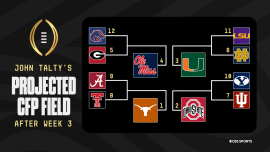
Answering SEC complaints
CFP staff members met with SEC coaches during the offseason at spring meetings. The meeting was unexpectedly tense, as coaches seemed to regret the move to nine conference games without an expansion of the postseason.
“Now, you could say there may be regret in there going to nine,” Georgia coach Kirby Smart told CBS Sports. “I’m not blaming the committee, I’m blaming the system, because I don’t know that they can recognize and acknowledge, truly, and say strength of schedule matters and you’re putting a team with one more loss in their column over a team that might have one less and they play the same schedule.”
The conference opponent strength metric, along with a revised strength-of-schedule, is likely designed to assuage their concerns. Four of the seven at-large selections were given to SEC schools last season. The group failed to win a single College Football Playoff game against an opponent from another Power Four league.
The coaches specifically expressed anger that Big 12 member BYU — which didn’t even make the playoff — finished ahead of Texas and Vanderbilt in the rankings. The Cougars were several spots ahead of both SEC schools in the most commonly cited strength-of-record metric, though the committee has its own internal metrics it declines to share.
Additionally, BYU finished with one fewer regular-season loss than Vanderbilt and two fewer than Texas. The Cougars picked up a second in the Big 12 Championship Game.
On its face, the College Football Playoff’s decision appears to be built around appeasing the SEC’s insecurity. While the new metric will reinforce that top-to-bottom, the SEC is the most powerful conference in the sport — a status few really question — it gives a seemingly superfluous metric to emphasize it.