dailynewsnblog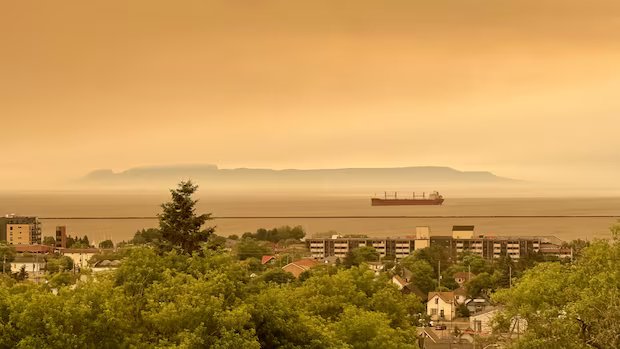
While the start to this year’s wildfire season in Canada got off to a slow start, it intensified rapidly, with fires developing in Ontario and the Northwest Territories in July.
Now, a new study from the World Weather Attribution (WWA), a collection of scientists who do rapid analyses on extreme weather events, found that human-induced climate change made these fires about twice as likely to occur.
“Time and again we see the same results: climate change is a key driver behind uncontrollably large and unprecedented fires,” Friederike Otto, a professor of climate science at the centre for environmental policy at Imperial College London and one of the authors, said in a press release.
“This shouldn’t come as a surprise. The science has been clear for decades: burning fossil fuels is making these wildfires more frequent, more intense and more difficult to contain.”
To date, more than 3.8 million hectares have been burned across the country, displacing thousands of people.
The analysis also found that, based on observations, this year’s wildfire event isn’t rare anymore in today’s climate. Instead, it’s expected to occur once every six to 15 years in Ontario and once every two to six years in the Northwest Territories.
In a world without climate change, it said, these events would have occurred less than once every 40 years.
The researchers focused on the seven-day and 30-day periods of the most extreme fire weather in Ontario and the N.W.T.
The effects of the wildfires went beyond the forests of Ontario and the Northwest Territories: smoke extended thousands of kilometres from their source affecting millions across southern Ontario and extending into the U.S. Midwest and northeast.

Firefighters in Ontario lack the resources they need to be effective because firefighting programs have been mismanaged by government for years, says Noah Freedman, vice-president of the union representing the province’s firefighters, who has experience leading fire crews.
In a WWA-hosted press briefing on Wednesday, Jonathan Boucher, wildland fire research scientist for the Canadian Forest Service of Natural Resources Canada, said what’s been notable for Ontario is that, already, the province has reached its highest ever recorded area burned.
And, he said, for both regions, the fires spread rapidly.
“As of now, as are our latest numbers, just above 90 per cent of the area burned had burned in a few weeks, in late June and July,” he said.
‘We’ve got to stop burning fossil fuels’
United Nations’ climate change executive secretary Simon Stiell said in a statement the science is clear.
“The science backs up what people on the front lines already know: humanity’s addiction to burning massive amounts of coal, oil and gas is heating our planet, turning more of Canada’s vast forests into tinderboxes, and spreading dangerous smoke far beyond the flames.”

Mike Flannigan, professor of wildland fire at Thompson Rivers University in Kamloops, B.C., who was not involved in the analysis, isn’t surprised by the findings.
“Our area burned almost quadrupled since the early 1970s, if you use a 10-year running average, and my colleagues and I attribute this largely, not solely, to human-caused climate change,” he said.
“I can’t be any clearer than that: We’ve got to stop burning fossil fuels.”
During the press briefing, study author Otto echoed that sentiment.
“If you care about anyone but the super-rich, you have to stop burning fossil fuels, because the impacts are here and are now and have huge consequences for all lives and livelihoods of people in all countries.”
Flannigan also noted that Earth’s warming climate, particularly in Canada, allows for longer fire seasons.
“As we warm, the atmosphere’s ability to suck moisture of dead fuels on the forest floor —needles, twigs, leaves — increases rapidly.”
He also said that Canada has had three bad fire seasons in a row, from 2023 to 2025, and that, during that time, roughly eight per cent of our forests burned.
“2026 comes along and, to me, it was a litmus test, because my narrative has always been, there’ll be bad years and there’ll be years that are quiet where it’s cooler and wetter, but now 2026 is yet another active year,” Flannigan said. “So four in a row. So my narrative 1786003963 is most years are going to be bad fire years.”
He’s also concerned about the wide-ranging effects of the smoke on the health of individuals, saying that, while cities may not be directly affected by the threat of a forest fire, the smoke from a thousand kilometres away could affect the quality of life for millions perhaps for weeks.
‘Not a local problem’
The analysis said many communities are unable to recover from one fire to the next and are facing “repeated displacement.” It also found that Indigenous communities are disproportionately affected, both in terms of physical and mental health.

Two large wildfires continue to burn near Vernon, B.C., with hot, dry weather raising fears the situation could get worse. Mayor Victor Cumming says the city is preparing for possible evacuations as residents cope with poor air quality.
“Simultaneous wildfires across Canada are stretching wildfire response and firefighting resources,” Roop Singh, head of urban and attribution at the Red Cross Red Crescent Climate Centre, said in a statement. “Indigenous communities, families, and firefighters are bearing the brunt of losses of homes, traditional practices and also the long-term mental health impacts.
Singh said fires like the ones in the N.W.T. and Ontario used to be rare events, but are so frequent now communities are “barely having the time to recover from one wildfire before the next one hits.”
All the researchers stressed during Wednesday’s press briefing that the world needs to move away from fossil fuels.
“We need to globally recognize that greenhouse gas emission is not a local problem, it’s a global problem,” Boucher said.
As for Flannigan, even as a wildfire scientist, he said, these constant years of record-breaking wildfire are a lot.
“I’m a fire guy, and I’m tired of the smoke,” he said. “So yeah, it’s enough.”