dailynewsnblog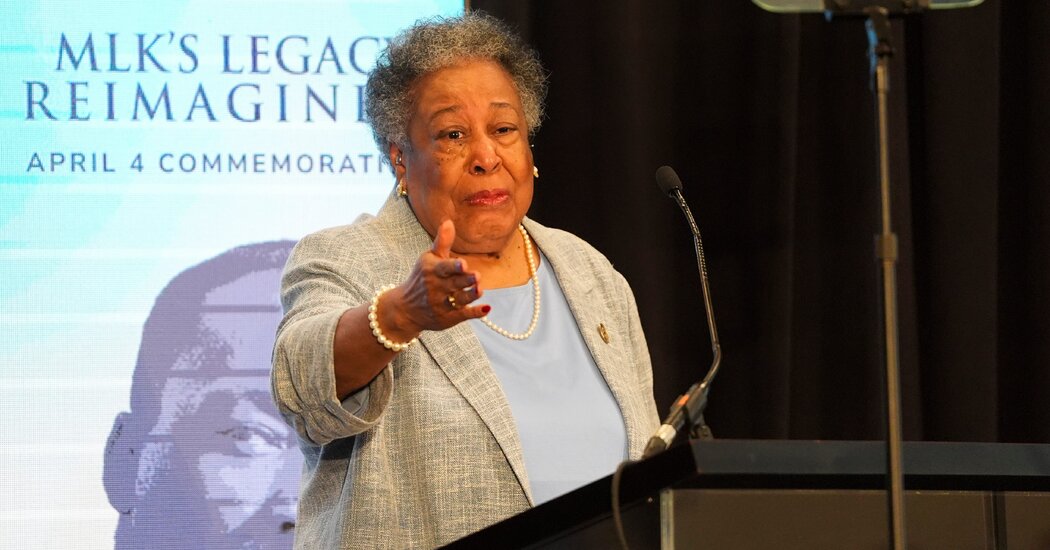
Clara Ester, a lay minister and civil rights activist who was one of the last surviving eyewitnesses to the assassination of the Rev. Dr. Martin Luther King Jr., died on July 9 in Mobile, Ala. She was 78.
She died in a hospital of complications from a stroke, her brother, Ronald Ester, said.
With the death of Ms. Ester, and that of the Rev. Jesse Jackson in February, Andrew Young, who worked with Dr. King on voting and civil rights issues and later became the mayor of Atlanta and the U.S. ambassador to the United Nations, is believed to be the only prominent surviving eyewitness to the assassination.
Ms. Ester was a 20-year-old college junior in Memphis when Dr. King came to the segregated city in April 1968 to support 1,300 striking Black sanitation workers seeking recognition of their union, improved safety standards and higher pay. As a student organizer, she participated in marches and in picket lines in support of the workers.
On April 3, she watched Dr. King deliver his “I’ve been to the mountaintop” speech at the city’s Mason Temple, part of the Church of God in Christ. Almost presciently, he said that while he might not live to see a time of racial equality and economic justice for Black people, he believed that “we, as a people, will get to the promised land.”
In the late afternoon on April 4, Ms. Ester drove her parents’ white Pontiac Tempest to the Lorraine Motel, bringing with her a friend, Mary Hunt. While Ms. Ester knew Dr. King was staying there, she told USA Today in 2018, she was mostly interested in the motel’s dinner special.
“I just wanted some catfish,” she said.
When she and Ms. Hunt arrived at the motel, she recalled in a personal essay in 2016 as the 50th anniversary of the assassination neared, that Dr. King was standing on the second-floor walkway outside his room, No. 306, and was casually talking to people below in the parking lot.
“Happy as a lark — laughing about stuff,” she told “NBC Nightly News” in 2018.
As she stood in the parking lot just after 6 p.m., looking up “at this great giant in my life,” Ms. Ester told the network, she heard a noise that sounded like a truck backfiring. It was a gunshot from a high-powered rifle. She did not take her eyes off Dr. King. The impact of the gunshot, she said, appeared to throw him up in the air and then back down as he collapsed onto the cement walkway.
She and Ms. Hunt ran up the stairs to his side. Ms. Hunt, wearing bobby socks, appears in Joseph Louw’s indelible photograph of the scene, in which he captured a small cluster of people standing around a fallen Dr. King as several of them point toward a rooming house where they believed the shot had been fired.
Ms. Ester’s presence on the walkway was confirmed in an F.B.I. report and in photographs in which she was partially obscured and shown from behind.
Ms. Ester recalled feeling for Dr. King’s pulse. “He was breathing but very slowly,” she wrote in her 2016 essay. “I unbuckled his belt to help. His eyes were open.”
She also asked for motel towels to try to stanch the bleeding of a severe wound to right side of Dr. King’s face and neck.
Perhaps because he had been speaking pleasantly with friends, she wrote, “there was a most comfortable, relaxed expression on his face.”
Dr. King was transported to St. Joseph’s Hospital in Memphis and was pronounced dead about an hour later. Nationwide civil unrest followed. James Earl Ray pleaded guilty to the assassination, though he later recanted his confession, and died in 1998 while serving a 99-year prison sentence.
For Ms. Ester, Dr. King’s death, she said, forever changed her life. “I know that I was no longer the same person I had been,” she wrote in her 2016 essay.
In 1970, she received a bachelor’s degree in elementary school education from LeMoyne-Owen College, a historically Black college in Memphis. She soon left Tennessee and lived her final 50 years or so in Mobile, where she became a lay minister and ran a community center.
“It hurt me that it happened, but it hurt me that it happened in my hometown, that that’s the legacy for this city,” she told The Associated Press in 2018 about Dr. King’s assassination.
Clara Jean Ester was born in Memphis on Feb. 17, 1948. Her father, Anderson Ester, was a railroad worker. Her mother, Willie (Love) Ester, cooked and cleaned at a community center.
Clara wrote in her essay that she felt protected by her parents from racism and segregation as a young girl. “We used to joke about colored water being Kool-Aid and the white water just being water, and that satisfied us as children,” she told The A.P.
When she was 7, however, she witnessed her mother being chastised in a train station, because the family used bathrooms and a water fountain designated for white people. “I’d never seen anyone talk to my mother like that,” she wrote. “That’s when I started to see the injustices.”
Her family belonged to the Centenary United Methodist Church in Memphis whose pastor, James M. Lawson Jr., was described by Dr. King as “the leading theorist and strategist of nonviolence in the world.” After Dr. King’s assassination, Ms. Ester — who later told USA Today that she had tossed Molotov cocktails during the sanitation workers strike — ruled out violence as a tactic for social change. Instead, she said, she wanted to “pick up the cross and carry it.”
“She knew she wanted to help people and right wrongs,” her brother, Ronald Ester, said in an interview with The Times.
In addition to her brother, Ms. Ester, who never married, is survived by a son, Reginald Ester.
In Mobile, she devoted herself to justice, compassion and reconciliation, becoming a deaconess, or lay minister, in the United Methodist Church and the executive director of a community center. At the center, she oversaw programs that assisted the blind, the deaf, and homeless mothers and children; operated night classes for students seeking their high school equivalency diploma; and collected toys for Christmas.
“There’s no kind of injustice — gay rights, immigrant rights, whatever — that I don’t feel obligated to address,” she wrote in her 2016 essay. “We have to learn how to love one another and live together.”