dailynewsnblog
A curious omission
Google users were more willing to excuse AI in 2024, but the backlash is real in 2026. People are increasingly looking to avoid AI features, which makes this 4GB stealth download all the more questionable. Google’s obsession with AI has led to numerous stumbles, even when the company has ostensibly good intentions, because we are all (rightly!) hyper-focused on how this technology is impacting our lives.
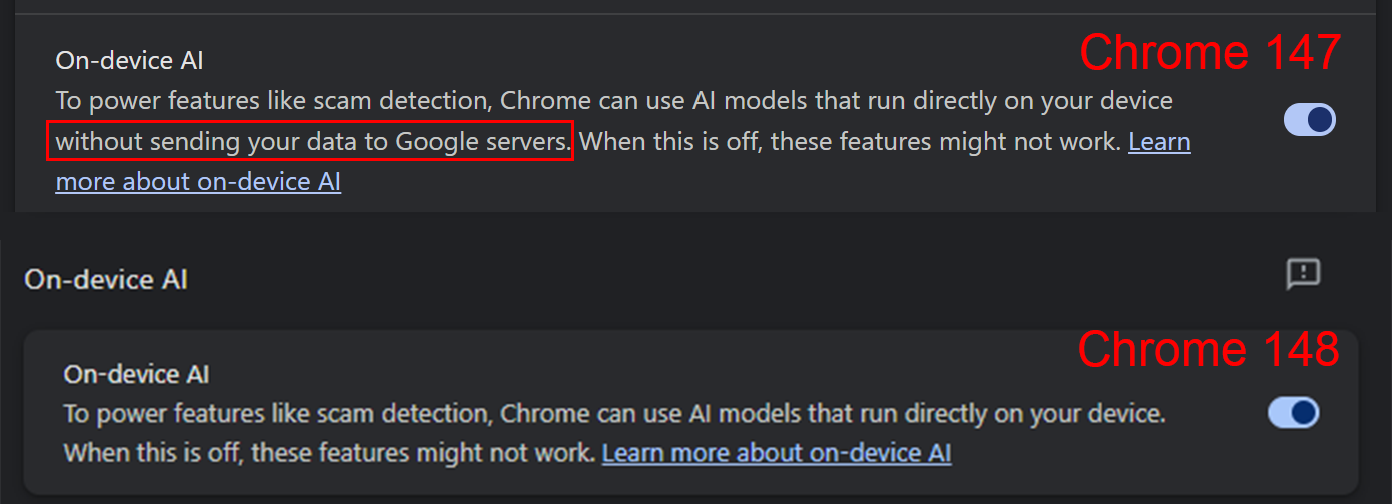
Some of those “good intentions” seem to have made the Chrome situation worse. As users sought ways to remove this AI model, many looked for the settings toggle. This happened to coincide with the wide release of Chrome 148, and the label for this toggle included a pretty suspicious change versus v147.
Credit:
Ryan Whitwam
Google claims this change was made to be clear about how Chrome’s APIs work.
Credit:
Ryan Whitwam
Google removed the stipulation that its on-device AI model would not send data to Google’s servers. This is alarming, as one of the primary benefits of local AI is its greater privacy. We reached out to Google to ask if this wording is due to a change in Chrome’s on-device AI.
“This doesn’t reflect a change to how we handle on-device AI for Chrome,” a Google spokesperson said. “The data that is passed to the model is processed solely on device.”
According to Google, the team decided to make this change earlier in 2026 to ensure it was being crystal clear about how AI works on the web. Chrome’s local AI has an API that a site might use, for example, to do summarization or edit your writing. In these instances, the website would naturally see the input and output. If it’s a Google website, that data ends up on Google’s servers. If it’s a non-Google site, Google doesn’t see any of that data.
That explanation may or may not be satisfying as the backlash against AI grows. Regardless, using the web is never completely private. If you’re uncertain about using AI tools on a site, you should always try to parse its privacy policy, which will tell you how your data (AI-generated or not) will be used. As long as Google is deploying AI as an opt-out service, you’ll have to be extra vigilant.
As the saying goes, it’s easier to ask for forgiveness than permission, but Google ought to be asking for permission a little more often.