dailynewsnblog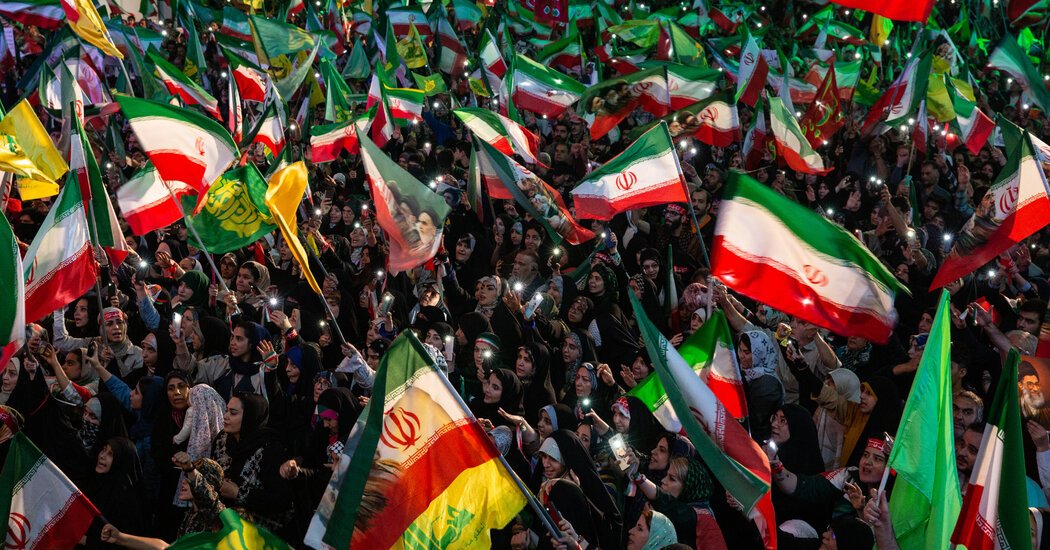
As President Trump tries to sort out his next steps on the Iran war, China is taking its own actions to ensure it benefits from whatever outcome eventually emerges.
China is prodding Iranian officials to negotiate with the United States, while also quietly allowing its companies to give Iran commercial support that could help Iran’s military if Mr. Trump dives back into a full-blown war.
The Chinese government has not taken a strong position on the war. It has multiple goals and acts with caution, so it is hedging, officials and analysts say.
The war will no doubt be an important issue in talks between Mr. Trump and Xi Jinping, China’s leader, when they meet in Beijing for a two-day summit scheduled to start May 14.
On the one hand, having the United States bogged down in yet another war in the Middle East is advantageous for China. The U.S. military has quickly expended an enormous amount of munitions, depleting stockpiles that would be critical in any future conflict with China. And the war diverts the Trump administration’s attention from Asia.
But China also sees a benefit to trying to help end the war, which Mr. Trump and Israel started more than two months ago. Early in the war, Iran’s military effectively closed the Strait of Hormuz to most ships while allowing vessels carrying Iranian oil to cross, including ones bound for China. But the Chinese economy has still been hurt by surging global energy prices, and the country is also feeling an impact from a U.S. naval blockade that prevents some ships from leaving Iran’s ports.
“Although some observe that Beijing might favor a prolonged war in Iran, the policy discourse in Beijing in fact favors de-escalation,” said Yun Sun, a scholar of China at the Stimson Center, a foreign affairs research group in Washington.
Both China and Russia have asked Iran to continue negotiations with the Americans, said two Iranian officials. Last Wednesday, Mr. Trump spoke to President Vladimir V. Putin of Russia about the war. And Secretary of State Marco Rubio and Wang Yi, his Chinese counterpart, discussed the war in a call on Thursday, said Liu Pengyu, a Chinese Embassy spokesman in Washington.
Mr. Trump already postponed the summit with Mr. Xi once because of the war. He wants to go to Beijing in a position of strength, officials say, and not with an unresolved conflict that continues to roil global markets and sap U.S. military resources.
“For China, there’s the issue of our blockade,” said Rush Doshi, a scholar at Georgetown University and the Council on Foreign Relations who worked on China policy in the Biden White House. “For us, there’s the issue of China’s support of Iran.”
American intelligence agencies have information that a Chinese company may have tried to send a shipment of shoulder-fired missiles to Iran. Chinese companies have also shipped Iran material that is considered dual-use, meaning it can serve civilian or military purposes, American officials say.
And after the U.S. Navy blockade started last month, Marines found material on an Iranian-flagged ship that Mr. Trump said was “not very nice” and perhaps “a gift from China.”
“I was a little surprised but — because I have a very good relationship and I thought I had an understanding with President Xi,” he told CNBC on April 21. “But that’s all right. That’s the way war goes, right?”
That came a week after Mr. Trump told Fox News that he had written a letter to Mr. Xi asking him not to send weapons to Iran. He said Mr. Xi wrote him a letter back saying that “essentially he’s not doing that.”
Mr. Trump’s apparent nonchalance was another sign of his drive to keep his summit with Mr. Xi on track. Months ago, Mr. Trump and top aides had intended to focus on tariffs and a potential trade agreement in talks with Mr. Xi, but now discussions over the Iran war could overshadow that.
Officials in Beijing are “holding off serious pressure on Iran until there is a direct ask from President Trump,” said Ms. Yun, who conducted interviews in the Chinese capital recently. Because officials want to “amplify positive relations” with the United States, they might take seriously any ask that Mr. Trump makes of China on Iran, she said.
Mr. Liu, the spokesman for the Chinese Embassy, said in a statement that “keeping the area safe and stable and ensuring unimpeded passage serves the common interest of the international community.” He criticized the U.S. naval blockade as “a dangerous and irresponsible move.” He did not mention the Iranian military’s attacks on ships that Iran had not granted safe passage.
Mr. Liu added that “the pressing priority is to prevent by all means a relapse in fighting.” Mr. Liu pointed to Wang Yi, China’s top diplomat, having had 26 phone calls with officials in Iran, Israel, Russia, the Gulf Arab nations and other countries before the United States and Iran reached a fragile cease-fire in early April.
Two of the calls were with Abbas Araghchi, the Iranian foreign minister, he added. China’s special envoy for the Middle East also traveled to the region.
China played a crucial role behind the scenes in getting Iran to accept the terms of the cease-fire, several foreign officials said, adding that diplomats from some of the countries involved in the conflict are encouraging China to stay involved. Like other officials interviewed for this article, they spoke on the condition of anonymity to describe sensitive diplomacy.
As for Chinese shipments to Iran, Mr. Liu said that “we handle the export of military products prudently and responsibly and strictly control the export of dual-use articles.”
In Iran, officials in the Islamic Revolutionary Guard Corps, or I.R.G.C., are talking about the possibility of growing their ties to China after the war, to get the type of military aid that Chinese officials have given Pakistan over many years, said Ali Vaez, the director of the Iran project at the International Crisis Group.
“I see more and more voices affiliated with the I.R.G.C., now the real power in Iran, openly saying that the failure of Iran has been that it was too shy about aligning itself with China and Russia and was instead trying to preserve its independence,” he said. “They say they need to mortgage out part of the country to China to end up where Pakistan is.”
Across the Persian Gulf, Saudi Arabia and the United Arab Emirates are trying to get China to play a bigger diplomatic role. On April 20, Crown Prince Mohammed bin Salman of Saudi Arabia called Mr. Xi to talk about the war.
During the war, Saudi Arabia asked China to press Iran to refrain from attacking the kingdom, a Saudi official said.
In 2023, China helped finalize a diplomatic opening between Iran and Saudi Arabia after those countries had talked about further engagement for years. China is seen in Riyadh as a vested party in relations between Saudi Arabia and Iran, the Saudi official said.
Pakistan, which has hosted one round of U.S.-Iran peace talks, is also relying on China to help push negotiations forward. On March 31, China and Pakistan issued a five-point statement calling for an immediate cease-fire, peace talks, the protection of civilian sites, an opening of the Strait of Hormuz and respect for the United Nations Charter.
On April 8, Prime Minister Shehbaz Sharif of Pakistan thanked five countries in a social media post for their help in sealing the cease-fire deal. China was at the top of the list.
China gave a public show of support for Iran that same week by joining Russia in vetoing a U.N. resolution that would have allowed for multinational military action to force Iran to open the strait. Behind the scenes, China told Iran it should show flexibility and agree to a cease-fire, Iranian officials said.
However, some analysts argue China’s appetite for expanding its diplomatic role in the Middle East is probably limited.
“Beijing’s priorities are more practical,” said Ryan Hass, a former career diplomat and White House national security official now at the Brookings Institution. “They want reliable access to energy inputs and secure markets for their exports. They do not want to accept another region’s security challenges as their own problems.”
Farnaz Fassihi contributed reporting.