dailynewsnblog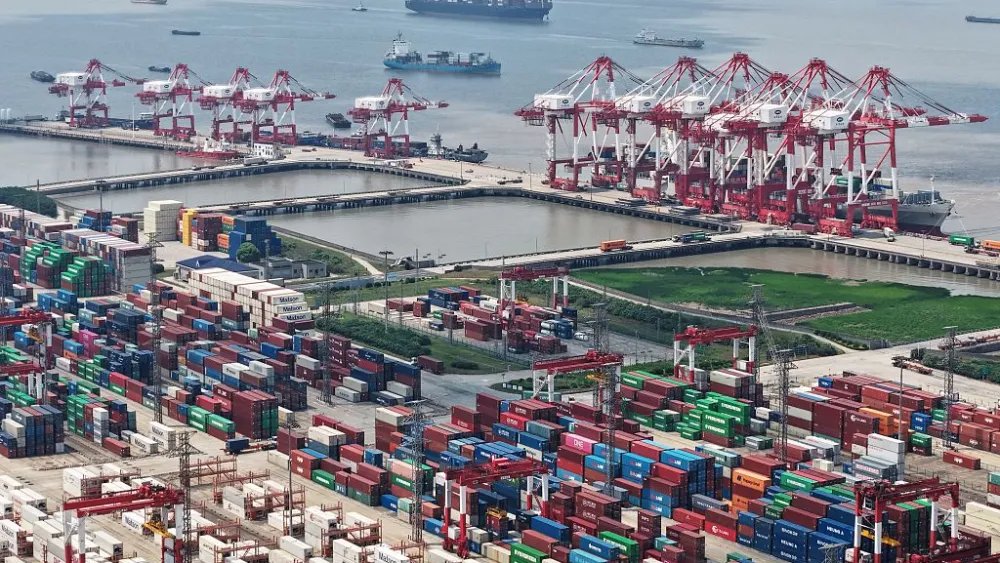
China’s largest container ports continue to endure congestion and delays weeks after multiple typhoons hit the eastern part of the country, causing some carriers to skip calls at the gateways.
According to data from container shipping research firm Linerlytica released Monday, there are 4.3 million 20-foot equivalent units (TEUs) waiting to berth at container ports globally, driven mainly by the east Asian berthing delays.
Total stranded capacity is higher now compared to the previous peak of 4 million TEUs reached during the Covid-19 pandemic in 2022, the company said. But when accounting for percentages, peak congestion hasn’t been reached yet due to the flurry of newly built container ships that ocean carriers ordered in the years after.
Stranded containers account for 12.6 percent of global fleet capacity at 34.4 million TEUs, still lower than the 2022 peak of 15.7 percent when the total fleet stood at just 25.3 million TEUs.
Even with more relative capacity, Linerlytica said the current port disruptions and the recent backlogs at the Panama Canal have created a short-term shortage of vessels that continues to lift freight rates.
Portcast data indicates that 139 vessels were queued up at the Port of Shanghai last Monday, reaching highs unseen across 2025 and 2026. For the Port of Ningbo, 77 ships are waiting to berth, also marking recent highs.
According to Hapag-Lloyd, the average waiting time for Gemini Cooperation services calling at Shanghai’s Yangshan deepwater port is approximately five to six days, and seven to eight days for non-Gemini services.
Earlier this month, Maersk CEO Vincent Clerc said that Shanghai had waiting-to-berth times of as much as 12 days, suggesting that port congestion was part of a wider need for global gateways to bolster their terminal and inland infrastructure as container demand increases.
Hapag-Lloyd indicated that the average waiting time at Ningbo is about three to four days for Gemini loops and three days for non-alliance services. For Qingdao, the average wait is 72 hours for both Gemini and non-alliance services.
On Monday, Maersk confirmed in a customer advisory that the Delos Wave 630N will omit a call at the Port of Shanghai to minimize delays to the vessel’s schedule. Cargoes planned for discharge in Shanghai have been updated to alternative routings, the company said.
The Malta-flagged Delos Wave is part of the Asia-to-Oceania Northern Star service and will instead dock at the Port of Xiamen on Friday before traveling to Hong Kong a day later. That container ship departed New Zealand’s Port of Tauranga on Aug. 15.
The cancellation came 10 days after Maersk shifted two other sailings on the Northern Star service—the Seaspan Guayaquil and AS California—from Shanghai to Xiamen. Those two vessels are expected to bring Shanghai back into their rotation by October, according to Maersk’s schedules.
In total, based on Hapag-Lloyd’s operational update from Aug. 18, at least 320,000 TEUs of capacity for the Gemini Cooperation has avoided Shanghai in the two weeks prior.
Another 70,000 TEUs mainly operating on Hapag-Lloyd’s Latin American services skipped past the Port of Ningbo, while another roughly 75,000 TEUs of capacity was lost at the Yantian Container Terminal after the Port of Shenzhen was omitted, mainly on Gemini loops.
One of the companies’ shared services, a joint Asia-to-Mediterranean AE15/SE3 loop departing from Qingdao is being canceled. That service was set to leave the Chinese port on Sept. 7.
Freight rates have continued their ascent amid the ongoing delays and schedule reliability concerns compounding other factors like the war in Iran, which has kept fuel costs elevated.
Shanghai-to-U.S. ocean spot freight rates accelerated 9 percent each on both West and East Coast routes, according to Drewry’s World Container Index (WCI) as of Thursday. Cargo to New York extended its peak price of 2026 to $9,507 per 40-foot container, while freight to Los Angeles broke into a new annual high at $6,802 on average.
Helping push rates up further, capacity declined 9 percent month over month in August on the Asia-to-U.S. East Coast route and fell 0.4 percent sequentially on the Asia-to-West Coast path.
The congestion and Middle East unrest have both also impacted intra-Asia freight rates, with Drewry counting a third-straight week of container price increases. Drewry’s Intra-Asia Container Index (IACI) rose 6 percent this week to $1,091 per 40-foot container.
The maritime research advisory service expects freight rates to increase in the coming weeks as well, supported by persistent congestion and equipment shortages.