dailynewsnblog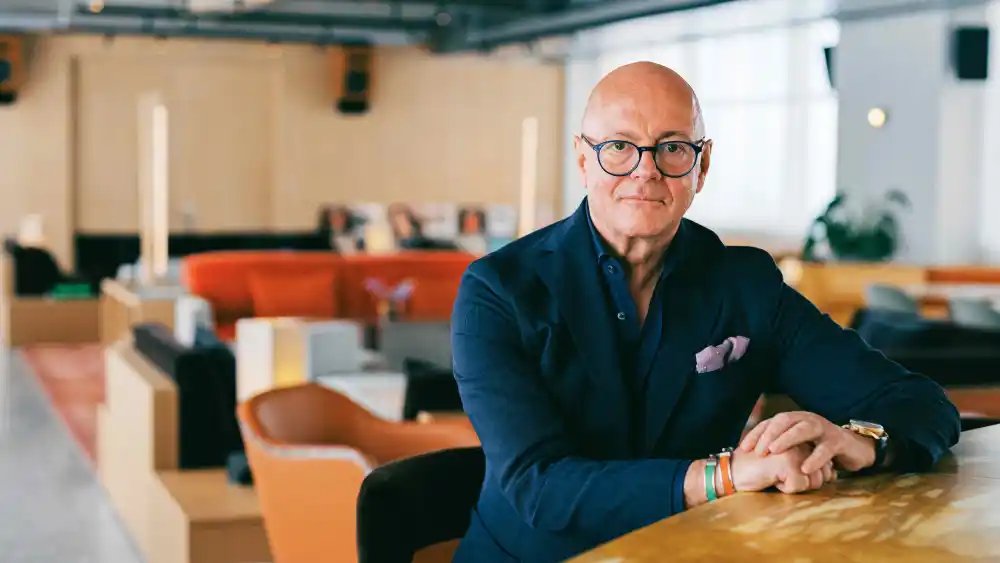
LONDON — He’s been in the industry for 50 years, yet still considers himself a student of retail. But Selfridges Group chief executive officer André Maeder — who started as an apprentice sales assistant in a Swiss fashion store and who has held top management roles at KaDeWe, Karstadt, Hugo Boss and Harrods — isn’t just any student. He’s a front-of-the-classroom kind, with sharpened pencils and questions to ask.
Maeder, who joined Selfridges in 2023 from the Berlin-based luxury department store KaDeWe, oversees the Selfridges flagship in London and three stores in Manchester and Birmingham, England; Brown Thomas and Arnotts stores in Ireland, and the De Bijenkorf chain in the Netherlands. Until recently he also was president of IGDS, the Intercontinental Group of Department Stores, the world’s largest association of its kind.

André Maeder of Selfridges
Jamie Stoker/WWD
Lately he’s been speaking at universities here and in Europe, urging post-graduate students to consider a career in the industry. “Retail is exciting, and offers a chance for young people to fast-track, and become leaders very soon. You can lead hundreds of people and, as a buyer, you can travel. There are so many exciting jobs,” Maeder said during an interview at 40 Duke, the new private members’ club on the top floor of Selfridges in London.
It is especially exciting in London, where competition is fiercer than ever. Selfridges, which had 775 million pounds in revenue and a pre-tax loss of 15.9 million pounds in fiscal 2024 [2025 figures will be reported in September], is competing against physical stores ranging from Harrods to Dover Street Market, and online giants such as Net-a-porter, Mr Porter and Mytheresa, now grouped under the ownership of LuxExperience. Depending on who buys Harvey Nichols, Selfridges might also have another newly resurgent competitor in Knightsbridge.
But Maeder has a plan. Looking dapper in a navy blue Eleventy suit and patterned pocket square, raspberry-colored socks and round glasses with a bright blue trim, Maeder talks about transforming Selfridges into a “retail media” platform and helping customers escape the everyday, whether they spend five minutes, or three hours in the store.
WWD: How has retail evolved since you started as a teenage sales assistant?
André Maeder: It is much faster and more complex. So many years back, a department store didn’t have restaurants, it didn’t have a cinema like Selfridges has now. Our partners — and customers — are much more global, international and demanding. The customer is also better informed and social media is playing a big role. For example, we just opened a new shop for Dolce & Gabbana, and we were very professional, taking our photographs, and then posting them on Instagram, and our other channels. But you can be 100 percent sure that the first pictures in the world were posted by a customer who attended the opening. Retail is moving fast, and Selfridges needs to move even faster.
WWD: How can Selfridges stand out in such a crowded, multilayered market?
A.M.: The competition is fierce, and it’s not just the other big department stores in Europe, and the world, that we compete with. Our competition is restaurants and wider culture. It’s holidays, retail concepts and sports. I always say that people have [a fixed amount of money] in their pocket every month, and have to make a decision about how to spend it. That’s why we are moving so fast toward becoming a “retail media” company.
At Selfridges, we want to have the best restaurants and we can offer you two beautiful terraces when you want to sit outside in the evening. We want to have the coolest bars in town, whether that’s in London, Birmingham, Manchester or in our other European stores. We want to have a cinema showing the latest movie, and to have designers like Marc Jacobs speak to our customers. He did that recently at 40 Duke.
The majority of our customer base is local, and we feel we are owned by the inhabitants of London, Manchester and Birmingham. We do have owners [Central Group and Saudi Arabia’s Public Investment Fund] but for more than 100 years, the flagship has belonged to London.

The terrace at 40 Duke.
WWD: What are some of the other challenges the store is facing right now?
A.M.: There’s one challenge that’s not really in our hands, and that’s the government’s cancellation of tax-free shopping [for foreign tourists] in the U.K. It was a big loss for us, even though our sales have recovered and more than half of our customer base is local. We have a very, very important international customer, and some of them are buying less with us because things are clearly cheaper in Paris or Milano. This is a problem, and I really wish that things will start to move quickly and to change under the new Prime Minister [Andy Burnham]. Everybody can see that canceling tax-free shopping was a mistake, not only for the luxury department stores — but also for taxi drivers, hotels, airports and many, many other industries.
WWD: Can you talk more about “retail media,” and why it is such an important strategy?
A.M.: We see ourselves as a platform for our partners, and for unexpected artists, a place where customers can discover new things, a [historic] market square that offers special products. We had more than 400 pop-ups and 650 events in our four Selfridges stores last year, the majority of which were at the Oxford Street flagship. In London we have a cinema, a members’ club, beauty services, a hair salon.
We also want to be the most imaginative shop in the world, and to spark joy by connecting people to original ideas. Our Dream On summer campaign is a good example. When you come into our beautiful atrium, you’ll see it’s filled with animals and imaginary figures. You can walk downstairs to the coffee shop and order sweets and cakes the same color as the animals. [The inflatable horses, butterflies, snails and other creatures are by the New York artist and designer Katie Stout. They’re suspended from the ceiling, and populate the windows, too.]
The world is tough enough right now. Whether you come into our store for five minutes or for three hours, whether you come to meet friends or to drink an espresso on your own, we want you to experience wonder. We are here to create something special, unforgettable, an experience that stays with you. Selfridges, more than anything else, is a place of imagination, of cultural relevance, of moments that surprise.
That’s how Selfridges differs from most department stores. In 1909 our founder, [the American] Harry Gordon Selfridge, said the store was open to the world, and nearly 120 years later that is still absolutely the case. We are a place of wonder and theater, and we haven’t really changed our strategy. We’ve just added to it.
We were pleased with trading in 2025, which was in-line with expectations. Our Disney Christmas campaign was a particular highlight, driving strong engagement throughout the festive season.

The atrium at Selfridges with animals from the Dream On campaign.
WWD: How does The Corner Shop concept space fit your vision?
A.M.: Our Corner Shop is the pièce de résistance of retail experience, and more than 150,000 people pass by its window on Oxford Street every day. Right now we have more than 20 fashion, jewelry and beauty brands from Saudi Arabia showing in a new world, a new dimension. Last Christmas, we had a Disney theme at The Corner Shop, and throughout the store. It was a win-win for Disney as much as it was for us. It was also the first time we thought of ourselves as a “retail media” company rather than a department store. Although we’re not planning to do Disney for Christmas this year, we’re thinking big — 2026 might be one of our biggest Christmases ever. I can’t give any more details now, but it will be all about winter dreams.
WWD: Can you talk more about 40 Duke, your new members’ club, and how that fits in with the strategy?
A.M.: We see 40 Duke as the peak of our mission to surprise, to do the unexpected. It’s a combination of a membership club for our VSP and VVSP customers [Very Selfridges People and Very Very Selfridges People, the highest levels of the “Unlocked” membership program] which no department store in the world has. Our VSP and VVSP customer base has more than tripled since 2022.
40 Duke is also a very exclusive home for personal and private shopping, with 24 rooms, and a place for the unexpected. We recently hosted a summer breakfast for dogs, and their owners, as part of our Dream On campaign. We have evenings when we read from new books as part of our book club, or organize special tasting menus as part of our wine club.
Just after we opened, Marc Jacobs came to meet with VSP customers over coffee, which was really great. We want to do that often, and we have more designers in the pipeline. We also had Chopard take over the terrace.
Caroline Scheufele [copresident and artistic director of Chopard] brought very exclusive watches and jewelry to the special jewelry room we have at 40 Duke. She also brought her evening dress collection [Caroline’s Couture by Chopard] and did a fashion show on the terrace with selected customers from Selfridges and Chopard. That’s our idea for the future. We want to be a platform for, and a partner to, the brands.

The bar at 40 Duke.
WWD: Now that 40 Duke is open, what’s next?
A.M.: We will be investing in our Oxford Street food hall, and I can give more details as the plans develop. It hasn’t been refurbished in 30 years and we’re still working on that in strategy and master plan. We already have our Brasserie of Light, our Alto by San Carlo Italian restaurant, and very soon we’ll be adding a new Lebanese restaurant called Loris. Fashion and accessories have always been very important for us, as has beauty. We just finished renewing our Oxford Street beauty hall, which is one of the top beauty halls in the world — without any question. This spring, we did something similar at Selfridges in Birmingham, and it’s now the biggest beauty hall in the U.K. outside London.
WWD: What role does AI play in the business?
A.M.: We want to use AI when it adds value to the whole customer journey, and if it makes commercial sense. For example, we can use the data to make more personalized recommendations. It’s not only for our VIP shoppers, but also for our shopping teams. Going forward, I believe AI will play a very important role, but we have to be very clear where we use it, and how we use it. It’s a tool for us, not a philosophy.

André Maeder of Selfridges
Jamie Stoker/WWD
WWD: What’s your daily routine at Selfridges in London? Do you walk the shop floor?
A.M.: I walk the shop floor every day for at least an hour. That’s my inspiration, and the best office space I could ask for. I love meeting our teams and customers, watching what’s happening, reading the room and the atmosphere. My favorite part of the job is interacting with customers, and with people generally. I’ve been in the same industry for 50 years and, to be honest, I never get tired of walking the shop floor. I’m as interested now as I was at the very beginning of my career.
I like seeing happy faces — that’s very important to me. But it’s not only the happy faces you see on customers who’ve just bought a new bag from Louis Vuitton or Dior. I also like seeing a happy face on someone who’s not even carrying a bag, someone who’s just wandering around the store looking at all of the beautiful things we have. It’s really a gift when you can get up in the morning and look forward to going to work. I’m in a privileged position, and I am very thankful for that.

One of the Dream On windows by the artist Katie Stout.
WWD: What’s your usual route around the store? Do you start at the top and work your way down, or vice versa?
A.M.: Sometimes I go from the fourth floor to the lower ground, or the other way around. But most of the time, I head straight to one of the new shops. We opened or renovated 150 new shops so far this year, most of them in London, and they are usually my first destination after [stopping at] the office.
I went to Dolce & Gabbana when it opened at 9 a.m., and from there I walked through womenswear and menswear, and into the other parts of the store. I’m almost nervous when I know there is a new shop opening, or nice events are happening, or a new product group is being launched. It’s really exciting and never stops being exciting.
Even this week [on Aug. 3], when we opened the Saudi promotion at The Corner Shop, I was nervous. We opened on a Monday morning, and I couldn’t sleep on Sunday night, because I was so excited. It’s a little bit like a footballer before they go out on the pitch, or a singer just before a concert. If you’re not nervous anymore, there’s something missing.

The private jewelry area at 40 Duke.
WWD: Who would you consider your mentors in the business?
A.M.: One of them, Vittorio Radice, is still involved in Central Group Europe. You know the story of Vittorio. He was running Selfridges in the 1990s and helped to make the store what it is today. Harry Gordon Selfridge set the philosophy of the store 120 years ago and Vittorio pushed it to the next level. The other is Dr. Bruno Sälzer. He was my CEO at Hugo Boss when I was the board member for sales and marketing worldwide, and he really mentored and pushed me and helped me in my career.

A look inside Saudi: Sky’s the Limit at The Corner Shop.
Courtesy
WWD: What’s the first question you ask when you’re interviewing someone for a job?
A.M.: I always ask, “What brought you here? Is it the job? The salary? The brand name? The function?” It’s quite interesting because you get a lot of different answers, and I do take them seriously. Usually the person is not expecting the question. Still, most of the answers are absolutely to the point.
WWD: What do you do out-of-hours, when you’re not walking the shop floor?
A.M.: I’m very active. I like to be outdoors. I’m Swiss, and I like the mountains. I’ve been skiing for 60 years. I was first on skis when I was five. Honestly, for me, that is the perfect holiday, being in the mountains in Switzerland and skiing in powder snow. I don’t do helicopter skiing, or even go off-piste. It’s not good for nature — or for my bones.

Afternoon tea at the Imagination Café at Selfridges, part of the store’s Dream On campaign.