dailynewsnblog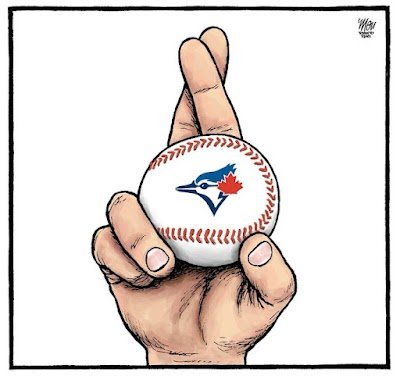
.jpg)
Wildcard Dreams
It has been done before, so maybe our Jays can do it again!
CBC’s Geoff Nixon writes From last place to the post-season? Here’s how the 2026 Blue Jays could pull it off
Prime Minister Mark Carney says “you’ve got to believe” the Toronto Blue Jays can still make the playoffs. But can they, really?
…According to Elias Sports Bureau, the official statistician of Major League Baseball (MLB), there are just two teams that have stood at 58-63 through 121 games — the same record the Jays have right now — that went on to make the playoffs in the wild-card era: The 2024 Detroit Tigers and the 2009 Minnesota Twins.
Randy Robles of Elias Sports Bureau believes “there’s some hope” for the Jays, noting that if there ever was a year for a struggling team to still have a chance, it would be this one, when so many American League teams have been playing so poorly.
Toronto has begun to claw its way to a better record, claiming series wins against the Washington Nationals, the St. Louis Cardinals, the Houston Astros and the Philadelphia Phillies in the past couple of weeks.
That winning trend has to continue for the team to have a shot at the post-season: “They gotta get to .500,” Robles told CBC News, referring to the point when a team has won as many games as it has lost.
The Texas Rangers, the team currently sitting in the third wild-card spot the Jays are vying for, was only one game above the .500 mark prior to Tuesday’s matchups.
All the teams seeking to take the Rangers’ spot — Toronto included — currently have losing records.
Summing up the challenge the Blue Jays face in climbing the standings, Toronto Star baseball columnist Mike Wilner saw a certain parity in the teams involved in the wild-card fight.
“Every team in front of the Blue Jays kind of stinks,” Wilner told CBC News. “The problem is, the Blue Jays kind of stink, too.”…
Yeah, well, not so much lately, buddy!
Canadian Prime Minister Carney in his new hand knit Blue Jays sweater made with Canadian wool 🧶 perfect for the playoffs in October. Go Blue Jays! 🇨🇦
[image or embed]
— Gaylyn Young 🇨🇦 🧶 🥾 🌾 (@gynottoday.bsky.social) August 9, 2026 at 4:47 PM
Prime Minister Mark Carney is not ready to give up on the Toronto Blue Jays, urging fans to ‘believe’ they can make it back to the playoffs this season.
[image or embed]
— CTV News Northern Ontario (@ctvnorthernontario.bsky.social) August 11, 2026 at 9:05 PM
Nasty? You ain’t seen nuthin’ yet!
In The Hill Times, former Liberal MP John McKay has some advice for the Carney negotiations: Canada needs more than strategy, it needs encouragement
…Prime Minister Mark Carney has hardly been short of advice on how Canada should respond. Every time another unjustified tariff is announced, the media erupts with instant analysis while a familiar parade of political commentators and self-appointed experts offers its preferred solution.
The federal Conservatives demand a plan. Some provincial Conservatives insist Canada should retaliate dollar for dollar. Others warn against provoking Washington. Still, others urge the prime minister to “rag the puck” while simultaneously skating with “elbows up.”
Anyone who has ever played hockey knows those are not complementary strategies. You either protect the lead or you finish the body check. Trying to do both at once usually means doing neither very well…
…This economic dispute has never been fought solely by governments. Millions of Canadians have chosen to cancel trips to the U.S., purchase Canadian products, avoid American brands, and seek alternatives in everything from groceries to vacation destinations.
Those decisions matter.
Reports suggest Canadian travel south of the border has fallen dramatically, with some popular winter destinations such as Myrtle Beach and Miami reportedly seeing declines of 50 per cent to 65 per cent in Canadian visitors. Canadian retailers report declining demand for U.S.-sourced products. Brown-Forman says Canadian sales have fallen sharply. Loblaws has reported 15-per-cent to 20-per-cent reductions in purchases of American goods.
These are not isolated statistics. They represent millions of individual decisions by ordinary Canadians who have decided that defending Canada’s economic interests begins with their own purchasing choices.
The prime minister should say so.
Instead of limiting public appearances to discussions of negotiating frameworks and forward guidance, he should regularly explain, in plain language, the measurable impact Canadians are having on the American economy. Show people that their sacrifices are producing results. Demonstrate that American exporters, tourism operators, and manufacturers are feeling the consequences. Let Canadians know that Washington is hearing from businesses that depend on Canadian customers.
Nothing sustains public resolve like evidence that collective action is working.
Canadians have accepted inconvenience. They’ve changed vacation plans, shopping habits, and long-established routines. Many have paid more for Canadian alternatives because they believe the cause is worth supporting.
Governments often ask citizens to stand together during difficult times. When they do, they also have an obligation to remind people that their efforts matter….
I think Carney is using our Elbows Up Anger cleverly now, to warn Trump that Canada is mad as hell and won’t take it any longer.
Here’s a gift link from The Globe and Mail story today about the negotiations:
Canada’s top trade negotiator has warned her American counterparts that if the White House imposes new tariffs on Aug. 19, the move would represent a “cliff” that risks halting negotiations with the U.S.
According to five sources briefed on the discussions, Janice Charette delivered the message in a meeting last week with United States Trade Representative Jamieson Greer.
Four of the sources said Ms. Charette cautioned the Americans on the public mood in Canada should President Donald Trump make good on his threat to impose the new tariffs.
The sources said she warned the officials that Ottawa would not be able to rein in or control the public or premiers’ reactions and the federal government will have lost the room to negotiate with the Americans….
… Ms. Charette spent the weekend hunkered down at the Canadian embassy working with a small army of trade negotiators and experts.
The sources said Ms. Charette is a well-respected and shrewd negotiator who chooses her words carefully. Two of them noted the importance of the use of the word “cliff” in her description of the Aug. 19 tariffs because it’s a term she has used in the past to frame the level of seriousness around trade talks.
Notably, in April she downplayed the significance of a July 1 review date for the Canada-U.S.-Mexico Agreement, saying it was a “checkpoint” and not a “cliff.”
Another one of the sources said Ms. Charette is well received by the Americans in part because of her candour and directness.
… In the current talks, the U.S. is demanding that Canada accept export quotas on steel and aluminum, remove retaliatory tariffs on U.S. products, such as autos, return American alcohol to store shelves, remove provincial procurement restrictions, and agree to Washington’s interpretation of how dairy quotas should be allocated.
In exchange, the two sides have discussed the U.S. lowering the 232 tariffs on steel and aluminum but leaving some level of tariff in place. Canada is also pushing for tariff relief for the auto and forestry sectors.
One of Mr. Trump’s top demands is for the ban that most premiers have imposed on American alcohol to be lifted. But premiers, in particular from Ontario, Quebec and B.C. have made it clear that they will be the ones to decide when that happens and they have insisted that the 232 tariffs in particular be resolved first.
On Tuesday, one provincial government source said American alcohol would only return to the shelves if there is significant and meaningful progress on the 232 tariffs on steel, aluminum, autos and lumber. The source said there is no way premiers will fold on the alcohol ban simply in exchange for more talks….
America needs to remember what kind of leader Carney is:
Greenland as metaphor
A couple of good pieces about how Trump’s attempt to grab Greenland demonstrates his illegal foreign policy.
…My suggestion is that you read or reread Heart of Darkness. You will understand perfectly the U.S. strategy against Greenland. In Conrad’s words:
“They were conquerors, and for that you want only brute force—nothing to boast of, when you have it, since your strength is just an accident arising from the weakness of others. They grabbed what they could get for the sake of what was to be got.”
“The conquest of the earth, which mostly means the taking it away from those who have a different complexion or slightly flatter noses than ourselves, is not a pretty thing when you look into it too much.”In this case, the Texas company is ultimately hiding behind the power of Washington.
What is happening now might be called Act II.
After all, Mrs. Vance followed by Vice-President Vance arrived uninvited in order to initiate the U.S. ground campaign intended to take over Greenland in March 2025. It didn’t work out because the Greenlanders said no. The Danes backed them. Then the EU and Canada stood up clearly against this Conradian attempt to grab hold of this massive island.
And yet Washington’s failure in 2025 has had no moderating effect on their ambitions.
They still want control of Greenland. And they will put this ahead of international law, of the international system. They will try to brush aside the EU and ignore any other rules which relate to the respect of territorial rights.
A last comment.
For anybody who’s feeling timid in Ottawa, let me repeat: if the U.S. by whatever means gets effective control of Greenland, Baffin Island will be next. Then they will attempt to control the North West Passage. And it will all happen fast.
Washington is in a hurry. The interest groups aligned with Mr. Trump’s administration know that the certainty of governmental backing is indeed certain to last only so long as the current president is in power.
They hope this will continue with the next president, someone like Vance. But they’re going to grab as much as they can while there is some certainty of backing from the U.S. system.
In The Grim Historian substack, Carlyn Beccia writes U.S. Adopts the “Naked Man” Doctrine in Greenland A lesson from history and my relatives on why this policy often fails.
…The “Naked Man” was first formally introduced on November 24, 2008, in Season Four, Episode Nine of How I Met Your Mother. But like many important developments in American foreign policy, nobody understood its significance at the time. You will thank me later. Maybe.
…if a date is going badly and [Mitch] suspects there is very little chance of sex, he waits until the woman leaves the room. Then he removes all his clothes.
Naturally, Ted asks the only reasonable question: Does that actually work?
According to Mitch, “two out of three times.”
To be clear, the Naked Man is not a pickup line. There is no seduction involved. Mitch simply eliminates several intermediate stages of human courtship and confronts his date with a radically altered set of facts. And nudity.
…Mitch’s war/love strategy depends entirely upon scrambling the normal sequences of human interaction. Five minutes earlier, Robin was trying to decide whether she even liked Mitch. Now Robin must decide what to do about the naked man on her couch. Thus, Mitch’s brazenness collapses the normal sequence of female decision-making. Or so his theory goes.
And, stripped of the testicles, there is an actual theory of power buried in there. Mitch has created a new reality and left everyone else to respond to it.
Political scientists have a more respectable term for this: a fait accompli.
I prefer Naked Man.
Because once you recognize the maneuver, Donald Trump starts looking less like a deal maker and more like a man who has spent eighteen years taking foreign-policy advice from CBS reruns.
Consider the White House ballroom. Trump wanted a colossal ballroom because he was experiencing a bit of um…size insecurity. So instead of asking for permission from the people who can consent to such an ambitious project, he stripped the East Wing.
Then Americans were forced to respond to the naked carnage.
A federal appeals court has since halted above-ground construction and ruled that the ballroom cannot proceed without congressional authorization. I guess you could call that a meaningful victory for the separation of powers, except for the small fact that the White House still looks like ancient Rome after the Visigoths arrived.
That is the advantage of the Naked Man Doctrine. Do the thing first. Then watch everyone else scramble to undo the thing and get clothes back on the deranged, naked Emperor.
Trump has increasingly applied the same philosophy beyond his own backyard. The Trump regime bombed Venezuela without the usual Congressional courtship. They essentially altered the political reality and left everyone else to debate the legality and consequences afterward.
Action first.
Authority later.
Never ask permission.
This is an old philosophy wearing a very long red tie.
….But Naked Man Doctrine is not only a joke about impulsivity. It is power exercised through presumption.
The ballroom: I have already demolished it.
Venezuela: We have already bombed them.
Greenland: The equipment is already here.
The boundary has not technically disappeared. It has simply become everyone else’s responsibility to enforce it. And enforcement is tiring. It requires lawsuits, coalitions, votes, sanctions, diplomatic confrontations, and sometimes throwing a drink in a creepy naked man’s face…
Here are some comments from Phillips O’Brien about Trump’s Wars
Alberta Separatism
In the Concis Canada substack, Shankar Narayan writes You Can Have the Brexit Economy—or the Carney Economy There Is No Middle Ground Between Them
…Brexit did not emerge in a vacuum. It was cultivated through a coordinated political project—the British expression of the same marination strategy that produced MAGA in the United States. Yet plenty of Britons still insist that it was a magnificent idea. Some reflexively invent reasons to attack anyone who confronts them with the reality of what Brexit has done.
One person warned Britain repeatedly about the damage it would cause. For his trouble, he was attacked from every direction…
Meanwhile, with Carney now in the driver’s seat in Canada, Canadian investment growth has risen to the top of the G7. The man they attacked for warning Britain about the destruction of investment is now leading a country in the opposite direction.
Carney is now confronting a version of the same political sales technique in Alberta. Supporters of the province’s separation process are not asking Albertans to leave Canada outright. They are presenting the October vote as a preliminary step: an opportunity to strengthen Alberta’s negotiating position before any final decision is made.
Carney has heard that argument before.
“In these separation issues, it is often advanced that, ‘Vote for this and it’s a free option,’ or, ‘Vote for this and we will strengthen our hand in future negotiations,’” he said in May.
“That is a very dangerous bluff.”
Carney then drew the connection directly to Brexit:
“I saw firsthand what happened in the United Kingdom when the view was, ‘Vote for this, it’ll be soft and then we’ll negotiate.’ They’re still, 10 years later, trying to undo what people didn’t think they were voting for, but what they ended up having.”
That is exactly the danger.
A vote that begins as leverage can quickly acquire political force of its own. Businesses do not wait patiently for every constitutional question to be resolved. Capital responds to uncertainty. Investment decisions are delayed, redirected or cancelled. Companies begin preparing for borders, regulatory divergence, disrupted supply chains, new currencies, divided pension systems and uncertain market access long before the final separation terms are known….
Wildfires Update
Latest update here from CBC on the BC wildfires.