dailynewsnblog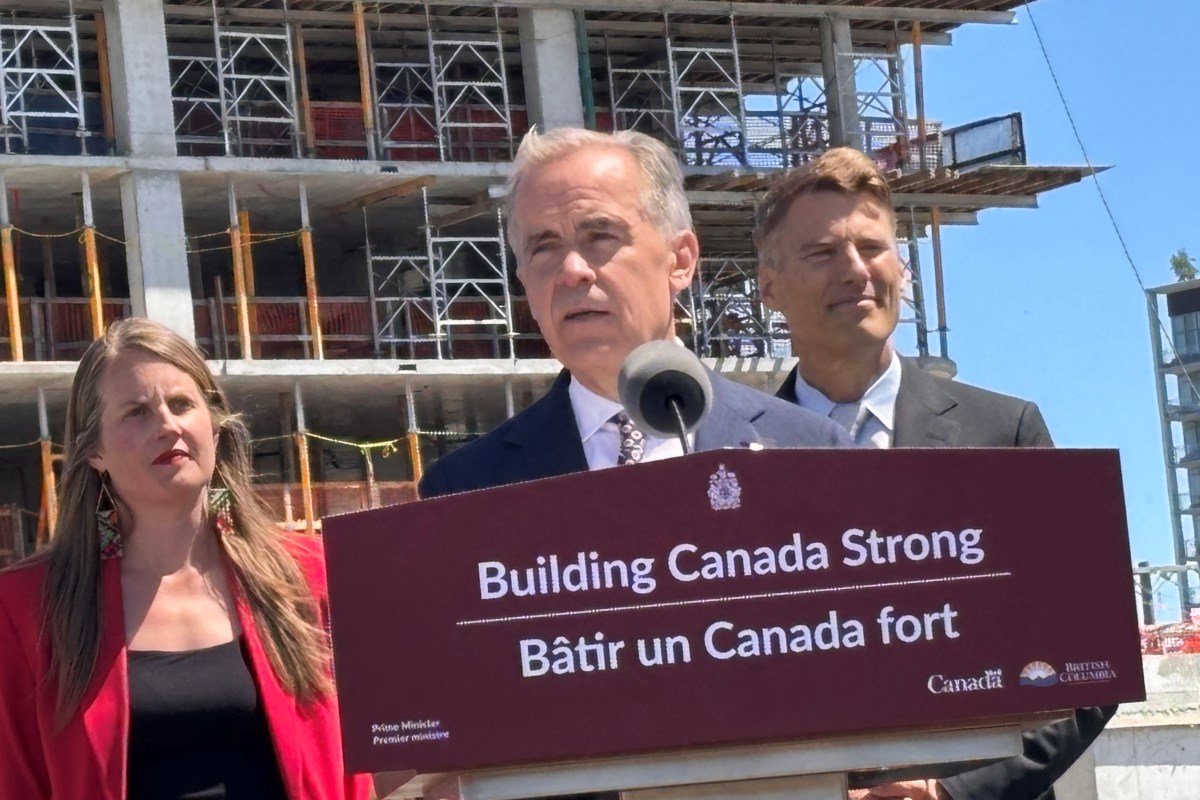

The federal government is stepping in to relieve developers of certain charges they must pay toward regional infrastructure
Prime Minister Mark Carney was in Vancouver Thursday, June 18 to announce measures to “unfreeze” the province’s real estate market with the aim of creating greater affordability for British Columbians.
Carney made the announcement with Premier David Eby and their respective housing ministers Gregor Robertson and Christine Boyle in South Vancouver’s River District, flanked by condo towers where two-bedroom units are selling for close to $1.1 million.
First, Carney announced $1.6 billion over the next 10 years, to be matched by the provincial government, to lower development cost charges (DCCs) for multi-unit housing by up to 50 per cent, or as much as $40,000 per unit in “priority communities.”
The funding will be used to “expand housing-enabling infrastructure such as water systems, wastewater systems, and local roads.”
It is not yet clear if this funding will directly compensate the Metro Vancouver Regional District, whose board slashed DCCs in April by $387 million over the next three years at the behest of development companies. Last month the board wrote a letter to senior governments asking to recover those costs.
Metro Vancouver chair and Burnaby Mayor Mike Hurley told Business in Vancouver the same day he was not made aware of the funding but the fact that it will go to water and wastewater systems indicates it will go to the utility provider.
“The devil will be in the details,” said Hurley, who did not vote for the developer subsidy in April, asserting “growth should pay for growth.”
Port Coquitlam Mayor and Metro board member Brad West did vote for the subsidy, saying it was a compromise toward other board members who wish to do away with DCCs altogether.
The new federal and provincial funds will be derived from general taxation revenue—the federal government’s new Build Communities Strong Fund.
BIV asked Carney if he had considered the shift from property taxation to income taxation.
Carney said development charges had “reached a level that they were pricing out people.”
“It’s a chance to prove this model at scale; more affordable housing, better communities,” he said. “And we will see as we move forward about extending it.”
What remains unclear is if development companies pass on the savings to home buyers.
Carney said development charges had “reached a level that they were pricing out people.”
“It’s a chance to prove this model at scale; more affordable housing, better communities,” he said. “And we will see as we move forward about extending it.”
BIV asked Carney if he would like to see housing prices fall further in Metro Vancouver.
“What we want is to establish … across Canada is to build more and make more available affordable housing—housing that works relative to what people’s incomes are,” he said. “That means more supply obviously and it means part of that housing coming in innovate ways.”
According to Statistics Canada, there is a surge in unsold condo units, which brought Carney to hint at another measure coming: the federal government buying those unsold units and converting them to so-called “affordable” housing.
“Looking out at condos that have been built, that are unoccupied, that are going to sit there potentially for another couple of years; we are going to go and use the right financing mechanisms and convert those into affordable housing so people can move in and use those,” said Carney.
Carney added “models” will be released in the fall.
“Effectively what you are doing is buying them at a price and spreading out the financing because you can do that for the underlying condo at our financing rate, but targeting at a level that is affordable,” he said. “It is a way to clear off on the books this overhang.”
Through Build Canada Homes and BC Housing, the senior governments will “convert more than 2,200 vacant condo units in priority growth areas into affordable homes,” the Prime Minister’s Office said in a statement.
West said his attendance at the event was as chair of the Mayor’s Council, which oversees TransLink, the regional transportation authority.
At the announcement Carney also divulged, via the press release: “The federal government will invest $2.5 billion over 10 years to build new transit projects—such as the Surrey-Langley SkyTrain extension project that is currently underway—and increase service access and frequency in high-traffic areas. This funding is in addition to the $852 million previously announced by the federal government to support TransLink and BC Transit.”
[email protected]
BIV’s free newsletters cover daily business, real estate, B.C. politics and more. Sign up here for B.C.’s most important business news delivered directly to your inbox.