dailynewsnblog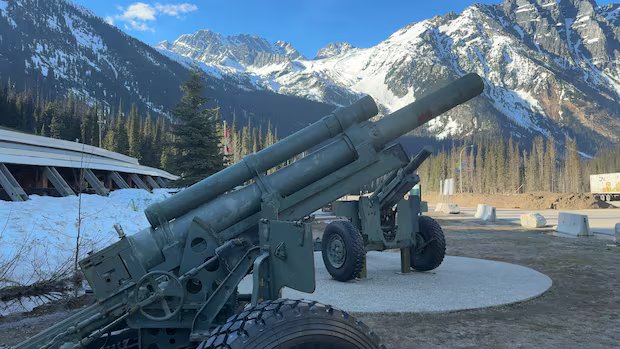

Listen to this article
Estimated 5 minutes
The audio version of this article is generated by AI-based technology. Mispronunciations can occur. We are working with our partners to continually review and improve the results.
The Canadian Armed Forces has made the decision to end its avalanche-control program in Rogers Pass, B.C., after just one more winter.
For more than 70 years, the Armed Forces have been firing large howitzers at the mountains that line the Trans-Canada Highway in Glacier National Park, located between Revelstoke and Golden B.C.
Operation Palaci, which is run under an agreement between the Department of National Defence (DND) and Parks Canada, aims to mitigate the impact of dangerous avalanches by triggering small, controlled slides that can be easily cleared from the highway and railway.

A longstanding partnership between Parks Canada and the Canadian Armed Forces is coming to an end. For more than six decades, artillery members have fired howitzers into the mountains of Rogers Pass for avalanche control. But as the CBC’s Jacqueline Gelineau reports, that will no longer be the case.
Operation Palaci is the longest running Forces operation in Canadian history, according to Parks Canada.
It is the only avalanche program currently managed by the DND and is also the world’s largest mobile avalanche control program.
After more than 70 years, the memorandum of understanding is set to expire in August 2027, and Daniel Blouin, a DND spokesperson, said the Armed Forces have already told Parks Canada they will not be renewing it.

In a statement, Blouin said the change is due to evolving defence modernization priorities and military priorities. He said this shift includes the divestment of the legacy artillery systems that are used to manage Rogers Pass.
After decades of use, the 105-millimetre C3 howitzers used to trigger avalanches have become expensive to repair. They are no longer produced or used by the Armed Forces in combat operations, making repairs time consuming and expensive.
Prime Minister Mark Carney has also stated the government is focused on rebuilding and rearming the Armed Forces.
“To protect Canada’s sovereignty, build our prosperity, and strengthen our strategic autonomy, the Canadian government must change how we invest in defence,” Carney said in a statement.
‘We are deeply concerned’
Revelstoke Mayor Gary Sulz says the change is “disappointing but it’s not surprising.”
“The military needs to go back to basically doing what the military does,” he said.

He said the change is concerning as highway travel is important to not only Revelstoke residents who need reliable access to medications and goods, but also Canada’s economy.
“We are deeply concerned with the impacts of these changes,” said Joanne Whittier, communications manager with the Ministry of Transportation, who echoed Sulz’s worry of prolonged highway closures.
“The withdrawal of Canadian Armed Force support will significantly increase closure durations through Rogers Pass,” said Whittier.
She said this comes at a time when both federal and provincial governments are working to strengthen inter‑provincial and international trade to bolster the economy.
Whittier said the ministry has requested that the Canadian Armed Forces services be extended in Rogers Pass until alternate strategies are implemented.
The future
The future of avalanche management in Rogers Pass after the memorandum of understanding expires has not been made public, but it will fall under the management of Parks Canada.
Parks Canada declined interview requests, but said in a statement that discussions are still ongoing with the DND.
“Ensuring public safety and maintaining the efficient, reliable flow of vehicles and goods along the critical Rogers Pass remain top priorities for Parks Canada,” said spokesperson Jennifer Burnell in the statement.
The operation manages avalanche hazards from 16 gun positions that mark 135 avalanche paths and approximately 270 artillery targets, according to Parks Canada.
The 43-kilometre stretch of mountainous highway poses unique challenges due to its high elevation, and high density of avalanche slopes. Until now, these features made the howitzers the most efficient method of avalanche management.

B.C.’s Ministry of Transportation and Transit said non-military options used in other parts of the province are available for avalanche management.
To protect highways in some high avalanche risk locations, the ministry has installed several remote avalanche control systems which can be detonated at any time day or night, in any weather.
The ministry said it intends to expand the use of this technology, particularly along high traffic routes.
Helicopters are also commonly used to drop explosive charges onto an at-risk slope, but this strategy is hindered at night or in poor weather when the helicopters cannot fly, said the ministry.
Drone technology is also being piloted in the mountains around Whistler and Jasper, Alta.
“This just gives us another tool in the toolbox,” said Josh Ogden, co-founder of Aerial Vehicle Safety Solutions Inc., which received permission to test its SnowDart system for avalanche control in Jasper.
Currently, the use of drones for avalanche control is not regulated in B.C., but the Ministry of Transportation said drone manufacturers are working with regulators in an effort to have the technology approved.