dailynewsnblog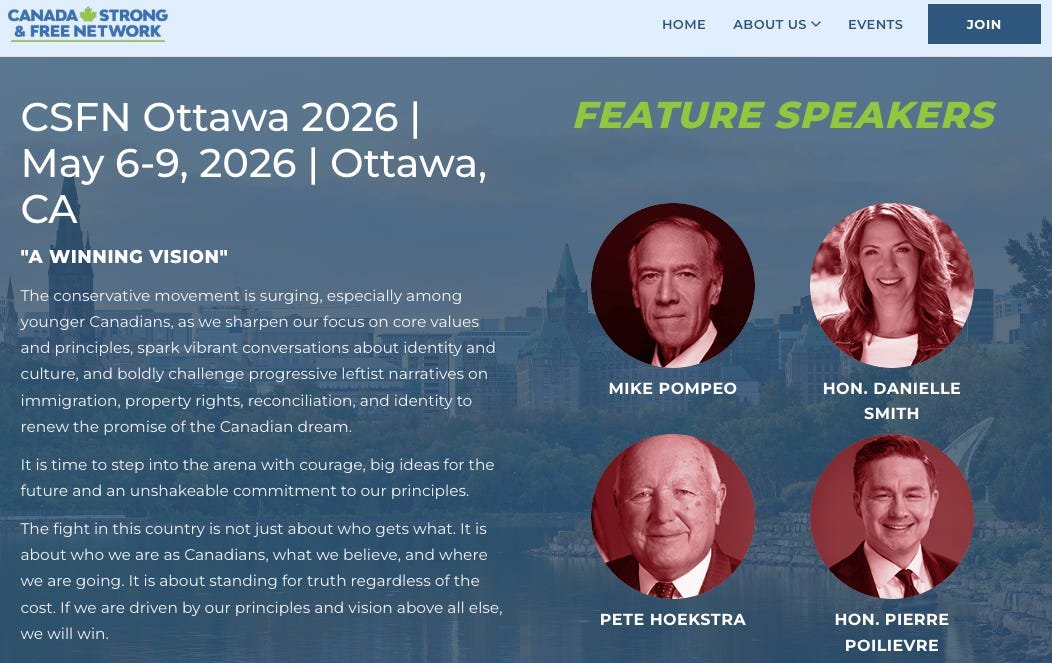
While Mark Carney returns from the European Political Community Summit as the first non-European leader ever to be invited, Pierre Poilievre is spending this week at the Canada Strong and Free Network’s Ottawa convention playing second fiddle to Danielle Smith next to headliners former Trump CIA director and secretary of state Mike Pompeo, and the United States’ embarrassment of an ambassador to Canada, Pete Hoekstra.
If we want to know where we’d be on the world stage in the alternate universe of the 2025 election having gone the way it looked like it would, we can clearly see it here.

The invitation to attend the EPC Summit in Yerevan, Armenia is a reminder of Carney’s immense respect on the world stage, earned over an impressive career of repeatedly being in the right place at the right time to solve problems created by the right wing. But it is also a warning that Canada’s place in the world does not automatically follow his eventual departure. Carney has a history of coming in, cleaning up a mess — and moving on to the next problem.
He was central to Canada’s role in mitigating the 2008 crash for our own citizens. He softened the crash-landing of Britain’s masochistic experiment in detaching itself from European unity. He stopped Poilievre in his magalomaniacal tracks and is rapidly reshaping Canada’s alliances and economy to be resistant to a collapsing American empire.
He will no doubt be courted elsewhere as soon as he gives the vaguest indication of being ready. Perhaps somewhere like the United Nations, where current Secretary General António Guterres is approaching the end of his second five-year term, as the international rules-based order faces its biggest test in generations — another right-wing catastrophe that will require someone serious to fix.
It is hard to clearly state whether Canada was invited to Yerevan, or if Mark Carney was invited, and where the line between the two is drawn. But we can answer the question with a greater degree of certainty by simply asking: under what other circumstances would Canada have been there?
It is hard to know for sure, but it would be hard to imagine Pierre Poilievre being at the European Political Community Summit talking about rebuilding the world order out of Europe. Rather, in spite of a stunning, comprehensive, and continuing rebuke by the people of Canada, he continues to double down not only on disinformation and personality attacks against those who defeated him, but in expressly aligning with our economic and political adversaries.
Poilievre has been attacking the Prime Minister for being “poorly educated in economics” in spite of his Harvard and Oxford degrees in economics, and his success running two central banks, an investment bank, and a country. One wonders what his standard would be for a well-educated economist. The point, though, is to attack credibility, to poison the well of public debate, and to cast doubt on the very idea of expertise. It is in line with his attacks on vaccines and science and climate change.
On that point, there was a third conference that mattered this week, one that not nearly enough people are talking about. Colombia hosted the “First Conference on Transitioning away from Fossil Fuels” attended by, according to Carbon Brief, 57 countries: Angola, Antigua and Barbuda, Australia, Austria, Bangladesh, Belgium, Brazil, Cameroon, Canada, Chile, Colombia, Denmark, the Dominican Republic, the EU, the Federated States of Micronesia, Finland, France, Germany, Ghana, Guatemala, Iceland, Ireland, Italy, Jamaica, Kenya, Luxembourg, Malawi, the Maldives, the Marshall Islands, México, Mongolia, the Netherlands, Nepal, Nigeria, Norway, New Zealand, Palau, Panama, the Philippines, Portugal, Saint Lucia, Senegal, Singapore, Slovenia, the Solomon Islands, Spain, Sweden, Switzerland, Tanzania, Turkey, Tuvalu, Uganda, the UK, Uruguay, Vanuatu, the Vatican, and Vietnam.
While, like so many environmental conferences before it, the result was mostly an agreement to keep talking with little in the way of concrete action, we should not take Canada’s presence for granted. We are a major producer of fossil fuels and, as we know, there is far too little interest in this country in progressing from that position. China has effectively used its vast coal resources to convert to an economy increasingly built on renewable energy. Canada has used our vast fuel reserves to… well, there are no great accomplishments that we have funded with that revenue.
Conspicuously absent from the list of attendees is the United States of America. But under an only slightly different result in last year’s elections, it is easy to imagine Canada also being absent.
We cannot take Canada’s current respect and position on the global stage for granted. It may be popular to say that Canada is the new leader of the free world and to bask in the international glow and respect of our Prime Minister, but it can all change on a dime if we allow the Conservatives and Pierre Poilievre to undo all that work. That can happen in the blink of an election.
As the Canada Strong and Free Network’s own conference clearly demonstrates, Pierre Poilievre is more than happy to show that he is subservient to the CIA and the American Ambassador, and will enthusiastically take Canada right there with him.
What concerns me most is that we dodged this for ourselves by the skin of our teeth, and the risk has not fully passed. When I look at the MAGA-led disaster of the United States contrasted with Canada’s rising star, I am proud of my country and angry for my neighbours. We take our current position for granted, but, to borrow from an ancient proverb, ‘there, but for the grace of just enough voters, goes Canada.’