dailynewsnblog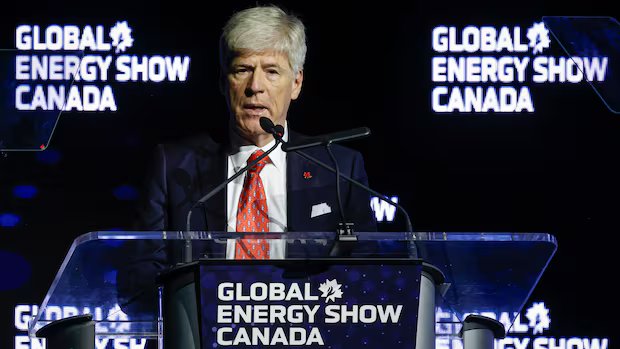

Listen to this article
Estimated 5 minutes
The audio version of this article is generated by AI-based technology. Mispronunciations can occur. We are working with our partners to continually review and improve the results.
Federal natural resources minister Tim Hodgson came to the Global Energy Show in Calgary with a message for international delegates: “Canada can be a supplier you need in a volatile world.”
But the CEO of a major oilsands producer cast doubt on whether Canada is rising to the occasion by making its support for a new West Coast oilsands pipeline contingent on a multibillion-dollar emissions-reducing project and an industry carbon levy.
Hodgson told the opening session at the conference and trade show on Tuesday that Canada is reliable, democratic and “once again open for business.” The event takes place as ongoing strife in the Middle East rattles energy markets, and the federal government looks to bolster Canada’s status as a reliable global energy supplier.
This year’s event was expected to attract 30,000 attendees, with a larger portion from abroad than in years past, organizers said.
“We all know energy policy is now economic policy. It is security policy. It is trade policy. It is investment policy,” Hodgson told the crowd.
“The world is not waiting for Canada. But Canada is not waiting either. We’re rising to the moment.”
At last year’s event, Alberta Premier Danielle Smith made an early push for a new bitumen pipeline to the northwest coast to be ultimately led by industry.
The Alberta government is aiming to file an application by July 1 to the federal major projects office for the pipeline, which so far has no private-sector backer.
The province and Ottawa signed a sweeping energy accord late last year setting out the conditions for a new West Coast oil pipeline. That pursuit is contingent on the massive Pathways carbon storage project moving ahead and vice versa.
Cenovus Energy Inc. CEO Jon McKenzie said the “newfound sense of co-operation and purpose” from the federal and Alberta governments is encouraging.
But McKenzie said the memorandum of understanding, and a subsequent agreement on implementing a new carbon pricing regime, does not instil confidence in oilsands producers, whose investment would be needed to fill a new pipeline.

“Industry has been clear that the industrial carbon tax is insidious and it should be revoked. Just as the retail carbon tax made life unaffordable for Canadians, the industrial carbon tax makes investments in Canadian energy and particularly our oilsands less competitive and drives out capital,” he said.
“The confirmation of the carbon tax does not provide certainty for investment. It provides certainty that a regulatory regime is increasingly out of step and uncompetitive.”
Alberta and Ottawa have agreed to cut carbon dioxide emissions by 16 megatonnes by 2045 with the Pathways project. Cenovus and four other oilsands peers are spearheading the plan to pipe CO2 captured from several oilsands sites in northeastern Alberta to a storage hub near Cold Lake, Alta.
“But the question is, really: how will Canada and Canadians benefit from this project? The reality is this is a project with no revenue. It is simply another cost burden that will be borne by industry and the two levels of government,” McKenzie said.
He estimated a project the size of Pathways would cost $20 billion to $30 billion while reducing global emissions by an infinitesimal amount.

Some rural landowners and First Nations leaders say the environmental and financial risks posed by the proposed Pathways carbon pipeline and storage project are too great.
“It’s difficult to imagine anybody would believe that this is a good use of funds regardless of their political orientation,” McKenzie said.
The pipeline itself, he said, is “unfinanceable” by the private sector under current circumstances.
“To date it has been assumed that the Canadian oil and gas producers will invest tens of billions of dollars necessary to grow production and make the one-million-barrel-a-day pipeline to the West Coast a reality. It is assumed that Canadian oilsands producers will bear the cost of the Pathways carbon capture project to make it a reality,” he said.
“But the reality is Canadian oilsands producers are not investing much beyond sustaining capital today without a competitive investment regime.”
The Alberta government, meanwhile, is aiming for the pipeline being designated a project of national interest by October and getting shovels in the ground as early as September 2027.
“I recognize that putting it on paper is one thing; execution is another,” Smith said during an onstage discussion at the conference.
“But I think the fact that we put it on a paper, signed an agreement, demonstrates that we’re both committed to achieving that outcome. And once we start demonstrating that we are meeting those targets, I think that the proof will be in that to the business sector and hopefully the investment will follow.”