dailynewsnblog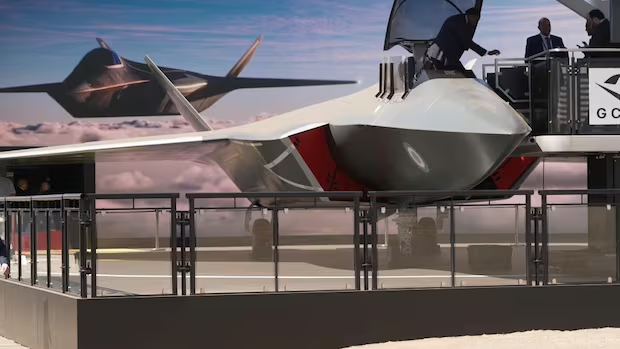
The Canadian government has signed on as the first observer in the U.K., Italy and Japan’s program to build the next generation of stealth fighter jets by 2035.
The commander of the Royal Canadian Air Force told CBC News that Canada can now take part in classified talks about what role it can play in the Global Combat Air Programme.
Lt.-Gen. Jamie Speiser-Blanchet also sounded confident that Canada could become a full partner later and eventually buy these jets.
“I think it is very feasible to imagine a world where Canada contributes and then ultimately would employ this aircraft in the future,” Speiser-Blanchet said in an exclusive interview.
Defence Minister David McGuinty said the government is taking the process “step-by-step” and would not commit now to purchasing the aircraft under development.
The move to join the three-nation program is part of Prime Minister Mark Carney’s strategy to diversify Canada’s military purchases and partnerships to become less reliant on the U.S., which on Monday imposed 50 per cent tariffs on a wide range of Canadian exports. Four members of Carney’s cabinet were at the U.K.’s Farnborough International Airshow trying to make deals when the news broke.
McGuinty made the announcement in London with the U.K.’s new Defence Secretary Wes Streeting and their Italian and Japanese counterparts. The U.K.’s new prime minister, Andy Burnham, welcomed Canada to the program in a statement.
“While Canada won’t have a decision-making role, the move gives them privileged access to the programme and paves the way for discussions on Canada’s future participation and contribution,” the U.K.’s ministry of defence said in a press release.

The announcement comes more than a year into Canada’s review of whether it will go ahead with procuring a full fleet of American fifth-generation F-35 fighter jets or move to a mixed fleet to include Sweden’s Saab Gripen-E fighters built in Canada. The government launched the review in response to U.S. President Donald Trump’s annexation threats and tariffs pummeling some Canadian industries.
The government has been slow to procure the F-35s and is set to receive its first four in October.
But one reason the government is already looking into the sixth-generation fighter jets while still procuring the fifth generation is because the technology is moving so quickly.
Technology advancing fast
China and Russia say they’ve already figured out how to detect fifth-generation fighter jets. Sixth-generation fighters are expected to have superior stealth technology, carry more weapons and operate more seamlessly with crewed and uncrewed systems, including drones.
A pilot in the cockpit could direct drones alongside the fighter jet more efficiently in both offensive and defensive roles.
McGuinty called it a “breakthrough” that Canada can get in early on this cutting-edge research.

Canada is expected to announce plans next week to play a role as ‘an observer’ in an international program to build the next generation of stealth fighter jets, CBC News has learned. The U.K., Italy and Japan are partnering to develop the advanced fighter by 2035.
Canada will be looking at whether Canadian industry can help build the aircraft. But Speiser-Blanchet said Canada could also play a role in testing platforms in the Arctic to make sure they work seamlessly.
Taking part in this international program will not replace the purchase of the fifth-generation aircraft, McGuinty said. Instead, it is a way to set Canada up for the future, similar to running a sports franchise, he said.
“You’re beginning to scout for and look for talent from 15- to 16-year-old players before they are at an age where they can recruit to your team,” he told CBC News.
Jets could complement existing fleet
Speiser-Blanchet said if Canada became a full partner and bought the sixth-generation jets, they could extend or complement the fifth-generation fighter fleet.
“Personally, I do think that would be a good step for Canada because we will want to be part of the allied efforts, working with our partners to be relevant and able to address those future threats,” she said.
The aircraft’s technology, she said, is so advanced it will use artificial intelligence to help fuse data to battle anticipated future threats.
“It’s taking it even further in terms of stealth technology — which is about remaining, undetected and then being able to operate in the airspace with more freedom to manoeuvre,” said Spieser-Blanchet.

The U.S. is working on its own sixth-generation stealth fighter jet, the F-47, which Trump has said will be the “most lethal aircraft ever built” and that nothing else would compare. But it is unclear whether the Americans will make the jets available to their closest allies.
Asked if Canada’s move could upset the U.S., British defence expert Trevor Taylor at the Royal United Services Institute said it might.
“It’s possible that it would upset some prominent figures in the United States, but I don’t think it would surprise many people in the U.S. because of what’s happened the last few months,” said Taylor, who is the institute’s Director of the Defence, Industries & Society Programme.
Interoperable with U.S. fighter jets
McGuinty said he does not think the U.S. will be upset because it wants NATO partners to take on more initiative and work together.
“I think the United States will be pleased to see that there are additional efforts going on right now,” McGuinty said.

Speiser-Blanchet said it will be “very important” that the fighter jets are interoperable with U.S. aircraft because they need to share data and work together.
BAE Systems in the U.K. is the country’s lead systems integrator for the Global Combat Air Programme. The company displayed a prototype of the jet at the Farnborough International Airshow this week and told CBC News the fighter jet will be interoperable with earlier and future generations of fighter jets in the U.S. and Europe.
“That’s a key part of the program,” said Jonny Morton, BAE’s future combat air system director for capability, partnerships and security. “It’s about our fourth-, fifth- and sixth-year platforms being integrated together to give us that advantage against adversaries.”
He said threats from adversaries are growing quickly and the fighter jet is focused on what those threats could look like in 10 to 20 years and how to respond.
“It will be survivable in a way that we’ve not seen today,” Morton said.